
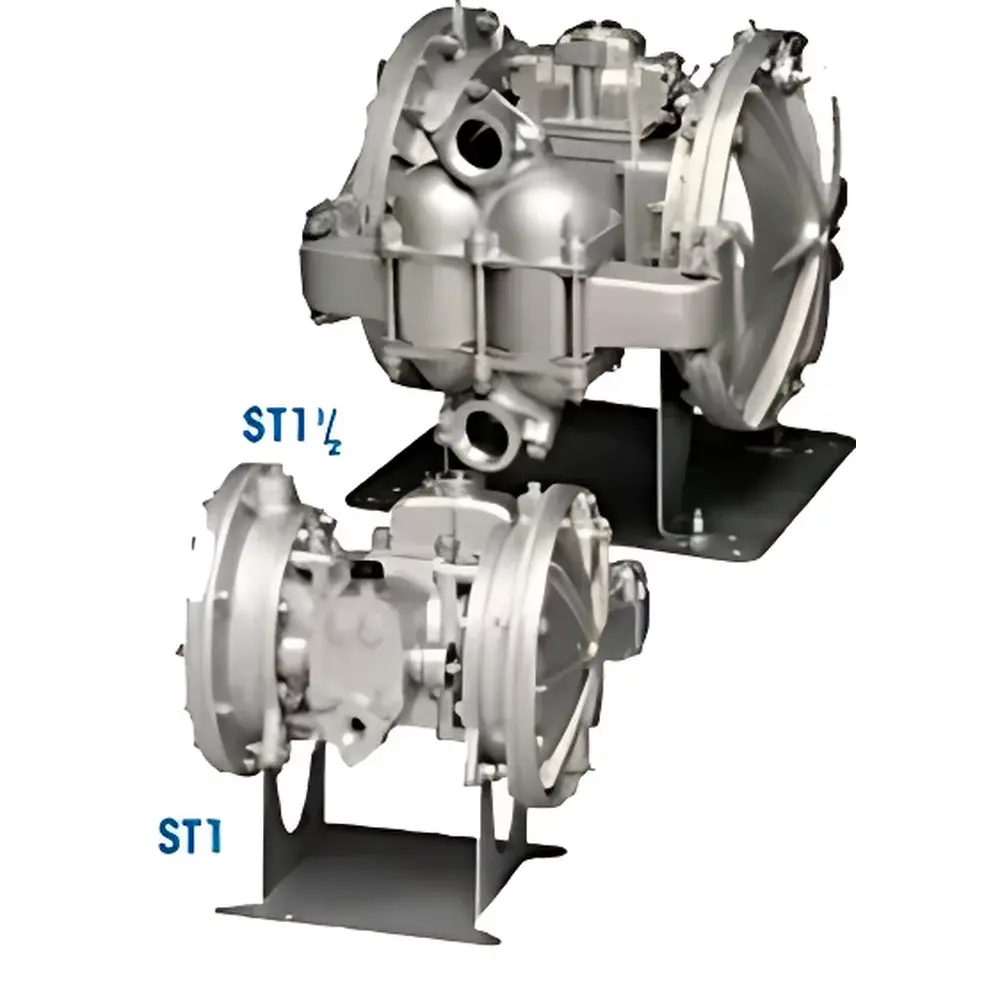
SANDPIPER (Warren Rupp) CD Series Pneumatic Diaphragm Pump
| Brand | Warren Rupp |
|---|---|
| Origin | USA |
| Manufacturer Type | Authorized Distributor |
| Origin Category | Imported |
| Model | CD-Series Sealed Ball-Valve Air-Operated Double-Diaphragm (AODD) Pump |
| Certification | ATEX, CSA, UL, CE, USDA, FDA |
| Construction Materials | Aluminum, Cast Iron, 316 Stainless Steel, Alloy C-276, Polypropylene (PP), Kynar® (PVDF) |
| Diaphragm & Valve Options | Thermoplastic Elastomer (TPE), PTFE |
| Solids Handling | Up to 3/4" (18 mm) |
| Dry Suction Lift | 18 ft (5.5 m) |
| Mounting | Free-Standing Base with Integrated Support |
| Leak-Detection Ready | Visual, Mechanical, and Low-Voltage Sensor Integration Supported |
| Flow Control | Adjustable Air Supply for Variable Flow & Head |
| Explosion-Proof Design | Intrinsically Safe Operation in Class I Div 1 & 2, Zone 1 & 2 Hazardous Areas |
Overview
The SANDPIPER CD Series is a high-integrity, air-operated double-diaphragm (AODD) pump engineered for demanding laboratory, pilot-scale, and process-critical applications where chemical compatibility, operational safety, and zero-leak performance are non-negotiable. Unlike centrifugal or peristaltic pumps, the CD Series operates on positive displacement via reciprocating elastomeric diaphragms actuated by compressed air—eliminating shaft seals, mechanical seals, or dynamic packing. Its fully self-priming capability (up to 18 ft / 5.5 m dry lift), ability to run dry indefinitely without damage, and inherent dead-head safety make it uniquely suited for intermittent dosing, transfer of unknown or hazardous fluids, and handling of abrasive slurries or high-viscosity media up to 100,000 cP. The pump’s sealed cavity architecture isolates process fluid from the air valve assembly, preventing contamination of pneumatic components and enabling safe operation in classified hazardous locations under ATEX, UL, and CSA directives.
Key Features
- Sealed cavity design with integrated leak-detection readiness—supports visual inspection ports, mechanical float switches, and low-voltage electronic sensors for real-time integrity monitoring.
- Hydraulically balanced diaphragm coupling system ensures uniform stress distribution across the diaphragm surface during both suction and discharge strokes, extending diaphragm service life by up to 3× versus conventional AODD designs.
- Full-bolted construction with top-discharge ball-valve manifold enables rapid disassembly, field-reversible flow direction, and 90°–180° rotational mounting flexibility for space-constrained installations.
- Material options include corrosion-resistant alloys (316 SS, Alloy C-276), thermoplastics (PP, PVDF/Kynar®), and elastomers (PTFE, TPE) selected per ASTM D1435, ISO 15142, and FDA 21 CFR Part 177 compliance requirements.
- No internal lubrication required; air valve remains isolated from process stream—reducing maintenance frequency and eliminating risk of product contamination in GLP/GMP environments.
Sample Compatibility & Compliance
The CD Series accommodates a broad spectrum of laboratory and process fluids: aggressive acids (e.g., concentrated HNO₃, HF), caustics (NaOH ≥50%), organic solvents (THF, acetone, chlorinated hydrocarbons), shear-sensitive biologics, abrasive mineral slurries (up to 18 mm solids), and viscous polymer solutions. All wetted materials meet FDA 21 CFR 177.2400 (for food contact), USDA sanitation standards, and USP Class VI biocompatibility testing where applicable. The sealed cavity configuration satisfies ISO 28580 leak-tightness benchmarks and supports audit-ready documentation for ISO 9001, ISO 13485, and FDA 21 CFR Part 11-compliant data logging when integrated with certified control systems.
Software & Data Management
While the CD Series is inherently analog and mechanically autonomous, it is fully compatible with third-party digital instrumentation ecosystems. Optional air-supply pressure transducers and flow meters (e.g., Coriolis or ultrasonic) can interface with LabVIEW™, DeltaV™, or Siemens Desigo CC via 4–20 mA or Modbus RTU protocols. Leak-detection sensor outputs support integration into centralized SCADA or MES platforms for automated event logging, predictive maintenance alerts, and full traceability per ALCOA+ principles. Audit trails generated through such integrations comply with 21 CFR Part 11 electronic record requirements when validated per GAMP 5 guidelines.
Applications
- Transfer of hazardous reagents in analytical chemistry labs (e.g., HF digestion workflows, solvent recovery loops).
- Accurate metering of catalyst slurries or nanoparticle dispersions in R&D reactor feed systems.
- Safe handling of cytotoxic compounds in pharmaceutical development suites under ISO Class 5–7 containment.
- Continuous sampling of corrosive effluents in environmental monitoring stations (EPA Method 1664, ASTM D7066).
- Pilot-plant dosing of high-solids battery slurry (NMC, LFP) with minimal shear degradation.
FAQ
Can the CD Series pump shear-sensitive biological samples without denaturation?
Yes—the gentle, low-shear positive displacement action and absence of rotating impellers or pinch rollers preserve macromolecular integrity. PTFE/TPE wetted paths further minimize adsorption and surface interaction.
Is validation support available for GMP-regulated environments?
Warren Rupp provides material traceability dossiers (MTRs), ASME BPE-compliant dimensional drawings, and IQ/OQ protocol templates aligned with Annex 15 and ASTM E2500.
What maintenance intervals are recommended for continuous lab use?
Diaphragm replacement is typically required every 6–12 months under 24/7 operation; air valve servicing is needed only after ≥10,000 cycles or if airflow efficiency drops >15%—monitored via upstream pressure differential.
Does the sealed cavity eliminate need for secondary containment?
It significantly reduces risk—but regulatory frameworks (e.g., EPA 40 CFR 264.175) may still require drip trays or sumps depending on fluid hazard classification and local jurisdictional interpretation.
Can the pump be operated remotely via PLC control?
Yes—via modulating air supply pressure (0.2–7 bar) using electric-pneumatic regulators; full start/stop sequencing is achievable with solenoid valves and interlocked limit switches.



