
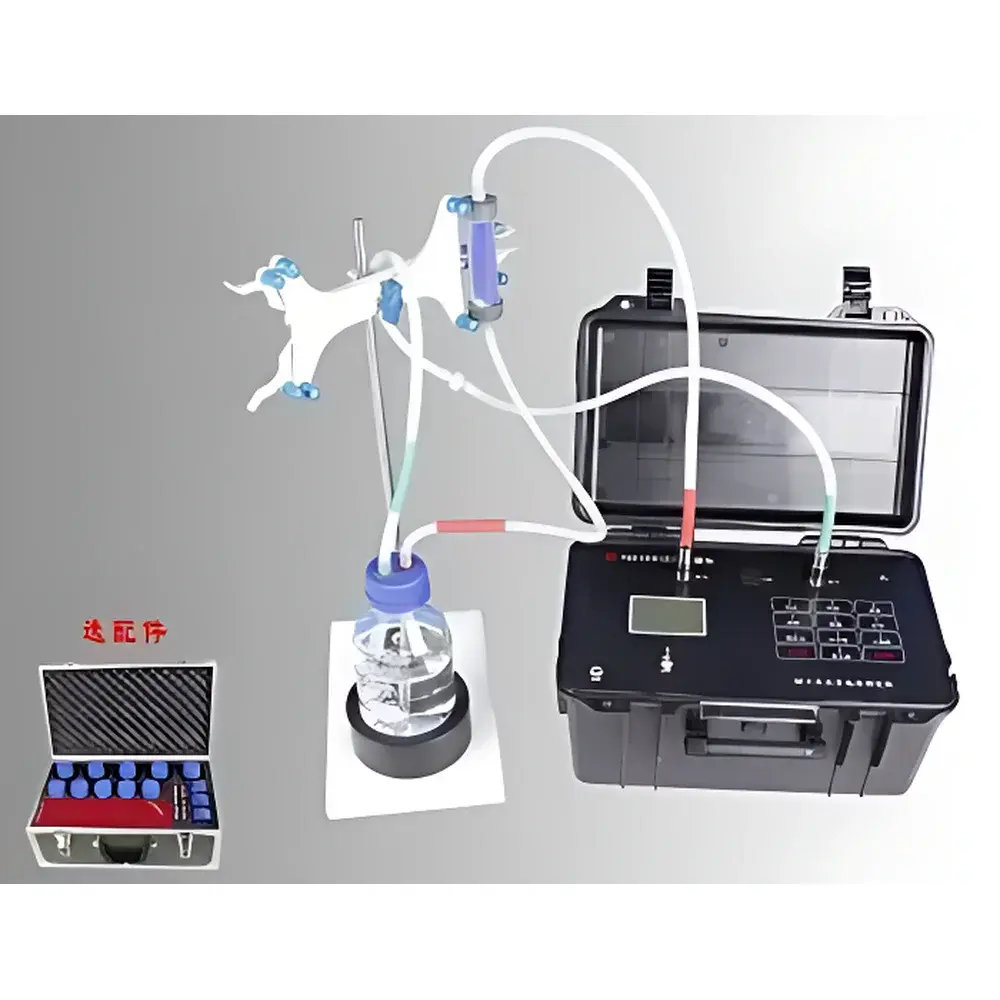
Sanpu FD216 Environmental Radon Monitor
| Brand | Sanpu |
|---|---|
| Model | FD216 |
| Origin | Beijing, China |
| Manufacturer | Sanpu Instrument Co., Ltd. |
| Detection Principle | ZnS(Ag) Scintillation + Photomultiplier Tube (PMT) |
| Measurement Modes | Active Pump-Driven Air/Solid/Water Sampling |
| Sensitivity | ≥0.68 cpm/(Bq·m⁻³) |
| Background Count Rate | ≤0.3 cpm |
| Radon-in-Air Range | 3–100,000 Bq/m³ |
| Soil Radon Range | 300–300,000 Bq/m³ |
| Radon Exhalation Rate Range | 0.001–10.000 Bq/(m²·s) |
| Water Radon Range | 0.003–100 Bq/L |
| Repeatability Error | ≤5% (at 2000 Bq/m³, 65% RH, 25°C) |
| 8-h Drift | ≤10% |
| Power Supply | Rechargeable Li-ion battery (30 h continuous operation) or AC adapter |
| Operating Temp | −10°C to +40°C |
| Max. Relative Humidity | ≤90% at +40°C |
| Data Storage | 2000 records |
| Display | LCD |
| Interface | USB + Bluetooth printing |
| Dimensions | 330 × 210 × 170 mm |
| Weight | 5 kg (main unit) |
| Calibration & Traceability | Certified by National Institute of Metrology (NIM), China |
Overview
The Sanpu FD216 Environmental Radon Monitor is a field-deployable, pump-assisted scintillation-based instrument engineered for quantitative radon-222 activity concentration measurement across multiple environmental matrices—ambient air, soil gas, building materials (via exhalation rate), and aqueous samples. Its detection architecture integrates a ZnS(Ag) scintillator coupled with a low-noise photomultiplier tube (PMT), operating on the well-established alpha-particle-induced scintillation principle defined in GB/T 16147–1995 and aligned with IEC 61577-1 technical requirements for radon measuring instruments. The FD216 satisfies the performance criteria specified in GB 50325–2010 for indoor air quality assessment in civil construction projects, making it suitable for regulatory compliance testing, occupational health surveys, geological radon potential mapping, and post-mitigation verification in residential and institutional buildings. Unlike passive diffusion-based detectors, the FD216 employs active sampling via an integrated diaphragm pump, ensuring consistent volumetric flow control and minimizing boundary-layer effects—critical for achieving high reproducibility in heterogeneous field environments.
Key Features
- Triple-mode measurement capability: simultaneous support for airborne radon (3–100,000 Bq/m³), soil gas radon (300–300,000 Bq/m³), radon exhalation rate (0.001–10.000 Bq/(m²·s)), and dissolved radon in water (0.003–100 Bq/L)
- ZnS(Ag)/PMT detection system with calibrated sensitivity ≥0.68 cpm/(Bq·m⁻³) and ultra-low background count rate ≤0.3 cpm
- Integrated rechargeable lithium-ion battery enabling up to 30 hours of uninterrupted field operation without AC power
- Programmable measurement cycles: 31 minutes for air/water, 11 minutes for soil gas, and 30 minutes for exhalation rate—optimized per ISO 11665-2 and ASTM D6767 protocols
- LCD interface with real-time count rate display, elapsed time tracking, and status indicators for pump flow, battery level, and detector saturation
- Dual communication interface: USB 2.0 for raw data export (CSV-compatible) and Bluetooth 4.2 for direct thermal printing of certified reports including timestamp, location ID, and result uncertainty estimation
Sample Compatibility & Compliance
The FD216 is validated for use with standard sampling configurations defined in national and international radon metrology frameworks. For air measurements, it interfaces with 0.5–2.0 L/min flow-regulated sampling lines and electrostatic collection chambers compliant with ISO 11665-4. Soil gas sampling follows ASTM D6767–22 procedures using stainless-steel probes and sealed manifolds; water analysis requires pre-equilibration in gas-tight vials per EPA Method 913.0. All measurement protocols adhere to GLP principles, with full audit trails enabled through timestamped internal logging. The instrument carries formal calibration certification issued by the National Institute of Metrology (NIM), People’s Republic of China, traceable to NIM’s primary radon reference standard (certified uncertainty <3.2%, k=2). While not CE-marked or FDA-listed (as radon monitors fall outside medical device regulation), its design conforms to electromagnetic compatibility (EMC) requirements per GB/T 18268.1–2010 and mechanical robustness standards for portable radiation instrumentation (IEC 61000-4 series).
Software & Data Management
Data acquisition and reporting are managed via embedded firmware supporting two operational modes: single-point snapshot acquisition and time-synchronized continuous monitoring (with user-defined intervals from 1 to 240 minutes). Each stored record includes sample ID, GPS-tagged location (when paired with external GNSS module), ambient temperature/humidity (via optional external sensor input), pump runtime, gross counts, background-subtracted net counts, calculated activity concentration, and estimated expanded uncertainty (k=2). Exported CSV files contain column headers compatible with LIMS platforms and statistical analysis tools (e.g., R, Python pandas). Firmware supports over-the-air updates via USB and maintains a write-protected configuration partition to preserve calibration coefficients and regulatory settings during routine maintenance.
Applications
- Indoor air quality auditing in residential, educational, and healthcare facilities per GB 50325–2010 and WHO Handbook on Indoor Radon (2021)
- Geological radon potential assessment for site selection of nuclear waste repositories or uranium exploration zones
- Validation of radon mitigation system efficacy (e.g., sub-slab depressurization, membrane barriers) before and after installation
- Research-grade exhalation rate mapping of construction materials (concrete, granite, phosphogypsum) under controlled humidity/temperature conditions
- Baseline radon-in-water screening for private wells and municipal supply intakes, supporting compliance with WHO drinking-water guidelines (100 Bq/L)
- Field training and inter-laboratory comparison exercises coordinated by provincial CDCs and environmental protection agencies
FAQ
What radon isotopes does the FD216 detect?
The FD216 is optimized for 222Rn (half-life 3.82 days) via alpha spectroscopy of its short-lived progeny (218Po, 3.05 min); it does not resolve 220Rn (thoron) due to overlapping decay kinetics and lack of thoron-specific filtration.
Is factory recalibration required annually?
Yes—NIM-recommended recalibration interval is 12 months under normal usage; extended intervals require documented stability verification per ISO/IEC 17025 Clause 5.6.
Can the FD216 be used in high-humidity environments?
It operates reliably up to 90% RH at +40°C; however, prolonged exposure >85% RH without desiccant preconditioning may elevate background counts due to moisture-induced scintillator quenching.
Does the instrument support remote data transmission?
No native cellular or Wi-Fi module is integrated; remote telemetry requires third-party IoT gateways interfacing via USB serial emulation or Bluetooth SPP profile.
How is measurement uncertainty quantified?
Total expanded uncertainty (k=2) incorporates contributions from counting statistics, calibration factor uncertainty (±2.8% from NIM certificate), flow rate deviation (±1.5%), and environmental correction factors—automatically computed and appended to each report.







