
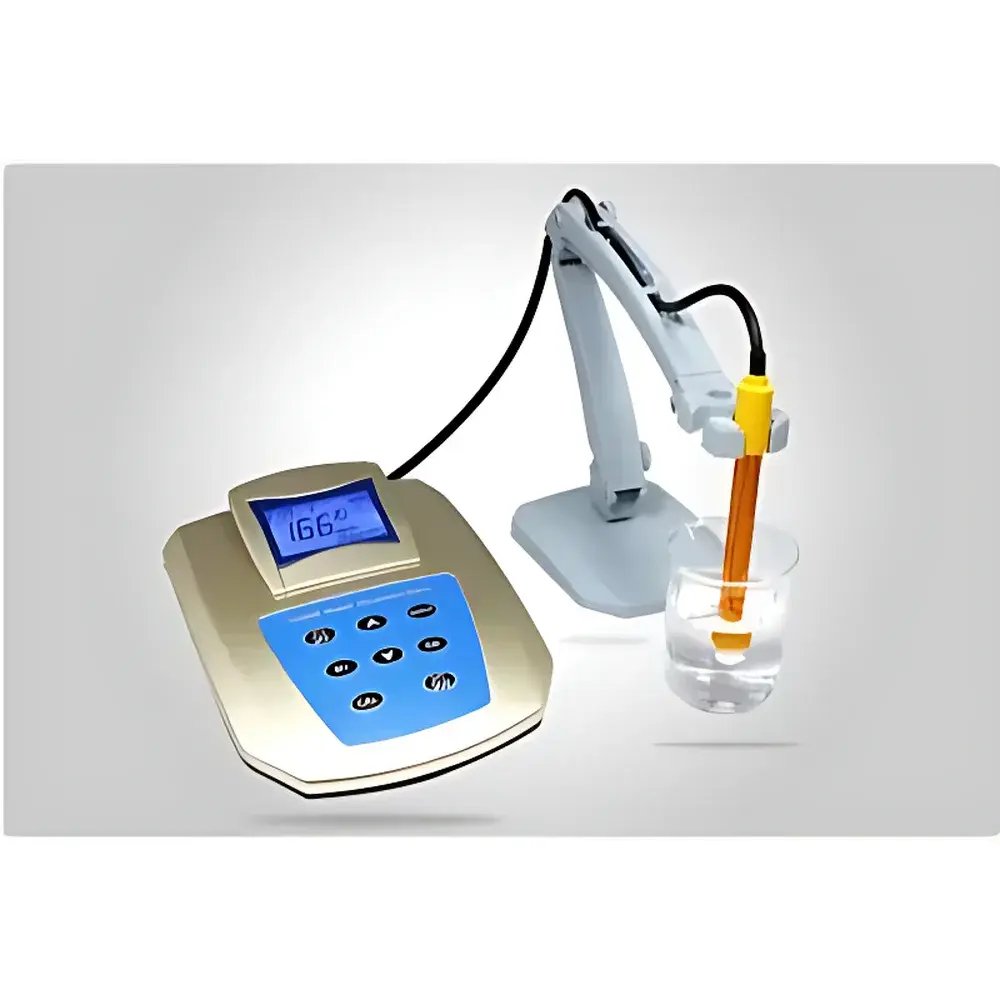
Sanxin YD200 Water Hardness Analyzer
| Brand | Sanxin |
|---|---|
| Origin | Shanghai, China |
| Manufacturer Type | OEM Manufacturer |
| Product Category | Domestic |
| Model | YD200 |
| Price | USD 560 (FOB Shanghai) |
| Measurement Principle | Potentiometric Ion-Selective Electrode (ISE) Method |
| Primary Analytes | Total Ca²⁺ and Mg²⁺ ions |
| Calibration Solutions | B1/B2/B3 standard buffers |
| Output Interface | RS232 serial port |
| Display | Backlit LCD with dual-unit real-time readout |
| Temperature Range | 0.0–60.0 °C (adjustable in °C/°F) |
| Hardness Units | mmol/L, mg/L (CaCO₃), mg/L (CaO), mmol/L (Boiler), mg/L (Ca) |
| GLP Compliance | Yes — automatic timestamped calibration logging, electrode history tracking, user ID support |
Overview
The Sanxin YD200 Water Hardness Analyzer is a benchtop potentiometric instrument engineered for precise, direct measurement of total water hardness—defined as the combined molar concentration of calcium (Ca²⁺) and magnesium (Mg²⁺) ions—in aqueous samples. Unlike classical EDTA titration, which relies on visual endpoint detection and suffers from interference by turbidity, coloration, or complexing agents, the YD200 employs a proprietary 601-F composite ion-selective electrode. This sensor integrates a PVC-based neutral carrier membrane with equal selectivity for Ca²⁺ and Mg²⁺, an Ag/AgCl reference element, and an integrated Pt temperature probe—enabling simultaneous, drift-compensated measurement under variable thermal conditions. The instrument operates on the Nernstian principle: the measured potential difference between the sensing and reference elements correlates logarithmically to the activity of divalent cations in solution. Its microprocessor-controlled electronics apply rigorous temperature compensation (0.0–60.0 °C) and auto-zero referencing to ensure reproducibility ≤ ±0.02 mmol/L across its full dynamic range.
Key Features
- Potentiometric ISE platform eliminates subjectivity and labor-intensive procedural steps inherent to volumetric titration methods.
- 601-F composite electrode features a chemically stable PVC membrane with optimized neutral carrier chemistry, delivering rapid response (< 30 s), low drift (< 0.1 mV/h), and resistance to fouling in municipal, industrial, and surface water matrices.
- Five native hardness units directly selectable on-device: mmol/L, mg/L (CaCO₃), mg/L (CaO), mmol/L (Boiler), and mg/L (Ca); three legacy European units (°fH, °dH, °eH) accessible exclusively through WH-Link PC software for regulatory reporting alignment.
- Full GLP functionality: timestamped calibration records (including electrode ID, buffer lot, operator ID), automatic electrode health diagnostics, and audit-trail-capable data storage for up to 200 measurements with date/time stamp.
- Intelligent auto-calibration protocol using factory-prepared B1/B2/B3 standard solutions (certified traceable to NIST SRMs), minimizing user error and ensuring metrological continuity.
- RS232 serial interface compliant with ANSI/TIA/EIA-232-F standards; supports bidirectional communication for remote configuration, firmware updates, and batch export of raw and processed data.
Sample Compatibility & Compliance
The YD200 is validated for use with drinking water, boiler feedwater, cooling tower effluent, wastewater effluent, and natural surface waters (rivers, lakes, reservoirs). It maintains accuracy in samples with turbidity ≤ 50 NTU and absorbance < 0.5 at 450 nm—conditions where EDTA titration fails due to endpoint masking. The instrument complies with ISO 6059:2022 (Water quality — Determination of hardness — Titrimetric method) as a validated alternative technique, and meets functional requirements of ASTM D1126–22 (Standard Test Method for Hardness in Water) for field-deployable electrochemical systems. All firmware and data handling routines conform to FDA 21 CFR Part 11 Annex 11 principles for electronic records and signatures, including secure user authentication, immutable audit logs, and electronic signature capability when paired with WH-Link software.
Software & Data Management
WH-Link is a Windows-based desktop application (v3.2+, compatible with Windows 10/11 x64) that transforms the YD200 into a networked analytical node. It enables real-time graphing of hardness vs. time, automated unit conversion across all nine standardized scales, statistical analysis (mean, SD, RSD, confidence intervals), and customizable report generation in PDF or Excel (.xlsx) format. Data files include embedded metadata: instrument serial number, electrode calibration history, ambient temperature, operator ID, and GPS-tagged location (when connected via optional USB-to-serial adapter with GNSS module). WH-Link supports LIMS integration via CSV/ODBC export and satisfies GLP/GMP documentation requirements for pharmaceutical water system qualification (e.g., USP , EP 2.2.38).
Applications
- Quality control laboratories verifying compliance with WHO Guidelines for Drinking-water Quality (≤ 500 mg/L CaCO₃) and EU Directive 2020/2184 (hardness limits for distribution networks).
- Power generation facilities monitoring boiler feedwater hardness per ASME PTC 19.11 to prevent scale formation and tube failure.
- Food & beverage manufacturers validating process water hardness for brewing, dairy processing, and soft drink formulation.
- Environmental agencies conducting baseline surveys of freshwater ecosystems and assessing anthropogenic Ca/Mg loading from agricultural runoff or limestone dissolution.
- Academic research in hydrogeochemistry, where simultaneous multi-unit reporting supports cross-study meta-analysis and historical dataset harmonization.
FAQ
What is the measurement principle used by the YD200?
The YD200 employs potentiometric detection using a composite ion-selective electrode calibrated against certified Ca²⁺/Mg²⁺ standards. It measures the thermodynamic activity—not just concentration—of divalent cations in solution.
Does the instrument require daily recalibration?
No. With proper electrode maintenance and use of B1/B2/B3 standards, calibration stability exceeds 72 hours under routine lab conditions. GLP logs automatically flag deviations exceeding ±2 mV from baseline.
Can the YD200 measure hardness in seawater or brackish samples?
It is not recommended for salinities > 5 g/L NaCl due to ionic strength effects on activity coefficients; however, dilution protocols with certified reference materials are supported in WH-Link.
Is the 601-F electrode replaceable, and what is its typical service life?
Yes—the electrode is a consumable component with a nominal lifespan of 12–18 months under continuous use. Each unit includes a unique serial number logged in WH-Link for predictive maintenance scheduling.
How does the YD200 handle temperature compensation?
An integrated Pt1000 sensor provides real-time thermal correction using the empirical equation dE/dT = −0.19 mV/°C, applied continuously during measurement without user intervention.
Related Products







