
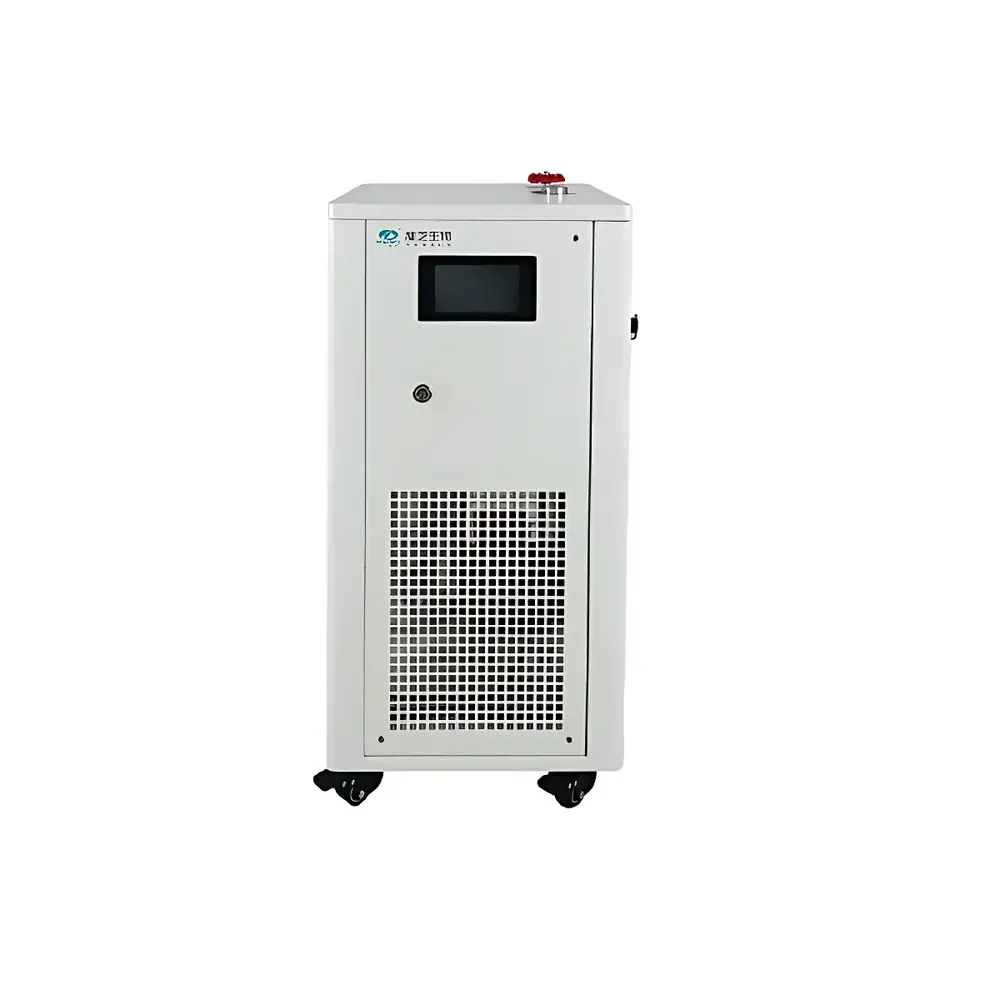
Scientz H25W-20 Series High-Temperature Circulating Temperature Control System (50°C to 200°C)
| Brand | Scientz |
|---|---|
| Origin | Zhejiang, China |
| Manufacturer Type | Direct Manufacturer |
| Country of Origin | China |
| Model | H25W-20 Series |
| Temperature Range | 50°C to 200°C |
| Temperature Accuracy | ±0.5°C (heat transfer medium) |
| Control Algorithm | PID Fuzzy Logic |
| Communication Protocol | MODBUS RTU over RS-485 |
| Display | 7-inch color touchscreen with real-time temperature curve visualization and logging |
| Programmability | Up to 5 multi-step programs, each with up to 30 segments |
| Temperature Feedback Points | Three PT100 sensors — unit internal temperature, outlet fluid temperature, and external process material temperature |
| Safety Protections | Self-diagnostic system |
| System Design | Fully sealed circulation loop — prevents oil mist at high temperatures and moisture ingress at low temperatures |
Overview
The Scientz H25W-20 Series High-Temperature Circulating Temperature Control System is an engineered solution for precise, stable, and programmable thermal management in demanding laboratory and pilot-scale bioprocessing, chemical synthesis, and materials testing environments. Designed around a closed-loop, single-fluid circulation architecture, it delivers accurate temperature control across a broad operational range—from 50°C up to 200°C—without requiring media exchange or system venting. Its core thermodynamic principle relies on forced convection of a thermally stable heat transfer fluid (e.g., silicone oil or specialized synthetic thermal fluids) through jacketed vessels or microchannel reactors, enabling rapid heat exchange with minimal thermal lag. Unlike open-bath systems, the fully sealed design eliminates evaporative loss, oxidation degradation of the fluid, and ambient contamination—critical for long-duration reactions, GMP-aligned processes, and reproducible material qualification testing.
Key Features
- PID fuzzy logic control algorithm ensures dynamic response to load changes while minimizing overshoot and stabilizing setpoints within ±0.5°C of the target medium temperature (±1.0°C at the process material interface)
- Triple-point PT100 temperature feedback: simultaneous monitoring of internal unit temperature, outlet fluid temperature, and externally mounted process temperature—enabling differential control strategies such as ΔT-based jacket-to-material tracking
- 7-inch industrial-grade color touchscreen interface with embedded data logging, real-time temperature curve plotting, and configurable alarm thresholds
- Advanced programmability: supports five independent temperature profiles, each comprising up to thirty user-defined segments with ramp rate, hold time, and target setpoint parameters
- Robust safety architecture compliant with IEC 61000-6-2 (EMC immunity) and IEC 61000-6-4 (EMC emission) standards, including hardware-level protections against overpressure, low fluid level, sensor failure, and thermal runaway
- MODBUS RTU protocol via isolated RS-485 port enables seamless integration into SCADA, LIMS, or PLC-controlled lab automation frameworks
Sample Compatibility & Compliance
The H25W-20 system interfaces with a wide range of reaction vessels—including glass-jacketed reactors (1–50 L), stainless steel pilot reactors, microfluidic chips, and automotive component test fixtures—via standardized flanged or threaded fluid couplings. Its sealed circulation loop meets ASTM E2912-21 requirements for thermal stability in accelerated aging studies and complies with ISO 17025 clause 6.4.10 regarding environmental condition monitoring during calibration-critical measurements. For regulated environments, optional audit-trail-enabled firmware supports 21 CFR Part 11-compliant electronic records when paired with validated data acquisition software. The system’s mechanical construction (cold-rolled steel housing with epoxy-polyester coating) conforms to IP20 enclosure rating and is suitable for installation in ISO Class 7 cleanrooms or controlled QC laboratories.
Software & Data Management
Onboard firmware provides local storage of temperature logs (≥30 days at 1-second sampling intervals), exportable via USB flash drive in CSV format. Optional Scientz LabLink™ software (Windows-based) extends functionality with remote monitoring, multi-unit synchronization, trend analysis, and automated report generation—including timestamped deviation alerts and pass/fail compliance summaries aligned with USP thermal validation guidelines. All logged data include metadata: operator ID, program name, segment number, and hardware status flags—ensuring traceability for GLP/GMP audits.
Applications
- Chemical Process Development: Precise exotherm management during nitration, sulfonation, hydrogenation, and photochemical reactions in batch and continuous-flow reactors
- Biopharmaceutical Manufacturing Support: Temperature-controlled buffer preparation, chromatography column equilibration, and lyophilization cycle simulation
- Advanced Materials Testing: Thermal cycling of battery cell modules, polymer curing kinetics, and composite resin post-cure profiling per ASTM D696 and ISO 11359
- Automotive Component Validation: Simultaneous thermal stress testing of EV power electronics, thermal interface materials, and cabin HVAC components across –25°C to +200°C envelope (with optional low-temp add-on module)
- Academic & Industrial R&D: Reproducible kinetic modeling, Arrhenius parameter determination, and calorimetric endpoint detection in catalytic and enzymatic systems
FAQ
What is the maximum allowable working pressure of the circulation loop?
The system operates at ambient pressure with a maximum rated static pressure of 3 bar (gauge); no external pressurization is required or recommended.
Can the unit be integrated into a distributed control system (DCS)?
Yes—via MODBUS RTU over RS-485, with register mapping documentation provided for OPC UA gateway compatibility.
Is external PT100 sensor calibration traceable to NIST standards?
Calibration certificates for optional certified external probes are available upon request, traceable to national metrology institutes per ISO/IEC 17025.
Does the system support cooling below 50°C?
The base H25W-20 model is optimized for heating-only operation from 50°C to 200°C; sub-ambient capability requires the H25W-20L variant with dual-stage refrigeration.
How often does the heat transfer fluid require replacement?
Under normal operating conditions (≤180°C continuous, no contamination), fluid service life exceeds 12 months; annual viscosity and acid number testing is recommended per ASTM D92 and D974.



