
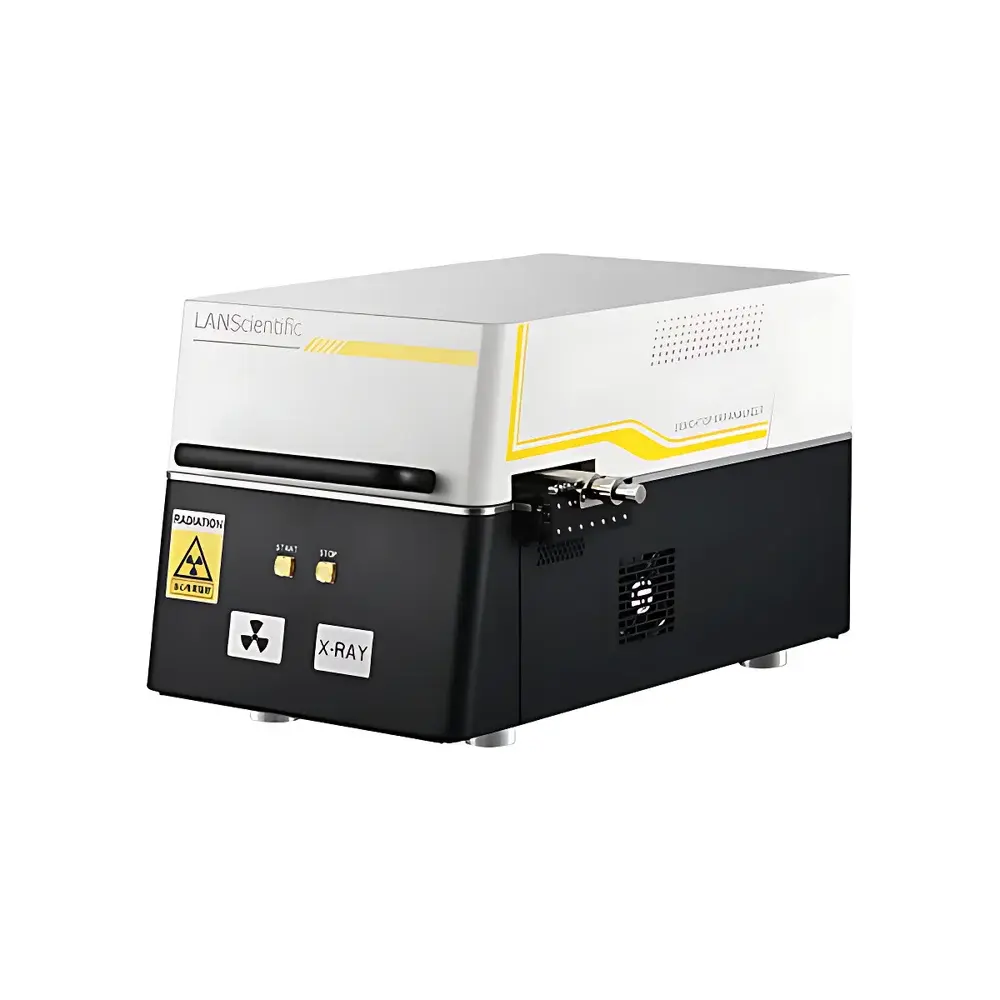
ScopeX PILOT Desktop X-Ray Fluorescence Coating Thickness Analyzer
| Brand | LANScientific |
|---|---|
| Model | ScopeX PC7 |
| Origin | Jiangsu, China |
| Manufacturer | LANScientific |
| Type | Benchtop ED-XRF Coating Thickness Analyzer |
| Measurement Principle | Energy-Dispersive X-Ray Fluorescence (ED-XRF) |
| Geometry | Bottom-illumination (upward irradiation) |
| Sample Handling | Manual X-Y stage with 25 µm resolution |
| Detection Depth Range | Up to 30 mm in recessed features |
| Optional Configurations | Micro-focus X-ray source, interchangeable collimators (φ0.1 mm to φ2.0 mm), automatic filter wheel (Al, Cu, Ti, Ni, Mo, Sn, Pb) |
| Compliance | Designed for ISO 3497, ASTM B568, ASTM F136, EN 14571, and GB/T 1764–2022 conformance |
| Software | Multi-FP fundamental parameters quantification engine with matrix correction, spectral deconvolution, and GLP-compliant audit trail |
Overview
The ScopeX PILOT Desktop X-Ray Fluorescence Coating Thickness Analyzer is an engineered benchtop solution for non-destructive, quantitative measurement of metallic and alloy coatings on substrates. Based on energy-dispersive X-ray fluorescence (ED-XRF) spectroscopy, the system operates under a bottom-illumination geometry—where the X-ray beam is directed upward through the sample stage—eliminating the need for manual focusing and enabling stable, repeatable positioning of irregular or recessed components. This configuration is especially advantageous for high-volume quality control in electroplating, PVD/CVD process monitoring, and post-treatment verification across precision manufacturing sectors. The instrument delivers trace-level elemental sensitivity (detection limits down to ~10 ng/cm² for common plating metals such as Ni, Cr, Zn, Sn, Au, Ag, and Cu) and supports multi-layer analysis up to three layers (e.g., Cu/Ni/Cr on steel), with thickness resolution typically ≤±1.5% for coatings ≥0.1 µm.
Key Features
- Bottom-illumination ED-XRF architecture ensures consistent beam alignment and minimizes geometric uncertainty during measurement of curved, stepped, or recessed surfaces.
- Integrated high-precision manual X-Y translation stage with 25 µm resolution enables accurate micro-area targeting—critical for evaluating localized plating uniformity on fasteners, connectors, or PCB vias.
- Muti-FP (Multi-Fundamental Parameters) software engine performs rigorous matrix correction using first-principles modeling, eliminating reliance on empirical calibration standards for unknown or complex substrate-coating combinations.
- Micro-focus X-ray source option (optional) enhances spatial resolution for sub-100 µm features, supporting analysis of fine-pitch electronic contacts, watch components, and miniature jewelry elements.
- Automated collimator and filter selection via motorized turret (standard configurations: φ0.1, φ0.2, φ0.5, φ1.0, φ2.0 mm; filters: Al, Cu, Ti, Ni, Mo, Sn, Pb) optimizes excitation efficiency and peak-to-background ratio across diverse coating systems.
- Variable-depth focal spot adjustment accommodates samples with depth variations up to 30 mm—enabling reliable quantification within threaded holes, grooves, and deep cavities without repositioning.
Sample Compatibility & Compliance
The ScopeX PILOT accepts solid, flat, or moderately contoured samples up to 200 × 200 mm footprint and 100 mm height (with optional extended-height chamber). It supports direct analysis of coated metals (e.g., Zn on steel, Ni on Cu, Au on Ni/Cu), alloys (e.g., brass, stainless steel), ceramics, and polymer substrates—provided surface roughness remains below Ra 3.2 µm. All measurement protocols align with internationally recognized standards including ISO 3497 (metallic coatings — measurement of coating thickness — X-ray spectrometric methods), ASTM B568 (standard test method for measurement of coating thicknesses by X-ray spectrometry), ASTM F136 (for titanium alloy coatings), EN 14571 (jewelry plating), and China’s GB/T 1764–2022 (paint and varnish — determination of film thickness). Instrument firmware and software support audit-trail logging per GLP/GMP requirements, with user access controls and electronic signature capability compliant with FDA 21 CFR Part 11 when configured with validated software modules.
Software & Data Management
The embedded analytical software provides full spectral acquisition, real-time peak identification, layer sequence definition, and thickness calculation using iterative FP algorithms. Each measurement session records raw spectrum, geometry settings, collimator/filter status, dwell time, and environmental parameters (temperature, humidity). Data export formats include CSV, XML, and PDF reports with embedded spectra and statistical summaries (mean, SD, Cp/Cpk). Batch processing mode allows automated evaluation of multi-point maps across a single part or across production lots. All data files are timestamped, digitally signed, and stored in a structured local database with configurable retention policies. Optional network integration enables secure transfer to LIMS or MES platforms via OPC UA or RESTful API interfaces.
Applications
The ScopeX PILOT serves as a primary metrology tool in industries where coating integrity directly impacts corrosion resistance, electrical contact reliability, wear performance, and aesthetic consistency. Typical use cases include: incoming inspection of electroplated automotive brake calipers and fuel system components; process validation of decorative chromium plating on bathroom fixtures; thickness mapping of immersion gold over nickel on high-frequency PCB edge connectors; quality screening of precious metal plating on watch cases and rings; verification of functional silver plating on RF shielding housings; and R&D characterization of nanoscale barrier layers in semiconductor packaging substrates. Its robust mechanical design and stable thermal management ensure repeatability across shifts and ambient temperature fluctuations (15–30 °C operating range).
FAQ
What coating thickness ranges can the ScopeX PILOT measure?
Typical measurable range spans from 0.01 µm (e.g., thin Au flash layers) to 50 µm (e.g., thick Zn or Sn deposits), depending on element pair, substrate composition, and measurement geometry.
Is vacuum or helium purge required for light element analysis?
No—air-path operation suffices for elements Na and heavier; optional He purge module is available for enhanced sensitivity to Mg, Al, and Si when analyzing anodized or conversion-coated aluminum parts.
Can the instrument differentiate between alloy coatings and pure metal layers?
Yes—the Multi-FP algorithm resolves overlapping spectral lines (e.g., Ni–Co, Cu–Zn) and calculates individual layer compositions and thicknesses simultaneously in multi-layer stack configurations.
How is calibration maintained over time?
Calibration stability is verified using certified reference materials (CRMs) traceable to NIST or BAM; drift correction is supported via built-in internal standard monitoring and periodic recalibration routines.
Does the system support automated pass/fail decision logic?
Yes—user-defined specification limits can be applied per layer, with real-time color-coded result display (green/yellow/red), SPC charting, and auto-flagging of out-of-spec measurements in batch reports.



