
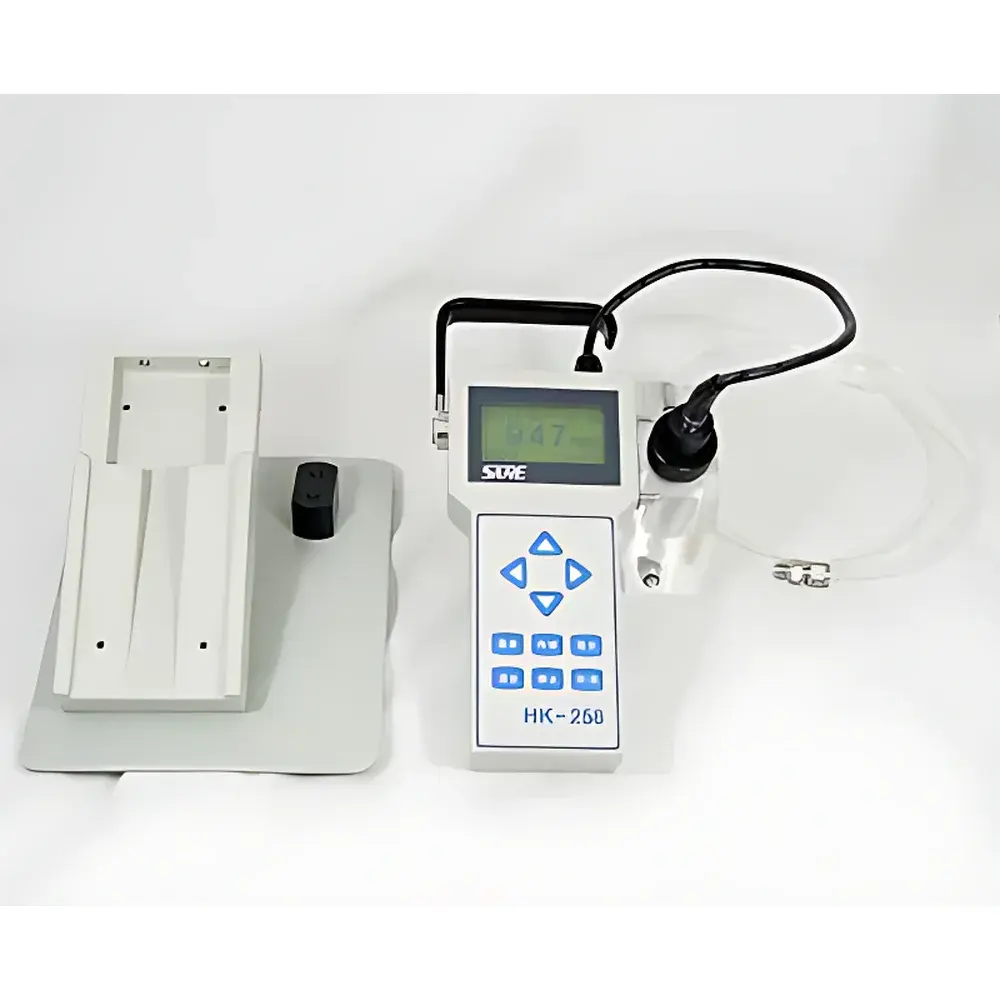
SENHK-258 ppb-Level Portable Dissolved Oxygen Analyzer
| Origin | Beijing, China |
|---|---|
| Manufacturer Type | Authorized Distributor |
| Origin Category | Domestic (China) |
| Model | SENHK-258 |
| Pricing | Available Upon Request |
| Measurement Range | 0–200.0 µg/L and 0–20.00 mg/L (auto-ranging) |
| Accuracy | ±<3% of reading |
| Temperature Compensation Range | 0–50 °C |
| Minimum Sample Flow Rate | 50 mL/min |
| Response Time (t₉₀) | ≤60 s at 25 °C |
| Power Supply | 2 × 3.6 V rechargeable Li-ion batteries |
| Continuous Operation Time (fully charged) | 15 h |
| Ingress Protection Rating | IP66 |
| Dimensions (L×W×H) | 190 × 250 × 180 mm |
| Weight (including charging dock) | 2.3 kg |
Overview
The SENHK-258 ppb-Level Portable Dissolved Oxygen Analyzer is an electrochemical field instrument engineered for high-sensitivity, trace-level dissolved oxygen (DO) quantification in aqueous environments—particularly where sub-microgram-per-liter resolution is critical. It employs a polarographic Clark-type sensor with a gas-permeable membrane and optimized cathodic reduction chemistry to deliver stable, low-drift measurements across ultra-trace (ppb) to low-ppm (mg/L) concentration ranges. Unlike conventional galvanic DO sensors, the SENHK-258 utilizes a precisely biased silver/silver chloride reference and gold cathode architecture, minimizing polarization artifacts and enabling true zero-point stability without routine zero calibration. Its design targets applications demanding regulatory-grade repeatability in ambient or process water monitoring—such as ultrapure water systems in semiconductor fabrication, pharmaceutical water-for-injection (WFI) loops, steam condensate return lines, and environmental groundwater profiling.
Key Features
- Ultra-low detection capability: Resolution down to 0.1 µg/L (ppb), with dual auto-ranging modes (0–200.0 µg/L and 0–20.00 mg/L) ensuring optimal signal-to-noise ratio across operational scales.
- Minimal maintenance requirement: Only two calibrations per year required; no zero-point adjustment needed due to inherent electrochemical stability and absence of zero drift.
- Extended electrolyte service life: Optimized membrane geometry and low-current operation reduce electrolyte consumption—single fill supports ≥6 months of continuous use under typical field conditions.
- Robust mechanical design: IP66-rated enclosure ensures reliable operation in humid, dusty, or splash-prone environments including outdoor sampling stations and industrial utility corridors.
- Intelligent power management: Dual 3.6 V Li-ion battery pack delivers 15 hours of continuous measurement; integrated smart charging dock provides LED status indicators for charging progress and full-charge confirmation.
- Real-time data logging: Programmable time-stamped acquisition enables autonomous unattended operation; internal memory stores date, time, temperature, and DO values with full recall capability.
Sample Compatibility & Compliance
The SENHK-258 is validated for use with deionized water, purified process water, boiler feedwater, condensate, and low-conductivity natural waters (conductivity <5 µS/cm). It complies with ASTM D888–22 (Standard Test Methods for Dissolved Oxygen in Water) for field-deployable electrochemical methods and supports alignment with pharmacopeial requirements including USP and EP 2.2.43 for oxygen determination in purified water and WFI. While not intrinsically certified for hazardous locations, its non-sparking electronics and sealed housing meet general-purpose industrial safety expectations per IEC 61000-6-2/6-4 for electromagnetic compatibility. Data integrity features—including timestamped logs and battery-voltage monitoring—facilitate GLP-compliant documentation when paired with validated procedures.
Software & Data Management
The analyzer interfaces via standard USB 2.0 to Windows-based desktop software (included), enabling export of CSV-formatted datasets for post-acquisition analysis in Excel, MATLAB, or LIMS platforms. All stored records retain embedded metadata: measurement ID, UTC timestamp, ambient temperature, sensor status flags, and calibration history identifiers. The software enforces audit-trail functionality—no record deletion or modification is permitted without administrator authentication and event logging. Although not natively 21 CFR Part 11 compliant out-of-the-box, the system supports integration into validated workflows through external electronic signature modules and controlled access protocols.
Applications
- Monitoring dissolved oxygen in ultrapure water distribution networks (e.g., semiconductor fab UPW loops).
- Verification of deaeration efficiency in thermal power plant condensate and feedwater systems.
- Field assessment of oxygen ingress in closed-loop HVAC chillers and heat exchanger circuits.
- Regulatory compliance testing for oxygen content in pharmaceutical purified water and water-for-injection (WFI) per USP/EP monographs.
- Long-term groundwater quality studies requiring portable, battery-operated trace-oxygen profiling.
- Validation of membrane degasifier performance in laboratory and pilot-scale water treatment systems.
FAQ
Does the SENHK-258 require zero-point calibration during routine use?
No. The polarographic cell design eliminates zero drift; only span calibration is necessary—twice annually under normal operating conditions.
Can the instrument operate while charging?
Yes. The analyzer remains fully functional during connection to the charging dock, enabling uninterrupted data collection during extended deployments.
Is temperature compensation automatic or manual?
Fully automatic: An integrated Pt1000 RTD sensor continuously monitors sample temperature between 0–50 °C and applies Nernstian correction in real time.
What is the minimum flow rate required for accurate measurement?
A sustained flow of ≥50 mL/min is required to ensure laminar diffusion equilibrium across the membrane and avoid boundary-layer artifacts.
How are historical calibration records accessed and exported?
Calibration events—including date, operator ID (if entered), span value, and sensor response slope—are stored alongside measurement data and retrievable via the PC software interface.




