
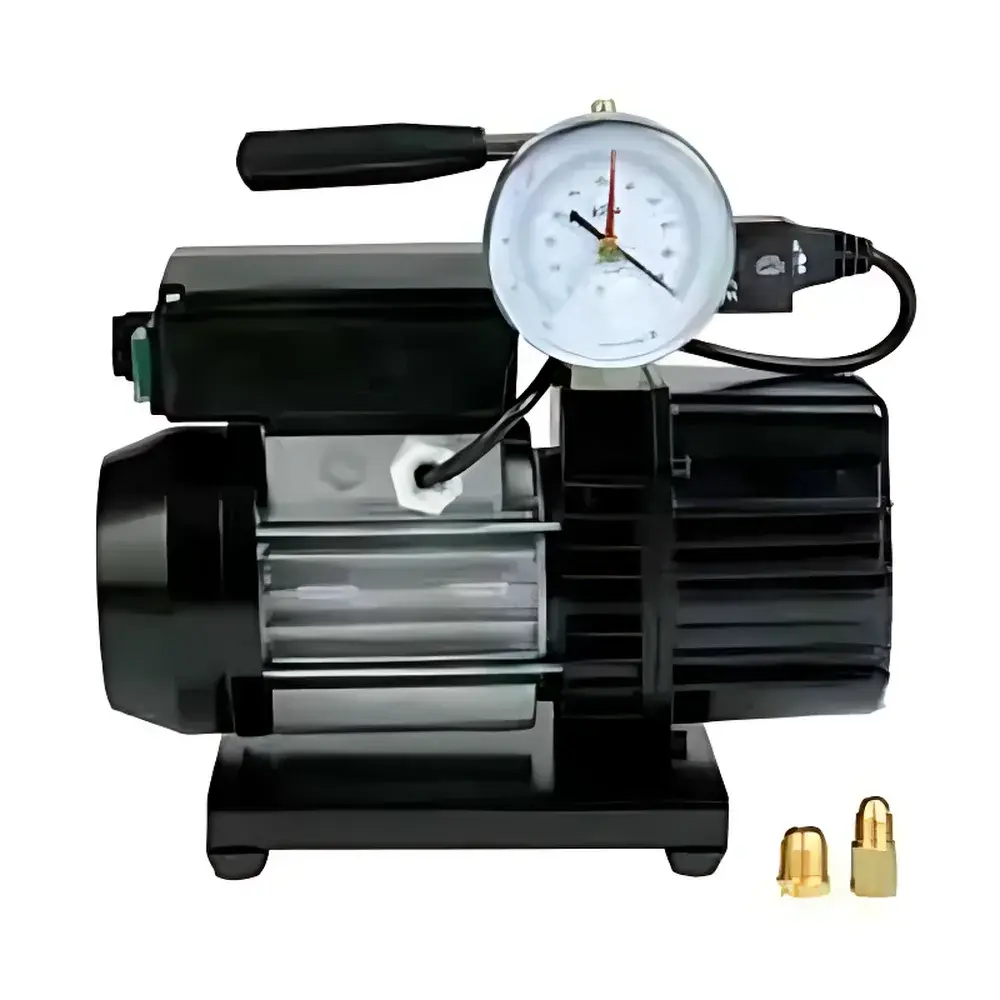
SETA 22423 Compact Oil-Lubricated Vacuum Pump with Integrated Vacuum Gauge
| Brand | SETA |
|---|---|
| Origin | Italy |
| Model | 22423 |
| Ultimate Vacuum | 1×10⁻² mbar |
| Air Flow Rate | 46 L/min (standard) / 66 L/min (high-flow variant) |
| Dimensions | 270 × 150 × 250 mm |
| Weight | 7 kg |
| Inlet Port Sizes | 1/4″, 5/16″, and 3/8″ NPT/Female |
| Oil Mist Filter | Integrated |
| Type | Rotary Vane, Oil-Lubricated Vacuum Pump |
Overview
The SETA 22423 is a compact, oil-lubricated rotary vane vacuum pump engineered for precision laboratory applications requiring stable, low-pressure environments. Designed and manufactured in Italy, this pump operates on the principle of positive displacement via rotating vanes within an eccentrically mounted rotor—generating consistent suction across a wide operating range. Its ultimate vacuum performance of 1×10⁻² mbar enables reliable operation in applications such as vacuum drying, solvent evaporation, filtration under reduced pressure, and degassing of solvents or resins. The integrated analog vacuum gauge provides real-time, direct readout of chamber pressure without requiring external sensors or calibration, enhancing operational transparency and reducing setup complexity. Its robust cast-aluminum housing ensures thermal stability and mechanical durability during extended duty cycles, while the optimized internal oil circulation system maintains consistent lubrication and minimizes wear.
Key Features
- Integrated analog vacuum gauge for immediate, tool-free pressure monitoring at the pump inlet
- Ultimate vacuum capability of 1×10⁻² mbar—suitable for medium-to-high vacuum processes in analytical and preparative workflows
- Compact footprint (270 × 150 × 250 mm) and lightweight design (7 kg) facilitate benchtop integration, mobile cart mounting, or installation in space-constrained fume hoods
- Dual-flow configuration: standard 46 L/min and high-capacity 66 L/min variants accommodate diverse evacuation demands—from small-volume glassware to multi-port manifolds
- Factory-installed oil mist filter captures airborne hydrocarbon aerosols generated during operation, significantly reducing ambient oil vapor contamination and improving lab air quality
- Triple interchangeable inlet ports (1/4″, 5/16″, and 3/8″ NPT female) simplify connection to common laboratory tubing, vacuum traps, and glassware adapters without additional fittings
- Low-noise operation (<62 dB(A) at 1 m) supports use in shared laboratory environments where acoustic compliance is required
Sample Compatibility & Compliance
The SETA 22423 is compatible with standard borosilicate glass vacuum apparatus (e.g., Büchner funnels, rotary evaporators, desiccators, and Schlenk lines) and chemically resistant elastomeric tubing (Viton®, silicone, or EPDM). It is not intended for use with corrosive, condensable, or particulate-laden vapors unless paired with appropriate cold traps or particulate filters upstream. The pump meets CE marking requirements per EU Machinery Directive 2006/42/EC and Electromagnetic Compatibility Directive 2014/30/EU. Its oil mist filtration system aligns with ISO 8573-1:2010 Class 4 particulate purity standards for compressed air/vacuum systems. While not certified for cleanroom use, its low outgassing rate and filtered exhaust support GLP-compliant sample preparation environments when maintained per manufacturer guidelines.
Software & Data Management
The SETA 22423 is a standalone electromechanical instrument with no embedded microprocessor or digital interface. As such, it does not feature firmware, data logging, or software connectivity. Pressure monitoring is exclusively analog via the front-panel gauge—eliminating dependencies on drivers, USB protocols, or cybersecurity configurations. This architecture ensures long-term reliability, immunity to firmware obsolescence, and full compatibility with legacy vacuum control systems. For labs requiring automated pressure regulation or audit trails, the pump may be integrated with external pressure controllers (e.g., MKS Baratron® transducers) and SCADA-compatible PLCs via 0–10 V or 4–20 mA analog signal inputs.
Applications
- Vacuum-assisted filtration in analytical chemistry and pharmaceutical QC laboratories
- Solvent removal and concentration steps in natural product isolation and peptide synthesis
- Deaeration of casting resins, adhesives, and composite precursors prior to curing
- Preparation of moisture-sensitive samples for FTIR, XRD, or TGA analysis
- Supporting vacuum manifolds in parallel reaction systems and automated sample prep stations
- Backing pump for secondary high-vacuum stages (e.g., turbomolecular or diffusion pumps) in materials science instrumentation
FAQ
What type of vacuum oil is recommended for the SETA 22423?
SETA specifies ISO VG 100 mineral-based rotary vane pump oil (e.g., Edwards RV-Oil 100 or equivalent). Synthetic alternatives meeting DIN 51506 VDL specifications may be used for extended service intervals.
Can this pump be operated continuously?
Yes—the unit is rated for continuous duty at ambient temperatures ≤35°C and relative humidity <80%. Ensure adequate ventilation around the cooling fins and perform oil level checks every 200 operating hours.
Is the integrated vacuum gauge calibrated and traceable to national standards?
The analog gauge is factory-set and user-adjustable via zero-screw calibration; however, it is not supplied with NIST-traceable calibration documentation. For metrologically critical applications, users should validate against a certified reference manometer annually.
Does the oil mist filter require replacement, and how often?
The filter element is serviceable and should be replaced every 500 operating hours or when visual inspection reveals saturation or discoloration of the filter media.
Are spare parts such as vanes, springs, or gaskets available through authorized distributors?
Yes—SETA supplies OEM spare kits (including rotor vanes, shaft seals, and inlet valve assemblies) with part numbers traceable to the 22423 service manual (Revision D, 2022).



