
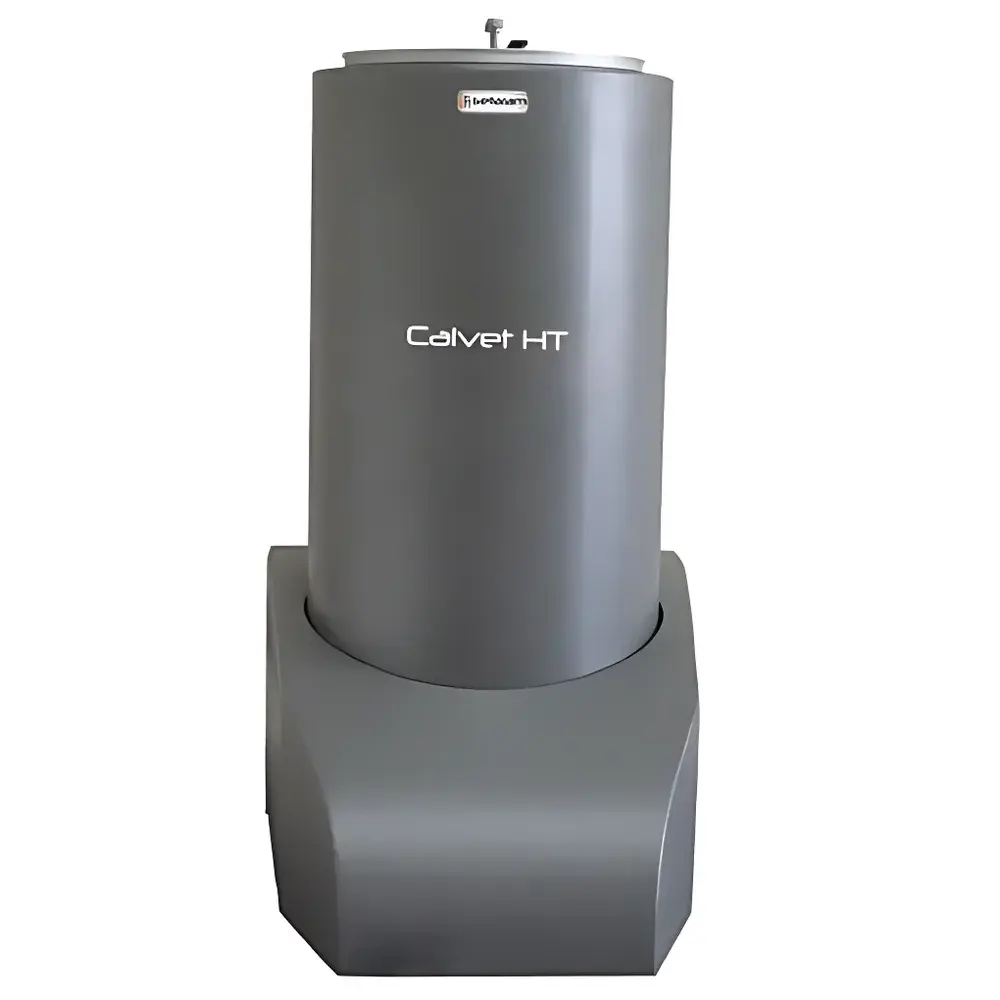
SETARAM CALVET HT High-Temperature Microcalorimeter
| Brand | SETARAM |
|---|---|
| Origin | France |
| Model | CALVET HT |
| Temperature Range | RT to 600 °C |
| Temperature Precision | ±0.5 °C |
| Measurement Principle | 3D Symmetrical Heat-Flow Calorimetry |
| Maximum Operating Pressure | 400 bar |
| Sample Configuration | Customizable high-pressure, vacuum-compatible, stirred, or gas-flow-integrated cells |
| Cooling | External recirculating water bath |
| Compliance | Designed for GLP/GMP-aligned workflows and ASTM E698, ISO 11358, and UN Test Series 3 compatibility |
Overview
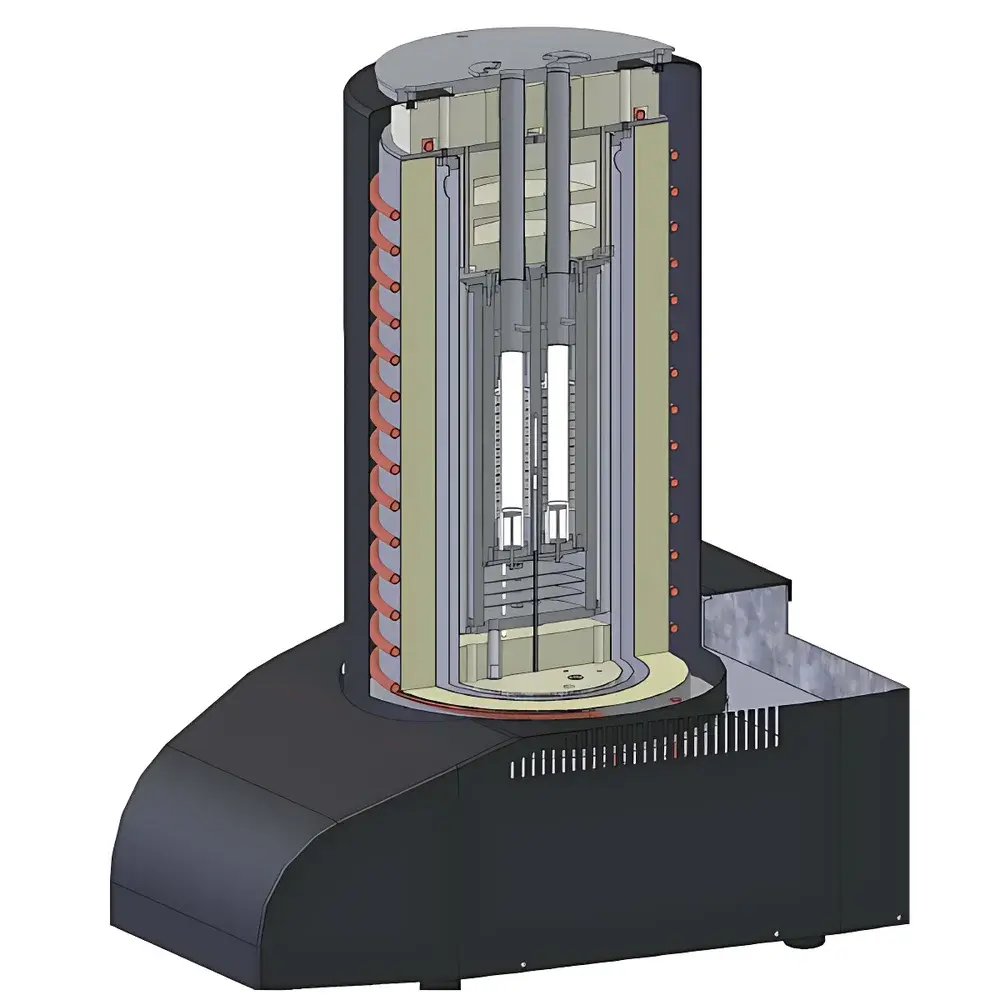
The SETARAM CALVET HT is a high-temperature, high-sensitivity microcalorimeter engineered for quantitative thermal analysis of energetic materials, catalytic reactions, process safety screening, and energy storage systems under rigorously controlled thermo-mechanical conditions. Unlike conventional differential scanning calorimeters (DSC) or heat-flux instruments, the CALVET HT implements true 3D symmetrical heat-flow calorimetry—based on dual cylindrical thermopile arrays—ensuring near-zero thermal loss and absolute enthalpy measurement accuracy. Each thermopile comprises 144 precision-calibrated thermocouples, fully surrounding both sample and reference zones radially, axially, and circumferentially. This architecture enables direct, model-free quantification of heat flow (in mW) without baseline extrapolation or calibration drift correction, delivering high reproducibility (<1% RSD) across repeated high-temperature runs up to 600 °C.
Key Features
- True 3D heat-flow detection via dual 144-junction thermopile arrays—eliminating directional heat-loss artifacts and enabling absolute enthalpy determination
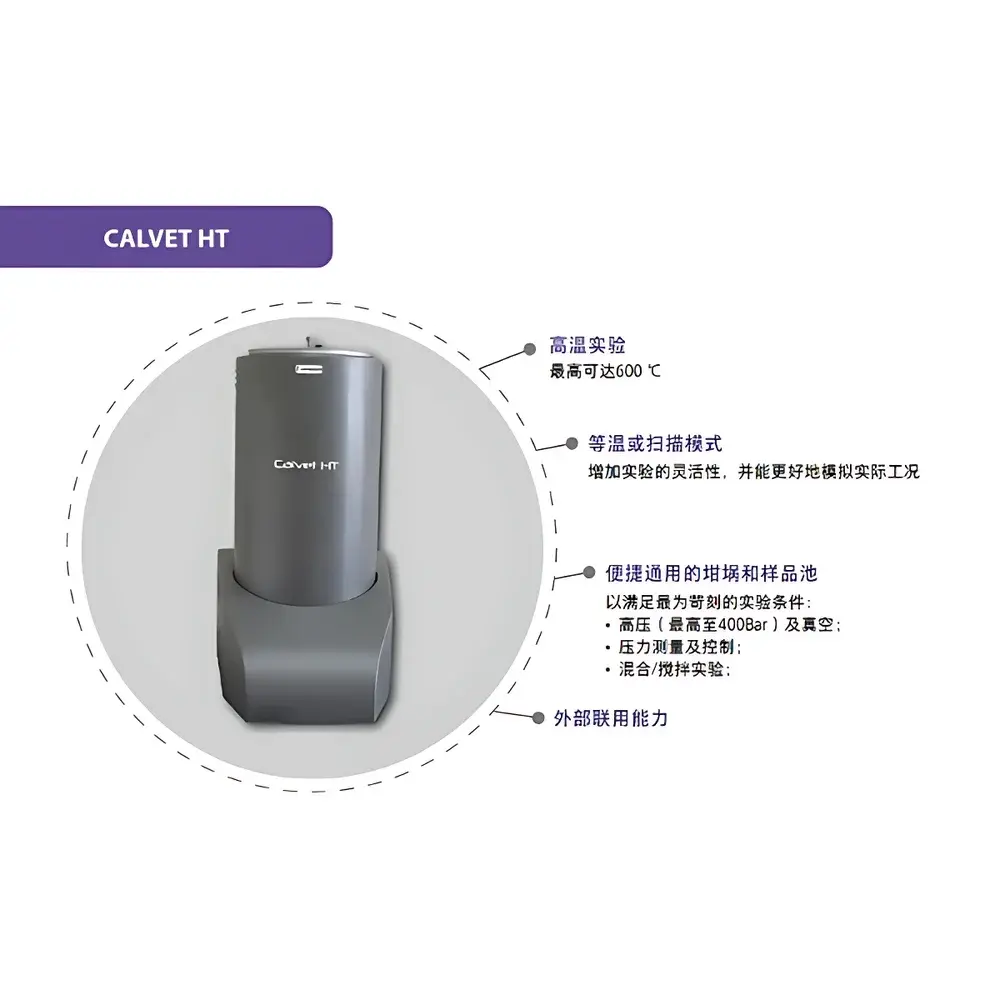
- Extended operational temperature range from ambient to 600 °C with ±0.5 °C thermal stability and programmable isothermal or dynamic ramp modes
- Integrated high-pressure capability up to 400 bar, with real-time pressure monitoring, active pressure control, and gas dosing interfaces
- Modular sample cell design: supports standard hermetic cylinders, stirred reactors, vacuum-sealed vessels, and gas-permeable configurations—all fabricated from corrosion-resistant Inconel, Hastelloy, and PEEK composites
- Active external cooling loop using recirculating water bath maintains outer jacket temperature below 40 °C, ensuring long-term thermal stability and operator safety during extended high-T experiments
- Full hardware synchronization interface (TTL/RS232/Ethernet) for coupling with FTIR, MS, or Raman spectrometers in hyphenated thermal analysis workflows
Sample Compatibility & Compliance
The CALVET HT accommodates solid powders, viscous slurries, gels, compressed pellets, and pressurized liquid/gas mixtures—ideal for UN hazard classification testing (e.g., UN Test Series 3 for self-heating substances), adiabatic runaway screening (ASTM E1981), and decomposition kinetics of propellants and battery electrolytes. All sample cells meet ISO 17025 traceability requirements for calibration and are validated per ASTM E698 (kinetic analysis of thermal decomposition) and ISO 11358 (polymer thermal degradation). The system architecture supports audit-ready data integrity: time-stamped raw heat-flow and temperature logs, electronic signatures, and full 21 CFR Part 11–compliant user access controls when operated with SETARAM’s T.A. Pro software suite.
Software & Data Management
Controlled via SETARAM’s T.A. Pro v5.x platform, the CALVET HT provides synchronized acquisition of heat flow (µW–W), temperature (°C), pressure (bar), gas flow (sccm), and stirring rate (rpm) with 10 ms temporal resolution. Raw data are stored in vendor-neutral HDF5 format with embedded metadata (instrument ID, operator, SOP version, calibration certificate IDs). Kinetic modeling modules include Ozawa-Flynn-Wall, Kissinger, and advanced isoconversional methods (Friedman, Vyazovkin) compliant with ICH Q5C and USP . Audit trails record all parameter modifications, file exports, and report generations—fully traceable for FDA, EMA, or ANVISA regulatory submissions.
Applications
- Process safety evaluation: Onset temperature, adiabatic time-to-maximum-rate (TMRad), and activation energy of exothermic decompositions in chemical manufacturing
- Energetic materials characterization: Sensitivity screening (impact/friction), combustion enthalpy, and thermal stability of explosives, propellants, and pyrotechnics
- Battery R&D: Solid-electrolyte interphase (SEI) formation enthalpy, cathode/anode side-reaction quantification, and thermal runaway propagation analysis under simulated abuse conditions
- Heterogeneous catalysis: Reaction enthalpy mapping of CO oxidation, Fischer–Tropsch synthesis, or NH3 decomposition under realistic pressure–temperature–gas composition gradients
- Polymers & composites: Curing enthalpy, post-cure exotherms, and filler–matrix interfacial reaction heat under elevated pressure
FAQ
What distinguishes CALVET HT from conventional DSC instruments?
The CALVET HT uses absolute 3D heat-flow measurement—not relative temperature difference—enabling direct enthalpy quantification without reference calibration standards or baseline assumptions.
Can the system operate under inert or reactive gas atmospheres?
Yes. Integrated mass-flow controllers support continuous N2, Ar, O2, H2, or custom gas mixtures at pressures from vacuum to 400 bar, with leak-tight sealing verified to <1×10⁻⁹ mbar·L/s.
Is kinetic analysis software included?
Yes. T.A. Pro includes ISO/ASTM-compliant kinetic modules with uncertainty propagation reporting and automated peak deconvolution for multi-step reactions.
How is temperature uniformity ensured across the 3D sensor volume?
A precision-machined copper thermal manifold, actively stabilized by dual PID loops and monitored by six independent Pt100 sensors, ensures radial and axial homogeneity within ±0.3 °C across the 25 mm sample zone.
Are custom sample cells available for proprietary reactor geometries?
SETARAM’s engineering team collaborates directly with users to design, validate, and document application-specific cells—including microfluidic integration, electrochemical three-electrode configurations, or fiber-optic temperature/strain monitoring ports.



