
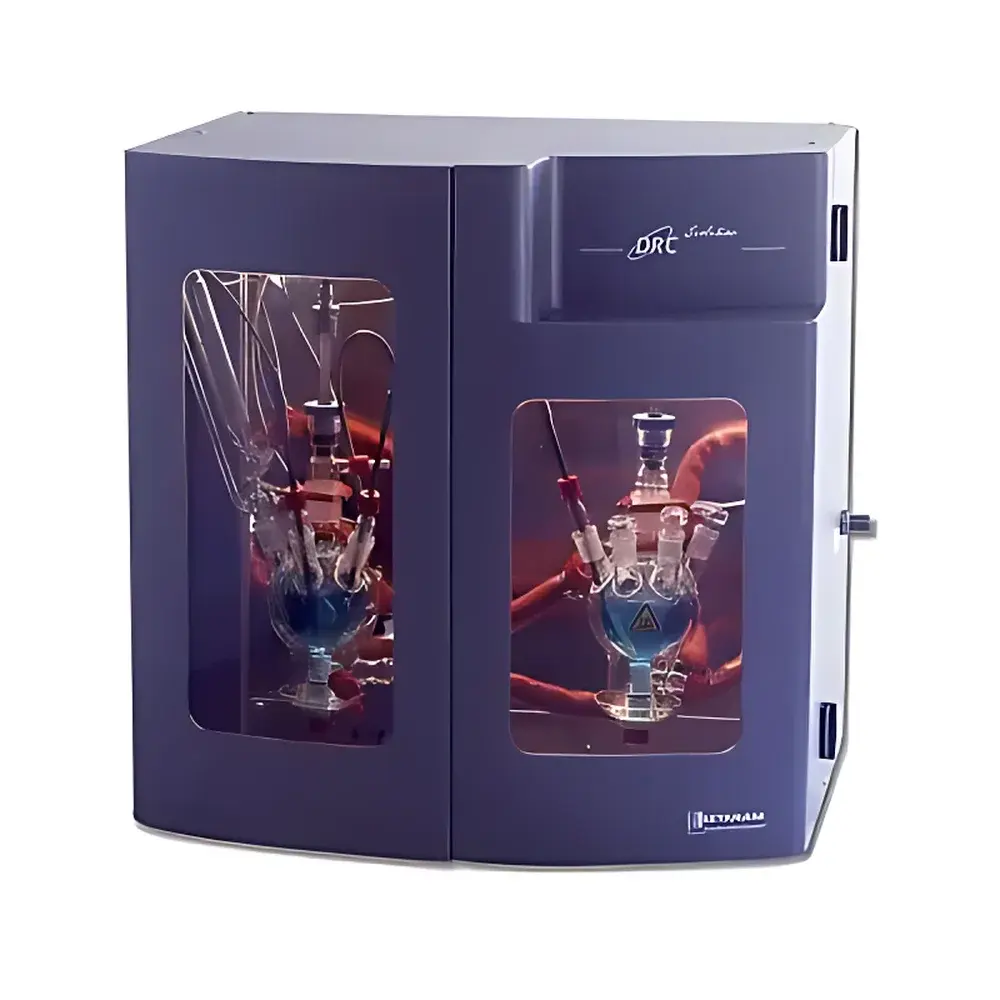
Setaram DRC evo Differential Reaction Calorimeter
| Brand | Setaram |
|---|---|
| Origin | France |
| Model | DRC evo |
| Type | Benchtop Differential Reaction Calorimeter |
| Operating Principle | Isothermal Micro-Differential Calorimetry (Based on Dual-Bath Temperature Difference Measurement) |
| Temperature Control | Dual Jacketed Reactor Vessels with External Circulating Bath |
| Detection | High-Precision Pt100 Differential Thermometry |
| Data Output | ΔT vs. t, Q vs. t, dQ/dt vs. t |
| Compliance | Designed for GLP/GMP-aligned thermal safety screening per ASTM E698, ISO 11358, and ICH Q1A(R2) guidance |
Overview
The Setaram DRC evo is a benchtop differential reaction calorimeter engineered for precise, real-time quantification of thermal effects during chemical reactions and physical mixing processes under controlled laboratory conditions. It operates on the principle of isothermal micro-differential calorimetry: two identical, double-jacketed glass reactors—one containing the reacting system, the other serving as an inert reference—are maintained at identical setpoint temperatures via independent external circulating baths. A high-stability Pt100 differential temperature probe continuously measures the minute temperature difference (ΔT) between the two vessels as a function of time. This ΔT signal is converted into heat flow (dQ/dt) using Joule-effect calibration, enabling calculation of cumulative reaction enthalpy (Q), peak power, onset time, adiabatic temperature rise (ΔTad), and apparent activation energy via integral or differential methods. Unlike adiabatic calorimeters (e.g., ARC), the DRC evo maintains near-isothermal operation—making it ideal for kinetic profiling, process safety screening, and early-stage reaction optimization where thermal runaway potential must be quantified without full-scale hazard escalation.
Key Features
- Dual-jacketed, borosilicate glass reactor vessels (standard 100–500 mL capacity) with optical transparency for direct visual monitoring of phase behavior, gas evolution, precipitation, or emulsion formation
- Independent temperature control of both reaction and reference cells via external thermostatic circulators (±0.01 °C stability)
- High-resolution differential thermometry (±1 mK sensitivity) with low thermal inertia design to capture rapid exothermic events
- Integrated gas inlet/outlet ports supporting controlled sparging, CO2 absorption studies, and vapor-phase reagent addition under inert or reactive atmospheres
- Modular architecture compatible with optional accessories: pH probes, conductivity sensors, automated dosing units, and reflux condensers
- Robust mechanical design compliant with CE marking and IEC 61000-6-2/6-4 electromagnetic compatibility standards
Sample Compatibility & Compliance
The DRC evo accommodates heterogeneous liquid–liquid, liquid–gas, and suspension-based systems—including catalytic hydrogenations, nitration, sulfonation, polymerization initiations, and CO2 capture solvent screening. Corrosion-resistant wetted parts (glass, PTFE, Kalrez® seals) enable compatibility with aggressive reagents (e.g., concentrated HNO3, Cl2, SOCl2). All data acquisition and storage meet ALCOA+ principles: audit trails, electronic signatures, and user-access controls are implemented in accordance with FDA 21 CFR Part 11 requirements when used with Setaram’s CALISTO software suite. Thermal data generated supports compliance with process safety standards including CCPS Guidelines, NFPA 495, and EU REACH Annex VII testing protocols for thermal stability assessment.
Software & Data Management
CALISTO v5.x provides instrument control, real-time visualization of ΔT, heat flow, and cumulative enthalpy curves, and automated peak detection with baseline correction algorithms. Raw data are stored in vendor-neutral .csv and .tdms formats. Advanced analysis modules include: (1) reaction onset determination via tangent intersection or 0.1 W/g threshold; (2) kinetic modeling (e.g., nth-order, autocatalytic, nucleation-growth) using nonlinear regression; (3) adiabatic extrapolation (Φ-factor correction) for worst-case scenario estimation; and (4) export to Aspen Tech, ChemCAD, or MATLAB for integration into process simulation workflows. Audit logs record all parameter changes, calibration events, and user logins—fully traceable for internal QA audits or regulatory inspections.
Applications
- Reaction calorimetry for API synthesis route selection and scale-up risk assessment
- Thermal hazard evaluation per ASTM E1981 and UN Test Series H for transportation classification
- Heat of mixing quantification for solvent selection and formulation development
- CO2 chemisorption/desorption thermodynamics in amine-based scrubbing solvents
- Hydration/dehydration enthalpies of crystalline hydrates and polymorphs
- Quality-by-Design (QbD) studies supporting ICH Q5C and Q8(R2) documentation
FAQ
What is the minimum detectable heat flow resolution of the DRC evo?
The system achieves a typical heat flow resolution of ±0.01 W under standard operating conditions (100 mL volume, 0.1 K temperature setpoint deviation). Resolution is volume- and ΔT-dependent; calibration with electrical heaters validates performance per ISO 11358-1.
Can the DRC evo operate under pressure?
No—it is designed for ambient-pressure operation only. For pressurized reaction calorimetry, Setaram recommends the C80 or Sensys Evo platforms.
Is the DRC evo suitable for kinetic modeling of consecutive reactions?
Yes. Its high temporal resolution (data acquisition up to 10 Hz) and low thermal lag enable deconvolution of overlapping exotherms using multi-peak fitting routines in CALISTO.
Does the system support automated reagent addition?
Yes—via optional integrated syringe pumps with programmable dosing profiles synchronized to calorimetric data acquisition.
How is calibration performed?
Electrical calibration is conducted using embedded resistive heaters in both vessels; temperature calibration uses NIST-traceable Pt100 reference probes. Full system validation follows ISO/IEC 17025-compliant procedures documented in the instrument’s IQ/OQ/PQ package.



