
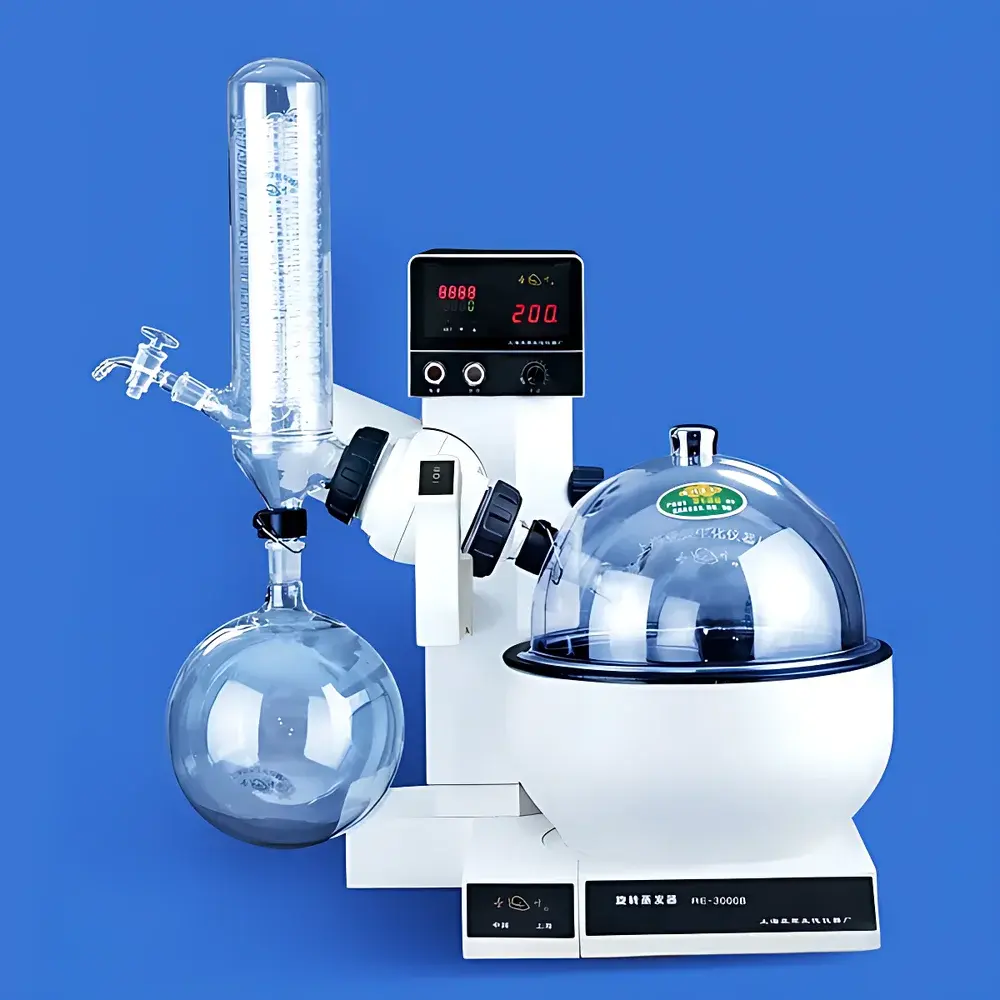
Shanghai Yarong RE-3000B Rotary Evaporator
| Brand | Jinye |
|---|---|
| Origin | Shanghai, China |
| Manufacturer Type | Direct Manufacturer |
| Country of Origin | China |
| Model | RE-3000B |
| Evaporation Flask Capacity | 50–3000 mL |
| Rotation Speed Range | 0–200 rpm |
| Temperature Control Range | Ambient to 99 °C (PID-controlled, digital display) |
| Temperature Control Accuracy | ±1 °C |
| Condenser Type | Dual-flow vertical condenser |
| Condensing Surface Area | 0.15 m² |
Overview
The Shanghai Yarong RE-3000B Rotary Evaporator is an engineered solution for efficient, reproducible solvent removal and concentration under reduced pressure in research and quality control laboratories. Based on the principle of rotary evaporation—where simultaneous rotation, vacuum application, and controlled heating lower the boiling point of solvents—the RE-3000B enables gentle yet rapid separation of volatile components from heat-sensitive samples. Its robust stainless-steel and borosilicate glass construction ensures chemical resistance and long-term dimensional stability. Designed for routine use in academic, pharmaceutical, and fine chemical environments, the system integrates precise thermal regulation, programmable rotational dynamics, and ergonomic vertical lift functionality to support method reproducibility across batch operations.
Key Features
- Motor-driven vertical lifting mechanism with smooth, backlash-free motion—enabling safe, repeatable positioning of the evaporation flask relative to the heating bath and condenser.
- Digital PID temperature controller with real-time display and ±1 °C accuracy across a 0–99 °C range; compatible with standard water or oil heating baths.
- Stepless speed regulation from 0 to 200 rpm via digital encoder feedback—ensuring optimal film formation and surface renewal for consistent evaporation kinetics.
- Standardized ISO-K (29/32) ground-glass joints throughout the vapor path—facilitating interchangeability with common laboratory glassware and accessories.
- Dual-flow vertical condenser with 0.15 m² effective cooling surface area—optimized for high-efficiency reflux and minimal bumping during low-boiling solvent recovery (e.g., acetone, dichloromethane, ethyl acetate).
- Integrated vacuum-tight sealing system using PTFE-coated stopcocks and silicone gaskets—maintaining stable sub-atmospheric pressure (typically 10–100 mbar) without manual adjustment.
Sample Compatibility & Compliance
The RE-3000B accommodates a wide range of sample matrices, including aqueous extracts, organic reaction mixtures, polymer solutions, and natural product fractions. Its 50–3000 mL flask capacity supports both small-scale screening (e.g., 100 mL extraction workups) and preparative-scale concentration (e.g., 2 L botanical distillates). All wetted parts comply with USP Class VI and ISO 10993 biocompatibility guidelines for non-invasive contact. While not certified for GMP manufacturing environments per se, the instrument’s traceable temperature and rotation parameters—when logged externally—support GLP-aligned documentation practices. It meets general electrical safety requirements per IEC 61010-1 and is suitable for installation in ISO Class 7 (10,000) cleanroom-adjacent labs when used with appropriate exhaust and solvent trap configurations.
Software & Data Management
The RE-3000B operates as a standalone analog-digital hybrid instrument with no embedded microprocessor or network interface. All operational parameters—bath temperature, rotation speed, and lift position—are monitored and adjusted manually via front-panel controls with LED readouts. For laboratories requiring audit-ready records, external data loggers (e.g., Omega OM-DAQPRO-5300 series) can be interfaced via 4–20 mA or 0–5 V analog outputs (optional retrofit). When integrated into validated workflows, the unit supports 21 CFR Part 11-compliant electronic record generation through third-party LIMS or ELN platforms—provided user-defined SOPs define calibration frequency (recommended every 6 months), verification checks (e.g., bath temperature uniformity mapping), and maintenance logs for motor brushes and vacuum seal integrity.
Applications
- Concentration of thermolabile compounds in natural product isolation (e.g., terpenes, flavonoids) without degradation.
- Solvent exchange protocols in peptide synthesis and oligonucleotide purification workflows.
- Removal of low-boiling solvents (e.g., hexane, ether) following liquid–liquid extraction in environmental residue analysis.
- Preparative drying of catalyst slurries and nanoparticle dispersions prior to lyophilization or spray drying.
- Routine QC testing of excipient blends in pharmaceutical formulation development—particularly where residual solvent limits (ICH Q3C) must be verified.
FAQ
What vacuum level is recommended for optimal performance with the RE-3000B?
A stable vacuum between 15–30 mbar is typically sufficient for most low-to-medium boiling solvents; higher vacuum (<10 mbar) may be required for high-boiling-point solvents such as DMSO or glycerol derivatives.
Is the heating bath included with the RE-3000B unit?
No—the RE-3000B is supplied as a main evaporator assembly only; compatible water or oil baths (e.g., 5 L capacity, ±0.5 °C stability) must be selected separately based on flask size and thermal inertia requirements.
Can the RE-3000B be operated continuously for extended periods?
Yes—designed for 8–12 hour shifts under nominal load; however, periodic inspection of the PTFE vacuum tubing, condenser coolant flow rate, and motor bearing lubrication is advised after every 200 operating hours.
Does the unit support inert gas purging during evaporation?
Yes—via optional inlet valve (not standard), enabling nitrogen or argon sparging to prevent oxidation of air-sensitive intermediates during concentration.
What maintenance intervals are recommended for long-term reliability?
Vacuum pump oil replacement every 3 months (or per pump manufacturer’s specification), condenser descaling quarterly, and annual verification of PID controller calibration against NIST-traceable reference thermometers.



