
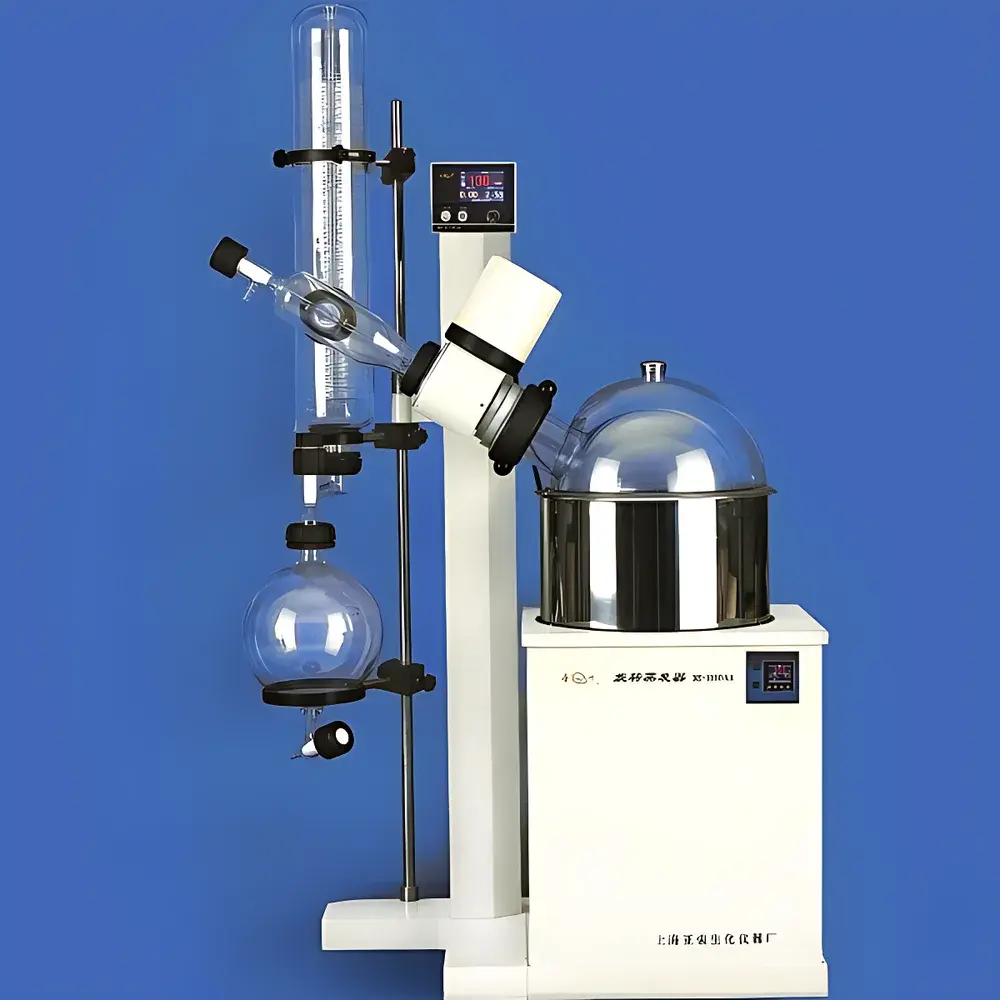
Shanghai Yarong RE-5210AA Rotary Evaporator
| Brand | Jinye |
|---|---|
| Origin | Shanghai, China |
| Manufacturer Type | Direct Manufacturer |
| Country of Origin | China |
| Model | RE-5210AA |
| Capacity | 10 L |
| Ultimate Vacuum Range | −0.01 to −0.095 MPa (±0.2–0.5% accuracy) |
| Rotation Speed | 0–138 rpm |
| Temperature Control Range | Ambient to 99 °C (PID-controlled, LED digital display) |
| Temperature Accuracy | ±1 °C |
| Condenser Cooling Area | 1.1 m² |
| Condenser Type | Vertical, extra-long dual-reflux coil |
Overview
The Shanghai Yarong RE-5210AA Rotary Evaporator is a robust, bench-to-pilot-scale solvent removal system engineered for reproducible, high-efficiency concentration, distillation, and purification under reduced pressure. Based on the fundamental principle of rotary evaporation—where simultaneous rotation, controlled heating, and vacuum application lower the boiling point of solvents while enhancing surface area and mass transfer—the RE-5210AA delivers stable performance in demanding laboratory and pilot production environments. Its 10 L flask capacity supports scalable batch processing, making it suitable for applications requiring consistent throughput without compromising thermal or vacuum stability. The system integrates a vertical, extra-long dual-reflux condenser with 1.1 m² effective cooling area, optimized for high latent heat rejection and minimal vapor bypass—critical when handling low-boiling or thermally sensitive solvents such as acetone, dichloromethane, or ethyl acetate.
Key Features
- Integrated PID temperature control with LED digital display ensures precise bath temperature regulation from ambient to 99 °C (±1 °C accuracy), minimizing thermal degradation of labile compounds.
- Stepless speed adjustment (0–138 rpm) enables fine-tuned optimization of film thickness and evaporation rate across diverse viscosities—from aqueous extracts to viscous polymer solutions.
- Self-contained vacuum management via built-in negative-pressure controller eliminates reliance on external vacuum pumps during routine operation; compatible with optional external vacuum sources for deeper vacuum requirements.
- Motorized water bath lift mechanism allows safe, repeatable elevation and lowering of the evaporation flask—reducing manual handling risk and supporting GLP-aligned workflow standardization.
- Large-capacity 10 L evaporation flask paired with continuous feed and discharge ports facilitates uninterrupted multi-batch processing in biopharmaceutical intermediate purification and fine chemical synthesis.
- Liquid crystal color display provides simultaneous real-time monitoring of temperature, rotation speed, and timer settings—enhancing operational transparency and traceability.
Sample Compatibility & Compliance
The RE-5210AA accommodates a broad spectrum of sample types, including aqueous, organic, and mixed-phase solutions encountered in natural product isolation, API purification, and catalyst recovery. Its stainless-steel and high-borosilicate glass construction meets ISO 3585 standards for laboratory glassware and resists corrosion from common solvents and mild acids/bases. While not certified for GMP manufacturing per se, the unit’s design supports compliance with GLP documentation requirements: all critical parameters (temperature, speed, time, vacuum level) are digitally recorded and exportable—enabling audit-ready data logs aligned with FDA 21 CFR Part 11 principles when integrated with compliant LIMS or ELN platforms. It is routinely deployed in facilities adhering to ASTM E2656 (Standard Guide for Validation of Solvent Recovery Systems) and USP guidelines for analytical instrument qualification.
Software & Data Management
The RE-5210AA operates as a standalone instrument with embedded firmware—no proprietary software installation required. All operational parameters are stored locally in non-volatile memory and can be exported via USB interface (optional module) in CSV format for integration into validated laboratory informatics systems. Time-stamped event logging—including start/stop timestamps, setpoint deviations, and vacuum fluctuation alerts—supports root-cause analysis during process troubleshooting. For regulated environments, users may configure password-protected parameter locks and user-level access tiers to meet ALCOA+ data integrity expectations.
Applications
- Biopharmaceutical downstream processing: concentration of fermentation broths, buffer exchange, and solvent removal prior to lyophilization.
- Fine chemical synthesis: removal of reaction solvents (e.g., THF, toluene) after Grignard or Suzuki couplings; recovery of chiral auxiliaries.
- Natural product research: gentle concentration of ethanol or methanol extracts from botanical matrices without terpene loss.
- Materials science: solvent casting of polymer films, nanoparticle dispersion concentration, and precursor solution preparation for thin-film deposition.
- Environmental testing labs: pre-concentration of EPA Method 525.3 target analytes from large-volume water samples.
FAQ
What is the maximum recommended operating vacuum for continuous 10 L batch processing?
The system is rated for sustained operation within −0.01 to −0.095 MPa; optimal efficiency for most solvents occurs between −0.07 and −0.09 MPa.
Can the RE-5210AA be integrated with an external cold trap or vacuum pump?
Yes—vacuum inlet includes standard NW25/KF25 flange compatibility for direct connection to secondary cold traps or oil-free diaphragm pumps.
Is the water bath lift function programmable or manually triggered?
Lift is motor-driven and manually initiated via front-panel button; no timed or sensor-triggered automation is included in base configuration.
Does the unit support inert gas purging during evaporation?
A dedicated gas inlet port (¼” NPT) is provided for nitrogen or argon blanketing—essential for oxygen-sensitive compounds or peroxide-forming solvents.
What maintenance intervals are recommended for long-term reliability?
Condenser coil cleaning every 50 operating hours; vacuum seal inspection quarterly; bath fluid replacement annually or per contamination assessment.



