
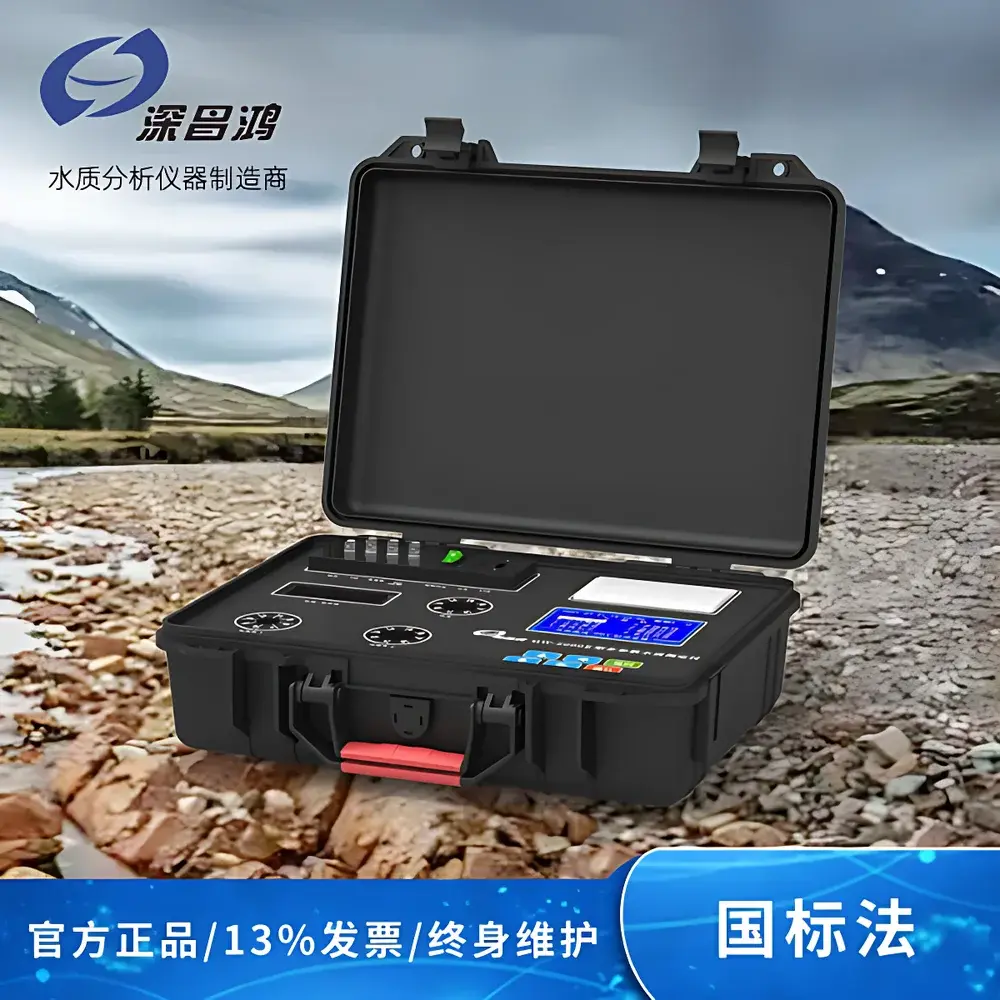
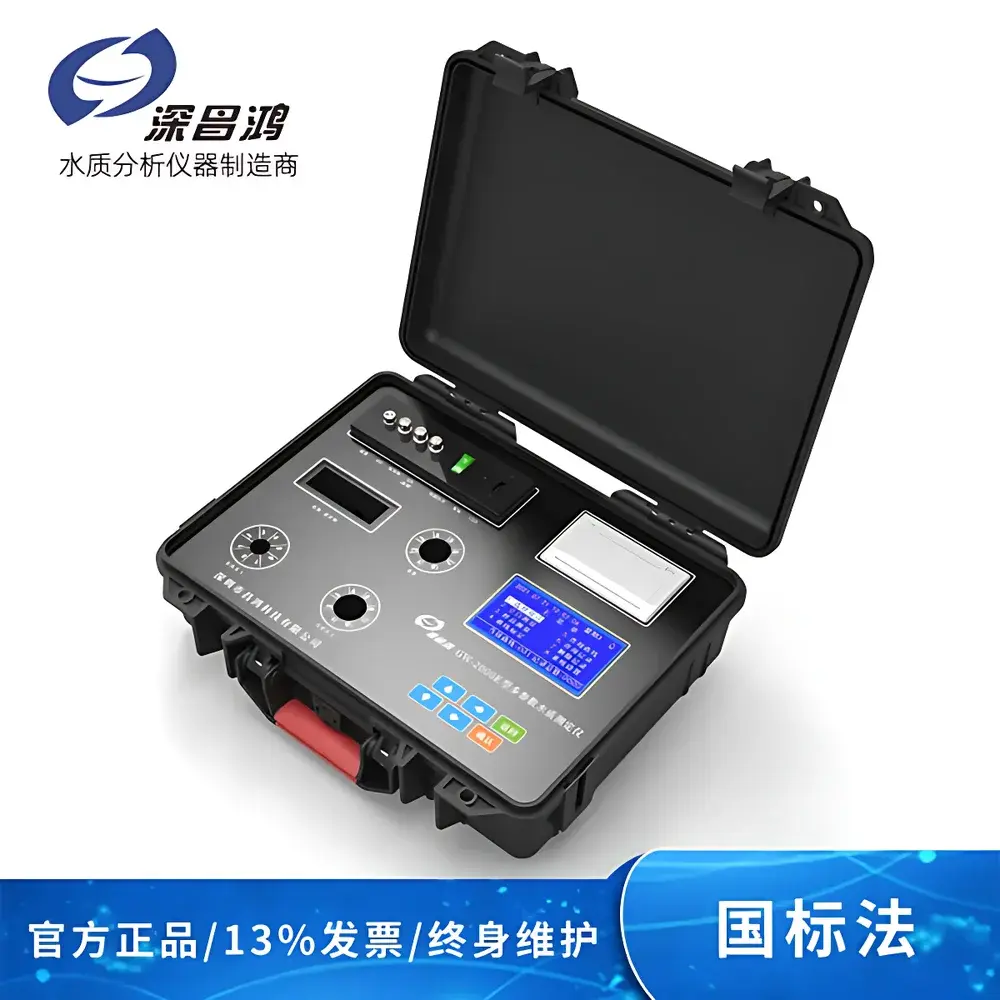
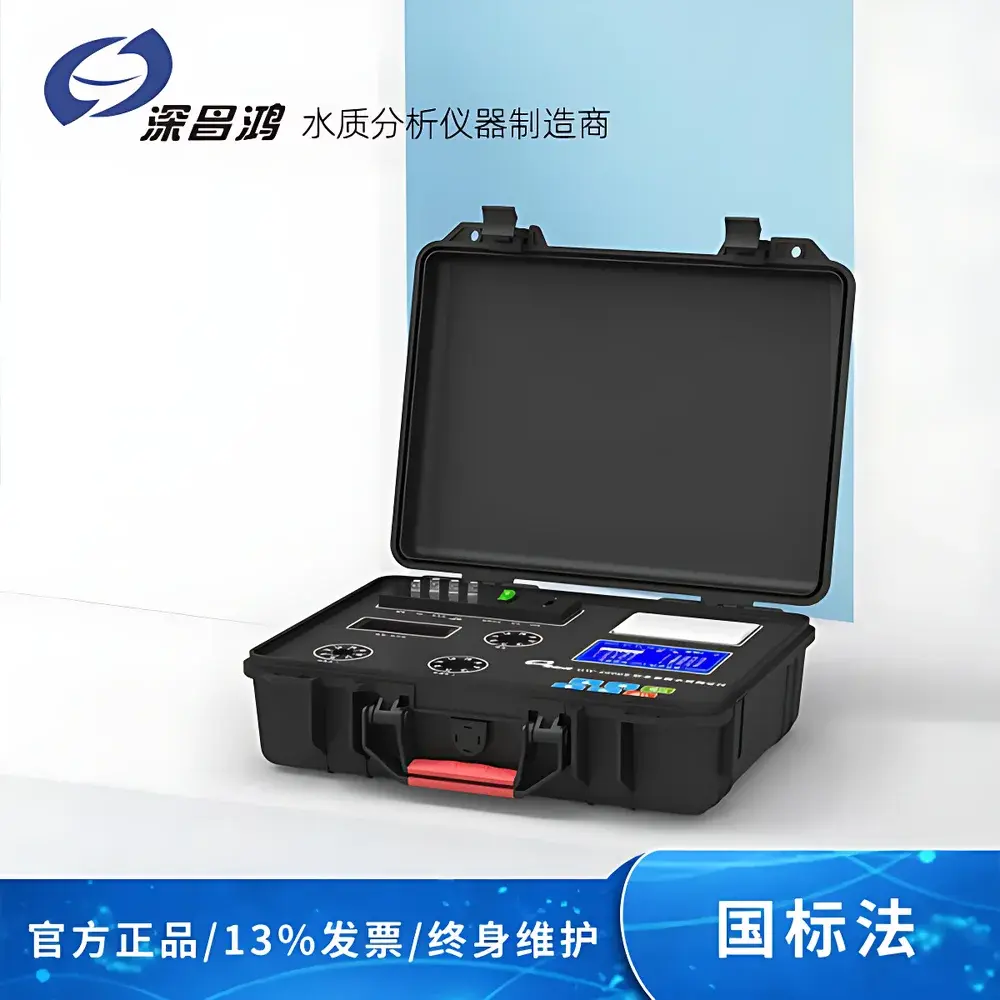
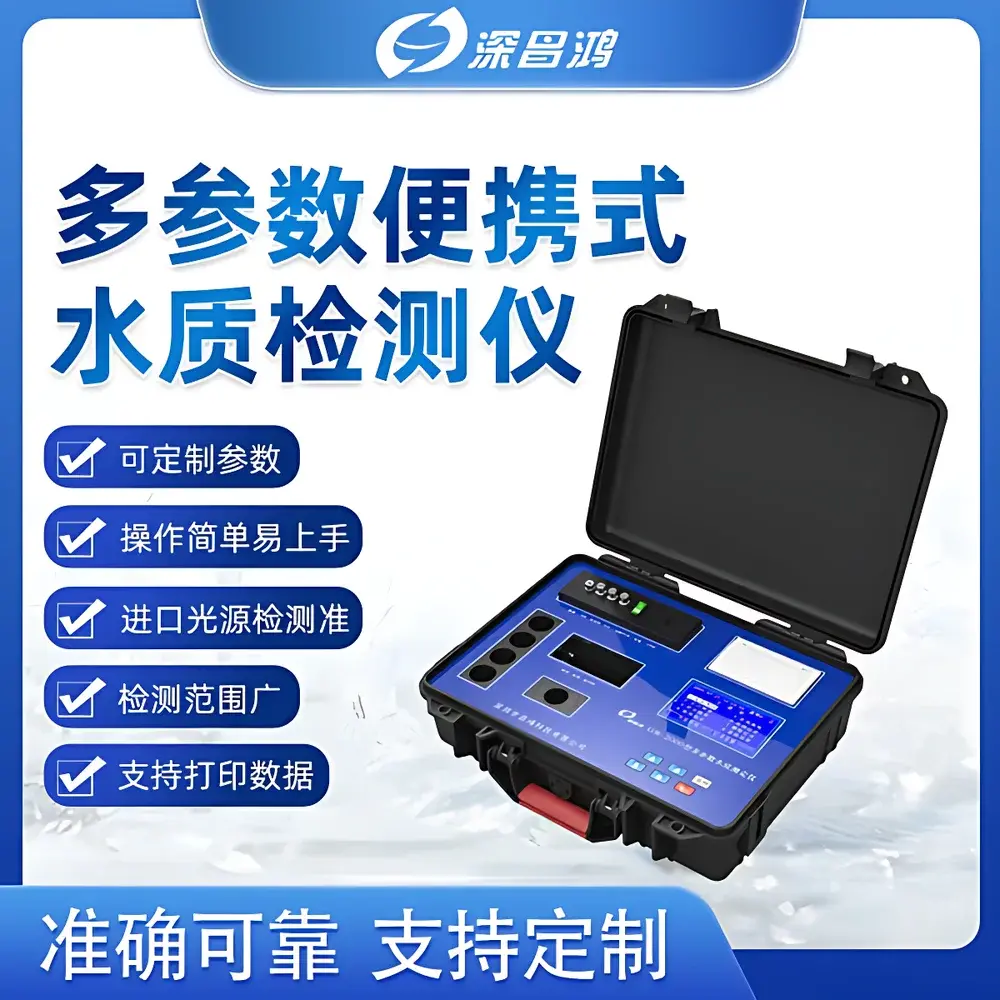
Shenchanghong GW-2000E Portable Multi-Parameter Water Quality Analyzer
| Brand | Shenchanghong |
|---|---|
| Origin | Shenzhen, China |
| Manufacturer Type | Direct Manufacturer |
| Product Category | Domestic |
| Model | GW-2000E |
| Instrument Type | Portable/Handheld Water Quality Analyzer |
| Measurable Parameters | COD, Ammonia Nitrogen, Total Phosphorus, Total Nitrogen, Copper, Iron, Nickel, Hexavalent Chromium, Phosphate, Nitrite, pH, Residual Chlorine, and >80 other water quality parameters |
| Wavelength Options | 340, 420, 440, 470, 520, 540, 560, 610, 630, 660, 680, 700 nm (customizable within range) |
| Absorbance Range | −2.000 to +2.000 A |
| Absorbance Accuracy | ±0.005 A |
| Repeatability | ≤3% |
| Optical Drift | <0.002 A over 20 min |
| Measurement Modes | Concentration, Absorbance, Transmittance |
| Cuvette Compatibility | Ø16 mm and Ø25 mm |
| Dimensions | 410 × 300 × 130 mm |
| Weight | 4 kg |
| Power Consumption | <10 W |
| Power Supply | Rechargeable Li-ion battery |
| Data Storage | 300 calibration curves + 1000 tagged measurement records (with timestamp & parameter ID) |
| Interface | USB port for PC data export |
| Compliance | Designed to support ASTM D1253, ISO 7027, ISO 6060, ISO 6223, EPA 4500-NO₂⁻ B, EPA 4500-NH₃ F, APHA 4500-P E, and GB/T 5750 series methods |
Overview
The Shenchanghong GW-2000E Portable Multi-Parameter Water Quality Analyzer is an integrated field-deployable instrument engineered for simultaneous quantitative analysis of over 80 physicochemical and contaminant parameters in freshwater, wastewater, drinking water, and environmental surface samples. It combines three complementary analytical modalities—electrochemical sensing (for pH, conductivity, and dissolved oxygen), nephelometric/turbidimetric detection (for turbidity via dual-path 90° scatter + transmission), and spectrophotometric quantification (via fixed-wavelength cold-light LED sources and narrow-band interference filters)—within a single ruggedized handheld platform. Its optical architecture eliminates thermal drift and lamp aging artifacts common in tungsten-based systems, ensuring long-term photometric stability (<0.002 A drift over 20 minutes). The instrument operates on the Beer–Lambert principle for colorimetric assays and adheres to standardized reaction chemistries aligned with APHA, ISO, and EPA methodologies—including dichromate oxidation for COD, indophenol blue for ammonia nitrogen, ascorbic acid reduction for total phosphorus, and alkaline persulfate digestion for total nitrogen. Designed for compliance-critical workflows, it supports traceable calibration, audit-ready data logging, and method-specific validation protocols.
Key Features
- Automated wavelength selection across 12 pre-installed LED channels (340–700 nm), eliminating manual filter changes and reducing operator error.
- Dual-mode sensor integration: electrochemical probes (pH, EC, DO) and optical modules coexist on one interface, enabling concurrent multi-domain measurement without instrument switching.
- High-fidelity photometric system featuring cold-light LEDs and precision interference filters—optimized for low stray light, high signal-to-noise ratio, and minimal spectral crosstalk.
- Onboard calibration management supporting up to 300 user-defined or factory-loaded calibration curves; all curves retain metadata including date, operator ID, reagent lot, and standard concentration.
- Robust data integrity architecture: automatic timestamping, parameter-tagged storage (1000 records), USB export with CSV/Excel-compatible formatting, and optional GLP-compliant audit trail generation.
- Field-optimized ergonomics: lightweight (4 kg), IP65-rated enclosure, rechargeable lithium-ion battery (≥8 h continuous operation), and intuitive LCD interface with multilingual prompt support.
- Fail-safe operational safeguards: power-loss data retention, one-touch factory reset with firmware-protected backup, and real-time diagnostics for optical path contamination or electrode degradation.
Sample Compatibility & Compliance
The GW-2000E accepts standard 16 mm and 25 mm round glass or plastic cuvettes, accommodating both low-volume (10 mL) and high-dilution (50 mL) protocols per APHA Standard Methods. It is validated for use with EPA-approved digestion kits (e.g., Hach TNTplus vials for COD and total nitrogen) and ISO-certified reagent sets for heavy metals (e.g., diphenylcarbazide for Cr⁶⁺, 1,10-phenanthroline for Fe²⁺). Measurement uncertainty complies with ISO/IEC 17025 requirements for in-field testing when used with certified reference materials (CRMs) traceable to NIST or BAM standards. The instrument’s software architecture supports 21 CFR Part 11–compatible electronic signatures and audit logs when deployed in regulated environments (e.g., municipal water utilities, environmental consulting labs, and third-party monitoring contractors). All optical and electrochemical modules undergo factory calibration against primary standards, with certificate-of-conformance documentation supplied per unit.
Software & Data Management
Firmware v3.2+ includes embedded data management tools compliant with ISO 14001 and ISO 9001 documentation requirements. Each stored measurement includes parameter name, wavelength, absorbance value, calculated concentration, calibration curve ID, sampling time/date, GPS coordinates (optional external module), and operator code. USB data export generates timestamped .CSV files compatible with LIMS integration (e.g., LabWare, STARLIMS) and statistical analysis platforms (Minitab, JMP). Optional desktop software provides advanced features: batch calibration verification, outlier detection using Grubbs’ test, QC charting (X-bar/R), and automated report generation in PDF format meeting ISO 17025 clause 7.8.2. Firmware updates are delivered via signed binary packages with SHA-256 hash verification to ensure integrity and prevent unauthorized modification.
Applications
- Regulatory field monitoring: EPA Region 10 NPDES compliance sampling, WHO drinking water safety screening, and EU Bathing Water Directive (2006/7/EC) turbidity & microbiological proxy measurements.
- Municipal infrastructure: real-time effluent verification at WWTP outfalls, distribution system chlorine residual mapping, and source water early-warning for algal toxins (via phosphate/nitrate trend analysis).
- Industrial process control: boiler feedwater hardness tracking, electroplating bath metal ion surveillance (Ni²⁺, Cr⁶⁺, Cu²⁺), and semiconductor fab ultrapure water purity checks (SiO₂, TOC proxies).
- Academic & research use: limnological surveys, sediment porewater profiling, and method development for novel chromogenic assays requiring precise multi-wavelength endpoint detection.
- Emergency response: rapid assessment during chemical spills (e.g., cyanide, phenol, formaldehyde) and post-disaster water safety triage (turbidity, residual chlorine, Fe/Mn).
FAQ
Does the GW-2000E meet EPA or ISO method equivalency requirements for regulatory reporting?
Yes—when operated with validated reagents and CRMs, its COD, ammonia nitrogen, total phosphorus, and turbidity measurements align with EPA Methods 410.4, 350.1, 365.4, and 180.1, respectively, and ISO standards 6060, 7027, and 6223.
Can custom calibration curves be imported from external laboratories?
Yes—curves can be loaded via USB in .CSV format containing wavelength, standard concentrations, and corresponding absorbance values; the instrument validates linearity (R² ≥ 0.995) before acceptance.
Is the instrument suitable for seawater or high-salinity brines?
Conductivity and pH electrodes include salinity compensation; however, colorimetric assays require dilution or matrix-matched calibration due to chloride interference—method notes are embedded per parameter.
What maintenance intervals are recommended for field longevity?
Optical path cleaning every 500 measurements; electrode conditioning weekly; annual factory recalibration recommended; firmware updates issued quarterly for security and compliance alignment.
Does the device support Bluetooth or Wi-Fi connectivity?
Not natively—but USB-C tethering enables real-time data streaming to Android/iOS tablets running the optional Shenchanghong FieldLink app (v2.1+), supporting geotagged photo capture and cloud sync to secure AWS-hosted portals.
Related Products







