
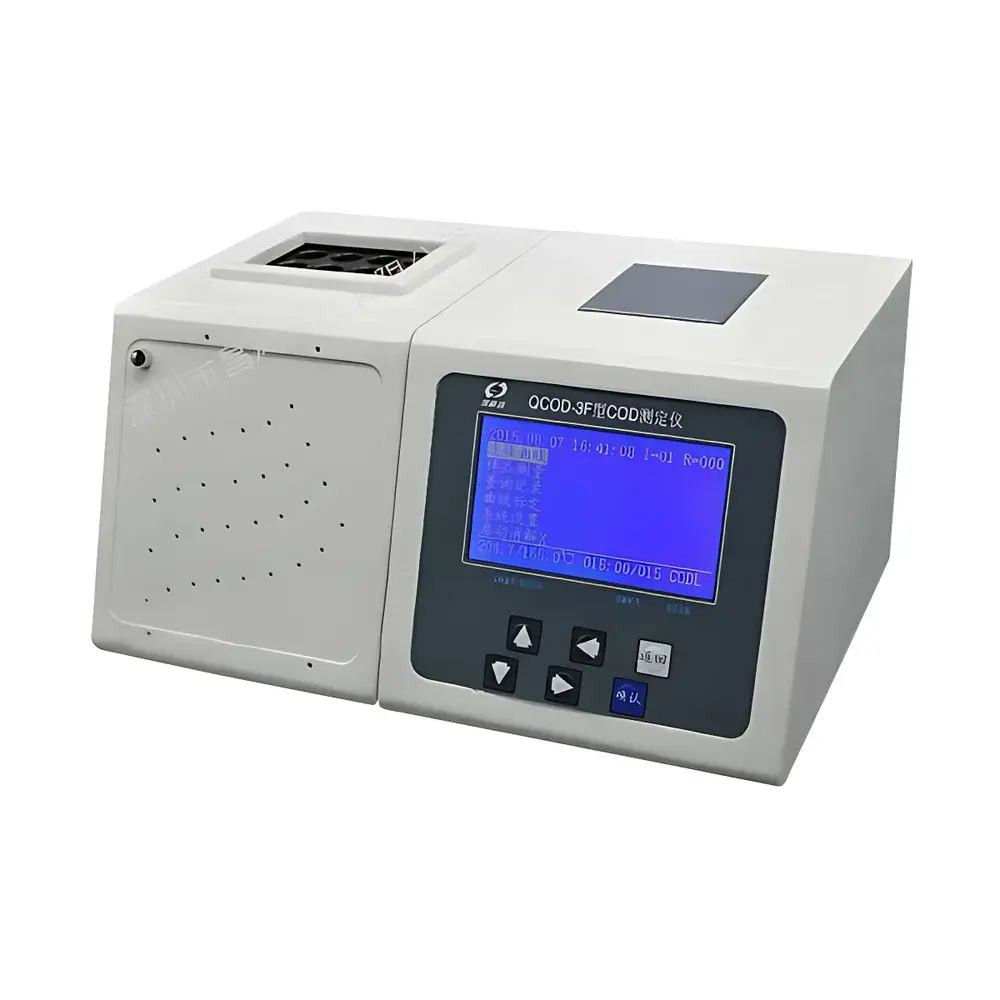
Shenchanghong QCOD-3F Economic Chemical Oxygen Demand (COD) Analyzer
| Brand | Shenchanghong |
|---|---|
| Origin | Guangdong, China |
| Manufacturer Type | Direct Manufacturer |
| Instrument Type | Benchtop Laboratory Analyzer |
| Measurement Principle | Potassium Dichromate Digestion Method (Sealed Reflux) |
| Wavelength | 610 nm |
| Measurement Range | 5–2000 mg/L (dilution applicable for higher concentrations) |
| Accuracy | ≤ ±8 % |
| Repeatability | ≤ 3 % |
| Detection Limit | 0.1 mg/L |
| Digestion Time | 15 min |
| Total Analysis Time | 20 min |
| Batch Capacity | 12 samples per run |
| Temperature Control Range | Ambient to 200 °C (default digestion setpoint: 165 °C) |
| Temperature Accuracy | ±0.5 °C |
| Timer Range | 1–999 min |
| Optical Drift | < 0.002 A within 20 min |
| Dimensions (Analyzer) | 240 × 205 × 170 mm |
| Dimensions (Digestion Unit) | 240 × 107 × 170 mm |
| Weight (Analyzer) | 3 kg |
| Weight (Digestion Unit) | 4 kg |
| Power Consumption | < 500 W |
| Operating Environment | 5–40 °C, RH ≤ 85 %, AC 220 V ±10 %, 50 Hz ±0.5 Hz |
Overview
The Shenchanghong QCOD-3F Economic Chemical Oxygen Demand (COD) Analyzer is a benchtop laboratory instrument engineered for precise, reproducible quantification of chemical oxygen demand in aqueous samples using the standardized potassium dichromate sealed-reflux digestion method. COD serves as a critical indicator of organic pollution load in wastewater, surface water, and effluent streams—making this analyzer indispensable for environmental monitoring laboratories, municipal wastewater treatment plants, and industrial discharge compliance testing. The system operates on a two-unit architecture: a dedicated digestion module and an independent photometric measurement unit. This physical separation eliminates thermal cross-interference, ensuring long-term optical stability during repeated analyses. Digestion occurs under controlled, pressurized conditions at 165 °C for 15 minutes—adhering closely to the procedural framework outlined in ISO 6060 and EPA Method 410.1. Following digestion, the sample is cooled and subjected to spectrophotometric analysis at 610 nm using a cold LED light source and narrow-band interference filters. A built-in microprocessor performs automatic calibration, background correction, and direct concentration calculation, displaying results in mg/L COD without manual interpolation.
Key Features
- Modular design with physically separated digestion and measurement units to preserve photometric integrity and extend optical system lifetime.
- Cold LED light source coupled with narrow-band interference optics ensures minimal thermal drift and high wavelength specificity at 610 nm.
- PID-controlled digital heating block with ±0.5 °C temperature accuracy and adjustable timer (1–999 min), enabling method flexibility beyond standard COD protocols—including applications requiring alternative digestion temperatures or durations.
- Integrated LCD display with Chinese-language interface supports intuitive navigation, real-time status feedback, and on-device data review.
- No tube transfer required between digestion and measurement—samples remain in the same vial throughout the workflow, minimizing contamination risk and operator error.
- Data storage capacity includes up to 20 user-defined calibration curves and 400 individual measurement records, retained through power interruption via non-volatile memory.
- Robust mechanical construction and low-power (<500 W) operation support continuous use in resource-constrained lab environments.
Sample Compatibility & Compliance
The QCOD-3F is validated for use with raw sewage, treated effluent, surface water, and industrial process water. Its chloride tolerance of up to 2000 mg/L enables reliable analysis of moderately saline or chlorinated wastewaters without pre-treatment. While not certified for regulatory submission under U.S. EPA or EU Water Framework Directive (WFD) reporting requirements, the instrument implements core methodological elements aligned with ISO 6060:1989 (Water quality — Determination of chemical oxygen demand) and ASTM D1252-06 (Standard Test Methods for Chemical Oxygen Demand). Laboratories operating under GLP or internal QA/QC frameworks may incorporate the QCOD-3F into routine monitoring workflows when paired with documented calibration verification, reagent lot traceability, and analyst training records. It is not compliant with FDA 21 CFR Part 11 due to absence of electronic signature and audit trail functionality.
Software & Data Management
The QCOD-3F operates independently of external computers and does not include proprietary PC software or USB/Bluetooth connectivity. All data handling is performed onboard: calibration curves are stored in EEPROM; measurement results include date/time stamps and associated curve ID. Users may export data manually by recording values from the LCD screen or interfacing with optional RS-232 output (if equipped per custom order). For laboratories requiring structured data archiving, integration with LIMS is achievable only via manual entry or third-party OCR-based capture solutions. No automated report generation, trend analysis, or multi-user access control is supported.
Applications
- Routine COD screening in municipal wastewater treatment plant influent, effluent, and sludge dewatering streams.
- Process control monitoring for electroplating, food processing, textile dyeing, and pharmaceutical manufacturing facilities.
- Environmental field lab support for rapid assessment of river, lake, and reservoir water quality during seasonal surveys.
- Educational use in university environmental engineering and analytical chemistry laboratories for teaching standardized oxidation-reduction titrimetric and spectrophotometric principles.
- Pre-compliance testing prior to formal certification using reference-grade instruments such as Hach DR3900 or Lovibond MD600.
FAQ
Does the QCOD-3F meet EPA-approved method requirements for regulatory reporting?
No. It implements the potassium dichromate digestion principle but lacks method-specific validation documentation, third-party certification, and electronic audit trail features required for official EPA or ISO/IEC 17025-accredited reporting.
Can the instrument measure samples with chloride concentrations above 2000 mg/L?
Not directly. Samples exceeding 2000 mg/L chloride require dilution or pretreatment with mercury sulfate to suppress interference—procedures not automated by the QCOD-3F and must be performed manually per ISO 6060 Annex A.
Is the digestion temperature fixed or adjustable?
Fully adjustable from ambient to 200 °C in 1 °C increments, with default factory setting at 165 °C to align with standard COD methodology.
What is the recommended maintenance schedule for optical components?
The cold LED and interference filter require no routine replacement; however, periodic cleaning of the cuvette compartment and optical path with lint-free tissue and isopropanol is advised every 100 measurements or weekly, whichever occurs first.
How is calibration verified between standard curve updates?
Users should run a mid-range certified reference material (CRM) daily or per batch. Acceptable recovery must fall within ±10% of certified value to confirm ongoing instrument performance.
Related Products







