
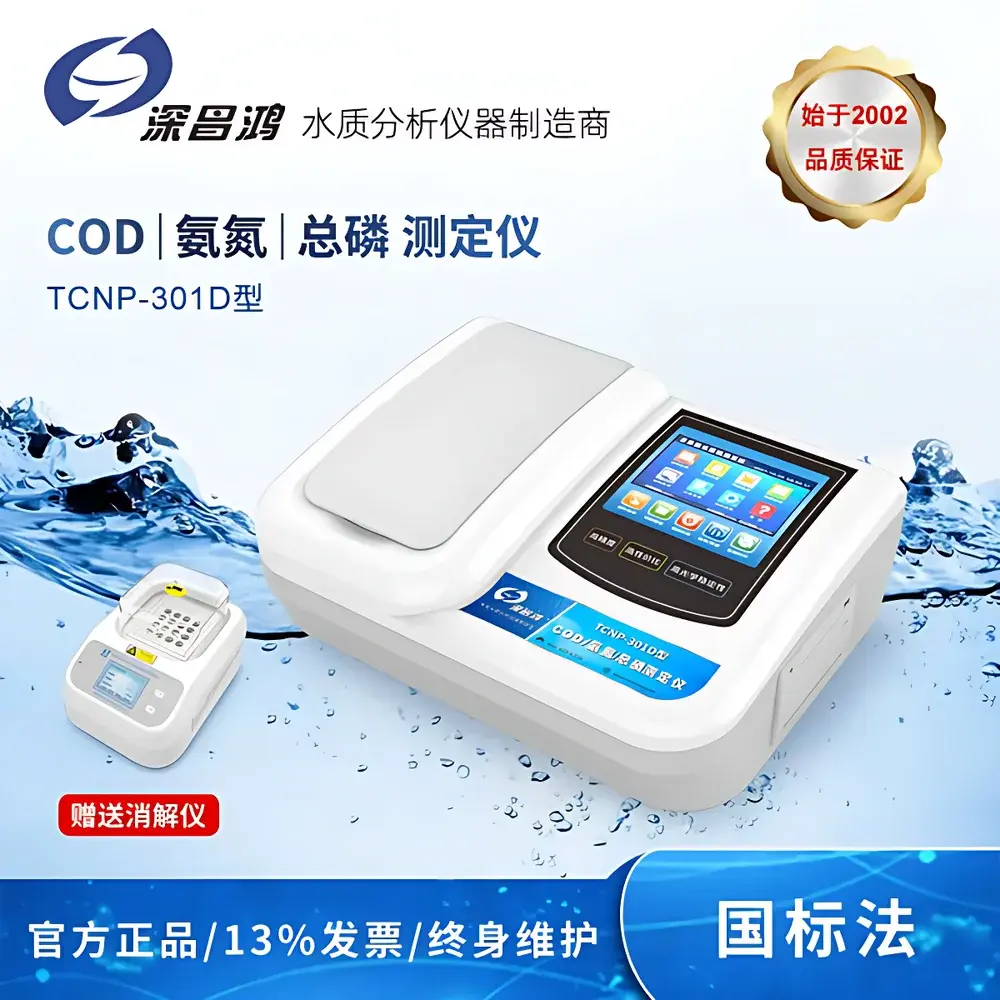
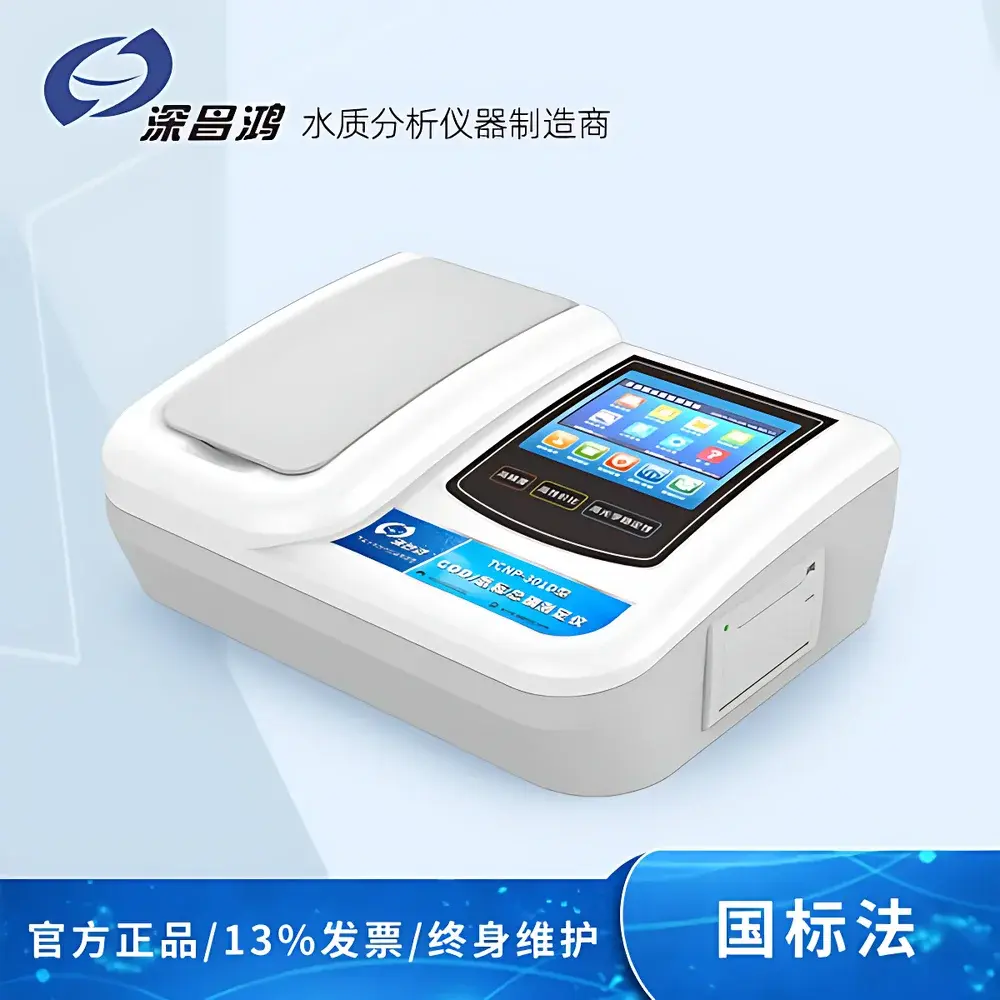
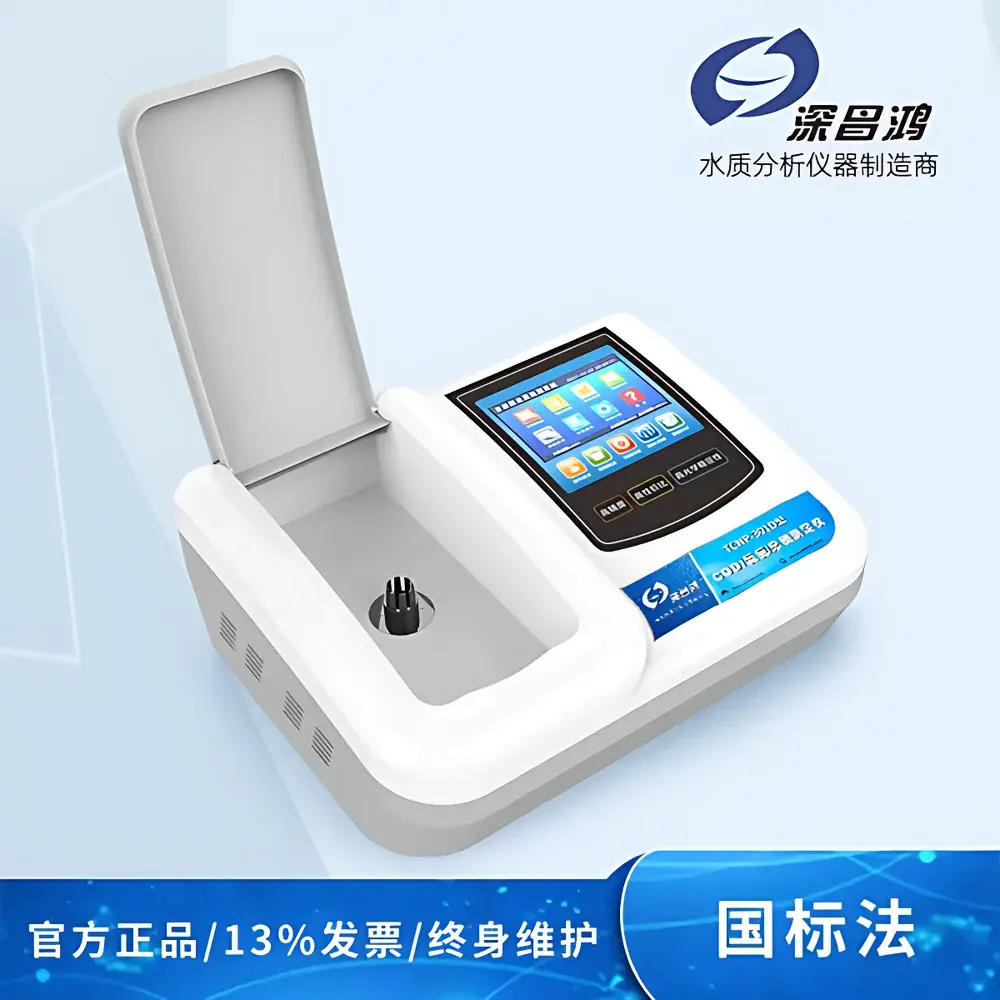
Shenchanghong TCNP-301D COD/Ammonia-N/Total Phosphorus Multiparameter Photometer
| Brand | Shenchanghong |
|---|---|
| Origin | Guangdong, China |
| Manufacturer Type | Direct Manufacturer |
| Product Category | Domestic |
| Model | TCNP-301D |
| Instrument Type | Laboratory Benchtop Analyzer |
| Measurement Principle | Rapid Digestion–Spectrophotometric Method (Colorimetric) |
| Wavelength Range | 420 nm, 610 nm, 700 nm (pre-configured for COD, NH₃-N, and TP) |
| Measurement Ranges | COD: 5–2000 mg/L (extendable to 20,000 mg/L) |
| Ammonia-N | 0.02–25 mg/L |
| Total Phosphorus | 0.00–20 mg/L |
| Accuracy | COD: ≤ ±5% FS |
| Ammonia-N | ≤ ±3% FS |
| Total Phosphorus | ≤ ±5% FS |
| Repeatability | ≤ 3% RSD |
| Detection Limit | 0.2 mg/L (COD) |
| Analysis Time | COD: 15 min |
| Total Phosphorus | 30 min |
| Batch Capacity | 16 samples (optional 20/25/36-position digestion blocks) |
| Digestion Temperature | 120–165 °C (adjustable) |
| Temperature Control Accuracy | ≤ ±1.0 °C |
| Optical Stability | ≤ 0.002 A / 20 min |
| Data Storage | 100,000 records (including parameter name, concentration, unit, timestamp, operator ID) |
| Display | 7-inch color TFT touchscreen with bilingual (Chinese/English) UI |
| Connectivity | USB port for data export and PC software integration |
| Power Supply | AC 220 V ±10%, 50 Hz |
Overview
The Shenchanghong TCNP-301D is a laboratory-grade multiparameter photometer engineered for simultaneous, standardized quantification of Chemical Oxygen Demand (COD), Ammonia-Nitrogen (NH₃-N), and Total Phosphorus (TP) in aqueous environmental samples. It operates on the principle of rapid thermal digestion followed by spectrophotometric detection using narrow-band interference filters and cold-light LED sources—ensuring high optical stability, minimal spectral drift, and compliance with internationally recognized colorimetric protocols including ISO 6060 (COD), ISO 7150-1 (ammonia), and ISO 6878 (total phosphorus). Unlike integrated digestor-photometer systems, the TCNP-301D employs a physically decoupled architecture: the photometric analyzer and the dedicated DIS-series digestion unit operate independently. This design eliminates thermal cross-talk, preserves baseline photometric integrity during extended batch runs, and supports method flexibility across regulatory-compliant digestion protocols (e.g., EPA 410.4, HJ 828–2017, HJ 535–2009, HJ 671–2013).
Key Features
- Modular dual-unit configuration: Photometer and digestion module are electrically and thermally isolated to guarantee long-term optical stability and measurement reproducibility.
- Cold-light LED optical system with 16-step adjustable light intensity calibration—enables dynamic range optimization without hardware modification and mitigates signal saturation at high concentrations.
- Pre-programmed wavelength channels at 420 nm (COD), 610 nm (NH₃-N), and 700 nm (TP), aligned with standard APHA/EPA absorption maxima for respective chromophores.
- Bilingual (Chinese/English) 7-inch capacitive touchscreen interface with context-sensitive operation guides, real-time status feedback, and embedded help modules for field technicians and lab personnel.
- Comprehensive curve management: Stores up to 250 factory-calibrated curves and 3,500 user-defined curves; each curve retains full metadata—including standard reference values, corresponding absorbance readings, calibration date, and operator ID—for full traceability.
- Dual-layer thermal safety in the digestion module: Active temperature monitoring with automatic power cutoff at ≥200 °C, plus programmable auto-shutdown post-digestion to prevent overheating and reagent degradation.
- Multi-point non-linear temperature calibration eliminates systematic offset errors inherent in low-cost thermistor-based digestors—achieving zero-error setpoint accuracy across the full 120–165 °C operating range.
- One-touch system recovery function restores factory defaults and user curve libraries in case of accidental data corruption or firmware interruption.
Sample Compatibility & Compliance
The TCNP-301D is validated for use with raw and treated wastewater, surface water, groundwater, and industrial effluents. Its digestion protocol accommodates chloride interference up to 2000 mg/L (COD mode), meeting the robustness requirements of ISO 15705 and HJ 828–2017. All measurement routines adhere to GLP-aligned data integrity standards: timestamps, operator IDs, and calibration history are immutably logged. The instrument supports audit-ready recordkeeping compatible with internal QA/QC workflows and external regulatory review. While not pre-certified for FDA 21 CFR Part 11, its structured data export (CSV via USB), deterministic calibration logging, and tamper-evident storage architecture provide foundational elements for laboratory validation under ISO/IEC 17025 and CNAS accreditation frameworks.
Software & Data Management
Data acquisition and reporting are supported via bundled Windows-compatible software distributed on included optical media. The application enables batch import/export of measurement records, graphical trend analysis, calibration curve visualization, and PDF report generation with customizable headers (lab name, analyst ID, QA stamp fields). All stored entries include mandatory metadata: parameter name, numeric result, unit, detection limit flag, digestion temperature/time, and unique operator code. USB connectivity permits direct transfer of raw datasets to LIMS environments. No cloud dependency or subscription model is involved—the system operates fully offline, preserving data sovereignty and simplifying IT security compliance in regulated laboratories.
Applications
- Environmental monitoring labs performing routine compliance testing against national discharge limits (e.g., China’s GB 8978–1996, EU Urban Wastewater Treatment Directive).
- Water treatment plants conducting process control checks on influent, effluent, and tertiary treatment streams.
- Research institutions evaluating nutrient removal efficiency in pilot-scale biological reactors or constructed wetlands.
- Educational laboratories teaching standard methods for water quality parameter quantification in environmental engineering curricula.
- Third-party testing organizations requiring traceable, repeatable, and auditable results for certification reports.
FAQ
Is the TCNP-301D compliant with U.S. EPA methods?
It implements digestion and detection principles consistent with EPA Methods 410.4 (COD), 350.1 (ammonia), and 365.4 (phosphorus), though formal EPA approval requires site-specific method validation per 40 CFR Part 136.
Can the instrument be calibrated using NIST-traceable standards?
Yes—calibration is performed using certified reference materials (CRMs) traceable to NIST or GBW national standards; all curve metadata includes CRM lot numbers and expiration dates.
What is the maximum allowable chloride concentration for COD measurement?
The instrument supports COD determination in samples containing up to 2000 mg/L chloride without pretreatment, as verified per HJ 828–2017 Annex B.
Does the system support automated QC checks such as blanks, spikes, and duplicates?
Manual entry of QC sample types is supported in the data log; however, automated scheduling or pass/fail flagging requires integration with external LIMS or custom scripting via exported CSV files.
How is firmware updated?
Firmware updates are delivered via USB drive using signed binary packages; no internet connection is required, ensuring secure deployment in air-gapped laboratory networks.
Related Products







