
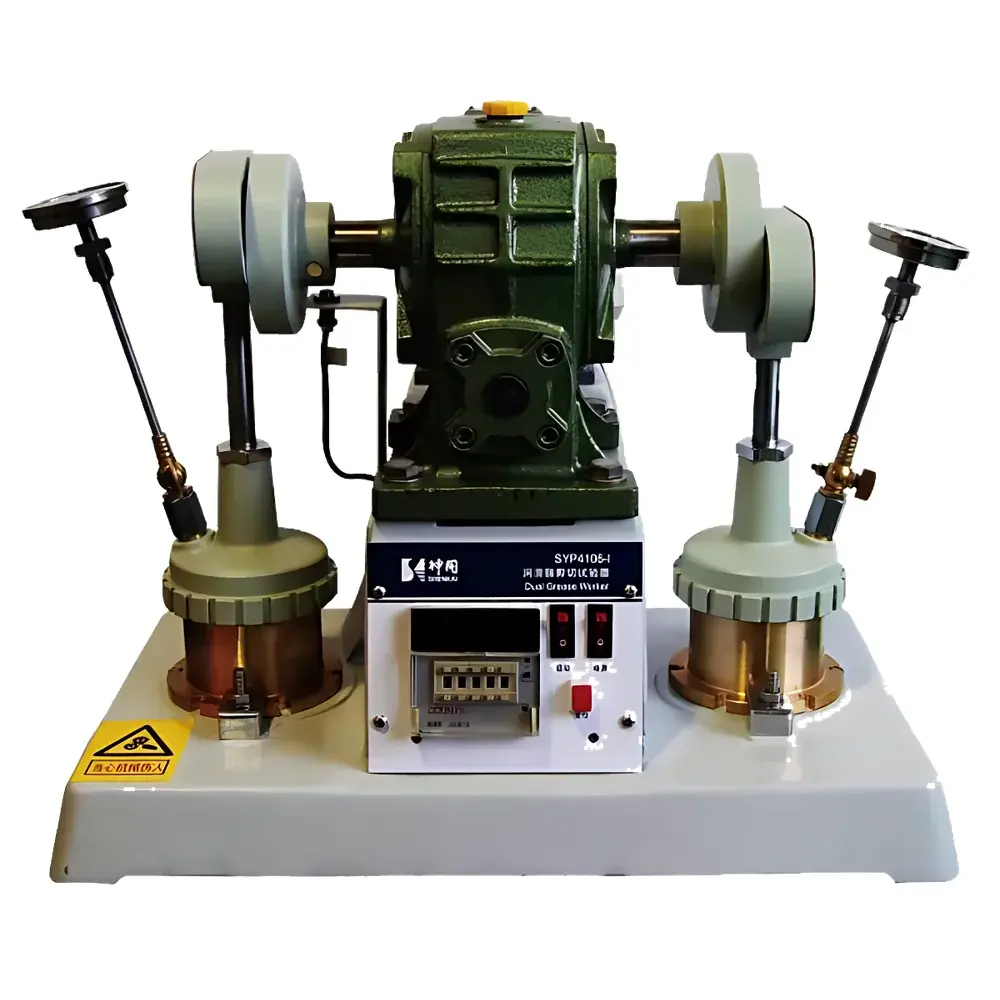
Shenkai SYP4106-I Grease Shear Stability Tester
| Brand | Shenkai |
|---|---|
| Origin | Shanghai, China |
| Model | SYP4106-I |
| Motor | Horizontal single-phase capacitor-start motor, 220 V AC, 50 Hz, 370 W, 1400 rpm |
| Shear Rate | 60 cycles/min |
| Stroke | 67–71 mm |
| Orifice Diameter on Plate | Ø6.35 mm (+0.13/−0.00 mm) |
| Temperature Range | 0–50 °C (bimetallic thermometer, 0.5 °C graduation) |
| Max Counter Capacity | 99999 |
| Power Supply | AC 220 V, 50 Hz |
| Compliance | GB/T 269 |
Overview
The Shenkai SYP4106-I Grease Shear Stability Tester is a precision-engineered laboratory instrument designed to evaluate the mechanical stability of lubricating greases under controlled shear conditions. It operates in strict accordance with GB/T 269—China’s national standard equivalent to ASTM D217 and ISO 2137 for grease cone penetration testing. The instrument subjects grease samples to repetitive mechanical shearing via a calibrated reciprocating mechanism, simulating real-world service conditions such as those encountered in rolling bearings or centralized lubrication systems. By quantifying changes in worked consistency—expressed as the difference between initial and extended working cone penetration (reported in units of 0.1 mm)—the tester provides a direct measure of grease shear resistance and structural recovery behavior. This data is essential for formulating high-performance greases, validating batch-to-batch reproducibility, and supporting failure analysis in industrial maintenance programs.
Key Features
- Motor-driven shear mechanism using a horizontal single-phase capacitor-start motor (370 W, 1400 rpm) coupled to a dual-output worm gear reducer (25:1 ratio), ensuring stable torque delivery and long-term operational reliability.
- Precisely engineered eccentric cam assembly delivering consistent 60-cycle-per-minute shear frequency, with stroke length maintained between 67 mm and 71 mm per cycle to meet GB/T 269 repeatability requirements.
- Standardized grease worker configuration featuring a perforated plate with six precisely machined orifices (Ø6.35+0.13−0.00 mm), aligned to reproduce the geometry and flow dynamics specified in the standard method.
- Integrated digital counter with 99,999-cycle capacity and real-time display, enabling unattended operation during extended shear sequences (e.g., 10,000 or 100,000 strokes for severe-duty evaluation).
- Built-in bimetallic thermometer (0–50 °C range, 0.5 °C graduation) mounted adjacent to the working chamber to monitor ambient thermal conditions during test execution—critical for minimizing temperature-induced viscosity drift.
- Compact, self-contained benchtop architecture with rigid baseplate and vibration-damped housing, minimizing external interference and ensuring measurement integrity across repeated trials.
Sample Compatibility & Compliance
The SYP4106-I accommodates standard NLGI-grade lubricating greases—including lithium, calcium, aluminum complex, polyurea, and clay-thickened formulations—in accordance with ASTM D217, ISO 2137, and GB/T 269. Sample volume requirements align with standard cone penetration cups (typically 120–150 g). The instrument supports three primary test modes: (1) standard working penetration (60 strokes), (2) extended working penetration (10,000 or 100,000 strokes), and (3) pre-shearing preparation for oxidation stability tests (e.g., ASTM D942 or GB/T 12709). All mechanical components are constructed from corrosion-resistant stainless steel and anodized aluminum to prevent grease adhesion and facilitate cleaning between samples. The design conforms to general laboratory safety standards for Class I electrical equipment (IEC 61010-1) and supports GLP-compliant documentation when paired with validated manual recording protocols.
Software & Data Management
The SYP4106-I is a standalone electromechanical instrument without embedded firmware or network connectivity. Data acquisition relies on external cone penetration testers (e.g., digital penetrometers compliant with ASTM D217 Annex A2) and manual logbook entries or LIMS-integrated spreadsheets. Users may implement traceable workflows by pairing the shear unit with time-stamped calibration certificates (motor speed verification, stroke length validation, thermometer calibration), all of which satisfy internal QA requirements and prepare laboratories for regulatory audits under CNAS-CL01 (equivalent to ISO/IEC 17025). While no proprietary software is supplied, the instrument’s deterministic mechanical operation ensures high inter-laboratory reproducibility when combined with standardized operator training and documented SOPs.
Applications
- Quality control of finished grease products prior to release, verifying conformance to NLGI grade specifications and shear stability thresholds.
- R&D evaluation of thickener systems, base oil blends, and additive packages—particularly for high-shear environments like electric vehicle axle joints or wind turbine pitch bearings.
- Root-cause analysis of grease softening or hardening observed in field failures, correlating lab shear data with rheological profiling (e.g., oscillatory amplitude sweeps) and microstructural imaging (e.g., cryo-SEM).
- Pre-conditioning step for oxidative aging studies, where controlled shear history directly influences subsequent oxidation kinetics and deposit formation behavior.
- Supporting technical documentation for OEM lubricant approvals, including submission packages for automotive (e.g., GM 6277M, Ford WSS-M2C949-A) and industrial equipment manufacturers.
FAQ
What standard methods does the SYP4106-I support?
It is fully compliant with GB/T 269, and functionally equivalent to ASTM D217 and ISO 2137 for working and extended working cone penetration testing.
Can it be used for non-NLGI greases, such as organosilicon or fluorinated formulations?
Yes—provided sample volume, consistency, and thermal stability fall within the operational envelope defined by the standard; however, method validation is required for non-traditional chemistries.
Is periodic calibration required for the shear mechanism?
Yes—motor speed, stroke length, and counter accuracy should be verified at least annually or per internal QA schedule using traceable metrology tools.
Does the instrument include a built-in penetrometer?
No—the SYP4106-I performs only the shear conditioning step; cone penetration measurements must be conducted separately using a certified penetrometer.
What maintenance is recommended for long-term reliability?
Lubrication of the worm gear reducer every 500 hours of operation, inspection of eccentric cam wear annually, and routine cleaning of the grease worker chamber after each sample series.






