
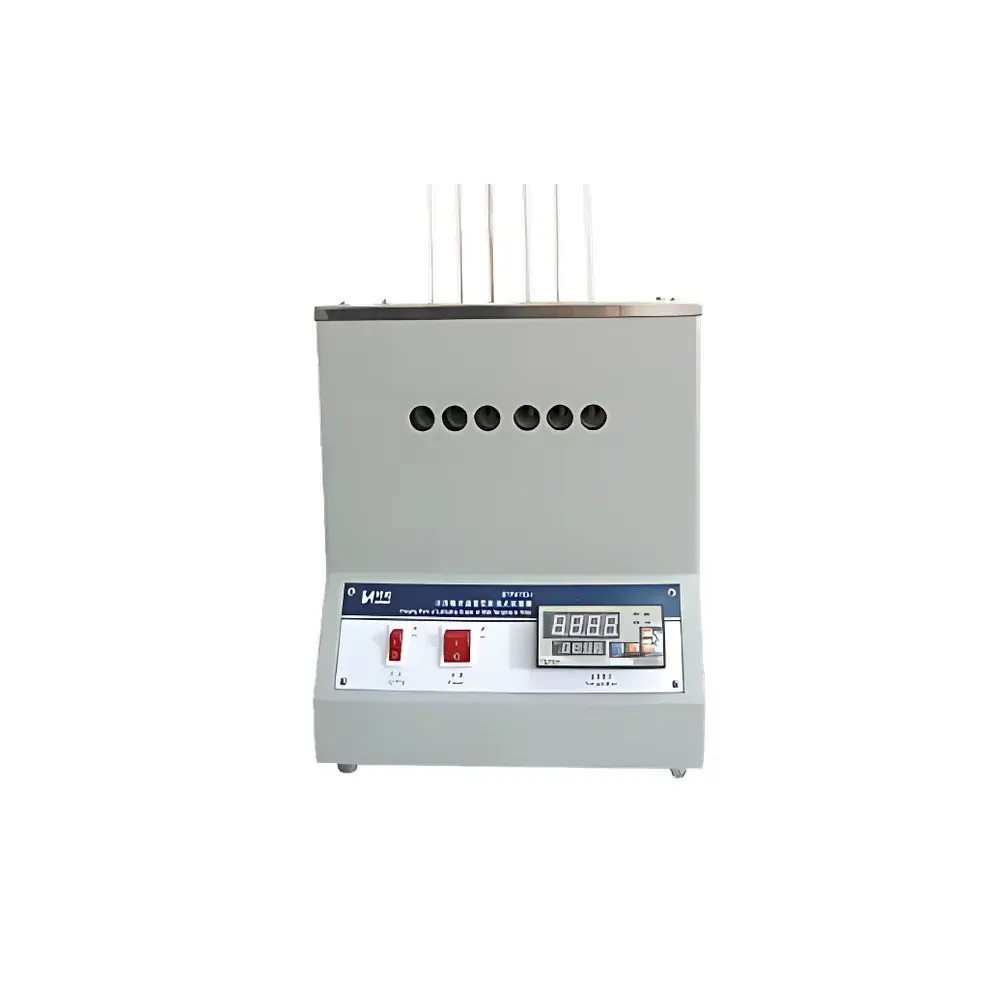
Shenkai SYP4110-I Wide-Temperature-Range Grease Dropping Point Tester
| Brand | Shenkai |
|---|---|
| Origin | Shanghai, China |
| Model | SYP4110-I |
| Heating Method | Aluminum Block Furnace (Alloy Cast Aluminum) |
| Heating Power | 700 W or 750 W |
| Sample Capacity | 6 Test Cavities |
| Grease Cup | Chrome-Plated Brass, Compliant with GB/T 3498 |
| Test Tube | Edge-Rimmed Thin-Walled Soft Glass, Compliant with GB/T 3498 |
| Cup Holder | Heat-Resistant Hard Glass |
| Temperature Sensor | Liquid-in-Glass Thermometer per GB/T 514, Range: −5 to 400 °C, Graduation: 1 °C |
| Standards Compliance | GB/T 3498, ASTM D2265 |
| Application | Laboratory-Scale Dropping Point Determination of Lubricating Greases |
Overview
The Shenkai SYP4110-I Wide-Temperature-Range Grease Dropping Point Tester is a precision laboratory instrument engineered for the standardized determination of the dropping point of lubricating greases — defined as the temperature at which a grease specimen transitions from a semi-solid to a fluid state under prescribed thermal and gravitational conditions. Based on the fundamental principle of controlled conductive heating and visual endpoint detection, the instrument employs an alloy cast aluminum block furnace to ensure uniform thermal distribution across multiple test positions. This design directly supports reproducible thermal ramping and minimizes axial and radial temperature gradients — critical factors influencing measurement accuracy in ASTM D2265 and GB/T 3498 protocols. Unlike open-flame or oil-bath systems, the aluminum block architecture provides rapid thermal response, stable equilibrium, and inherent resistance to oxidation and contamination, making it suitable for routine QC laboratories operating under ISO/IEC 17025 or internal GLP frameworks.
Key Features
- Six independent test cavities enable parallel analysis of up to six grease samples per cycle, improving throughput without compromising inter-cavity temperature uniformity (±1.5 °C max deviation at 250 °C, per internal validation).
- High-efficiency aluminum block furnace (700 W or 750 W nominal power) ensures rapid heat-up and precise steady-state control; block material composition optimizes thermal conductivity while maintaining structural integrity over repeated thermal cycling.
- Digital temperature display with real-time readout allows user-defined setpoint programming and continuous monitoring — essential for method adherence and audit-ready documentation.
- Standard-compliant components: chrome-plated brass grease cups and edge-rimmed thin-walled soft glass tubes conform strictly to dimensional and material specifications in GB/T 3498 and ASTM D2265.
- Heat-resistant hard glass cup holders provide mechanical stability and optical clarity during observation, facilitating unambiguous endpoint identification (first drop falling from cup rim).
- Integrated thermometer mounting system accommodates standard GB/T 514 thermometers (−5 to 400 °C, 1 °C graduation), ensuring traceable calibration against NIST-traceable references.
Sample Compatibility & Compliance
The SYP4110-I is validated for use with conventional and specialty lubricating greases including lithium-, calcium-, aluminum-, polyurea-, and clay-thickened formulations. It supports both non-melting (e.g., silica-gelled) and melting-type greases within the operational range of −5 °C to 400 °C. The instrument fulfills mandatory requirements of GB/T 3498 (Chinese National Standard) and ASTM D2265 (Standard Test Method for Dropping Point of Lubricating Grease), and its mechanical and thermal design aligns with ISO 6743-9 (Lubricants, Industrial Oils and Related Products — Classification — Part 9: Family X (Greases)). While not inherently 21 CFR Part 11 compliant (as it lacks electronic data capture), its analog operation and physical record generation support paper-based GLP/GMP workflows where manual entry into LIMS or ELN systems is standard practice.
Software & Data Management
The SYP4110-I operates as a standalone benchtop instrument with no embedded firmware or digital data logging capability. Temperature is monitored visually via calibrated liquid-in-glass thermometer and recorded manually. Laboratories integrating this unit into regulated environments typically pair it with validated electronic lab notebooks (ELNs) or LIMS platforms for structured data entry, signature capture, and audit trail generation. All physical records — including test logs, calibration certificates for thermometers, and maintenance logs — must be retained per organizational SOPs aligned with ISO/IEC 17025 clause 7.5 (Technical Records) and FDA guidance on data integrity (ALCOA+ principles).
Applications
- Quality control release testing of incoming raw materials and finished grease products in manufacturing facilities.
- Formulation development support for R&D teams evaluating thickener performance and thermal stability limits.
- Comparative thermal behavior assessment across grease families (e.g., NLGI grade correlation with dropping point trends).
- Failure analysis investigations involving grease degradation, overheating events, or incompatibility-induced softening.
- Educational laboratories teaching ASTM/GB standard methods in tribology, petrochemical analysis, and materials science curricula.
FAQ
What standards does the SYP4110-I comply with?
It is designed and verified for full conformance with GB/T 3498 and ASTM D2265.
Can the instrument be used for low-drop-point greases below 0 °C?
Yes — the integrated thermometer covers −5 °C, and the aluminum block’s thermal inertia allows stable control near sub-zero endpoints when paired with appropriate cooling accessories (not supplied).
Is calibration of the thermometer included with purchase?
No — users must procure and maintain NIST-traceable calibration certificates for each thermometer per their quality system requirements.
How is temperature uniformity across the six cavities verified?
Uniformity is confirmed during factory acceptance testing using calibrated reference thermometers inserted into all cavities simultaneously at three temperature points (100 °C, 200 °C, 300 °C); a certificate of conformance is provided.
Does the unit require external ventilation or fume extraction?
Not routinely — however, testing high-volatility or decomposing greases above 300 °C may generate vapors requiring local exhaust ventilation per OSHA and laboratory safety policies.





