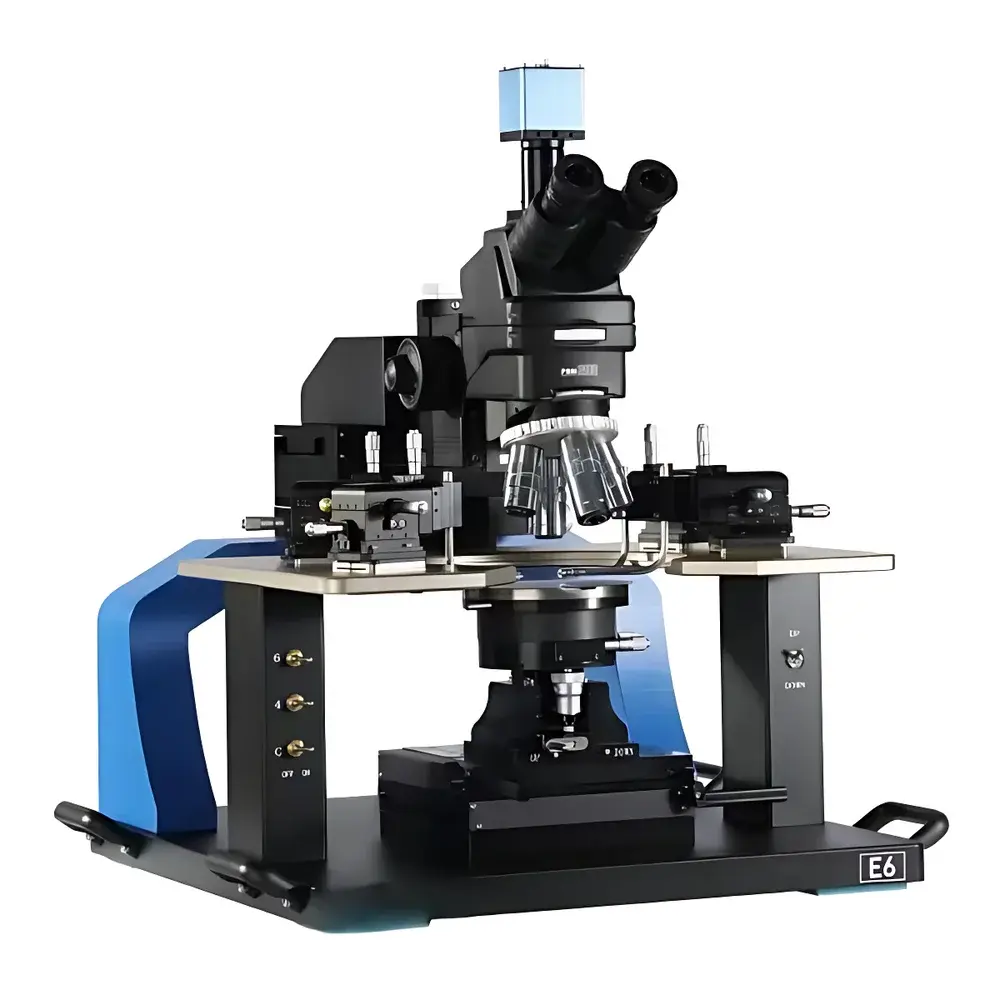
SHNTI E-Series Enhanced Manual Probe Station
| Brand | SHNTI |
|---|---|
| Origin | Shanghai, China |
| Manufacturer Type | Authorized Distributor |
| Product Category | Surface Resistivity Probe Station |
| Operation Mode | Manual |
| Compatible Wafer Sizes | 4", 6", 8", 12" |
| Modular Expansion Support | mmWave (mmW), Failure Analysis (FA), MEMS, Wafer-Level Reliability (WLR), Optoelectronics |
Overview
The SHNTI E-Series Enhanced Manual Probe Station is a precision-engineered semiconductor characterization platform designed for low-to-mid volume R&D, process validation, and failure analysis laboratories. Built upon a rigid granite base and optimized mechanical kinematics, it implements a manual coaxial probe positioning architecture compliant with industry-standard probe station topology—featuring independent X-Y-Z translation stages, fine-focus micrometers, and vacuum chucking for stable wafer immobilization. The system operates on the fundamental principle of four-point probe (4PP) and two-point probe (2PP) electrical contact measurement, enabling accurate surface resistivity, sheet resistance, contact resistance, and I-V/C-V characterization of planar semiconductor structures. Its design prioritizes mechanical stability, thermal drift mitigation, and electromagnetic interference (EMI) shielding—critical for high-impedance and low-current measurements down to picoampere levels. Unlike automated handlers, the E-Series retains full operator control over probe placement, force modulation, and alignment—making it ideal for non-standard die layouts, irregular substrates, and iterative device-level debugging.
Key Features
- Modular UPStart™ Architecture: Field-upgradable hardware modules support seamless integration of mmWave RF probes (up to 110 GHz), micro-manipulator-based failure analysis tools, MEMS actuation interfaces, wafer-level reliability test fixtures (e.g., bias-temperature stress, TDDB), and optoelectronic coupling stages (e.g., fiber alignment, photodetector probing).
- Ergonomic Manual Operation: Dual-hand control layout with tactile feedback micrometers, low-friction linear motion guides, and intuitive probe arm locking mechanisms reduce operator fatigue during extended testing sessions.
- Multi-Wafer Compatibility: Vacuum chuck with interchangeable insert rings accommodates 100 mm (4″), 150 mm (6″), 200 mm (8″), and 300 mm (12″) silicon, compound semiconductor, or glass wafers—maintaining flatness tolerance ≤ 5 µm PV across full chuck surface.
- Probe Positioning Accuracy: Sub-micron repeatability (≤ ±1 µm) in X-Y plane with 0.1 µm resolution Z-axis adjustment; compatible with standard 100 µm–500 µm pitch probe cards and custom cantilever probes.
- EMI-Suppressed Enclosure: Optional Faraday cage variant meets CISPR 22 Class B emission limits; grounding points and shielded cabling paths minimize noise coupling into sensitive DUT signals.
Sample Compatibility & Compliance
The E-Series supports a broad range of substrate materials including Si, SiC, GaN, GaAs, InP, SOI, and flexible polymer films. It complies with SEMI Standard F47-0218 (Probe Station Safety Requirements) and incorporates safety interlocks for vacuum loss and stage overtravel. For regulated environments, optional documentation packages support GLP/GMP traceability—providing calibration certificates per ISO/IEC 17025, maintenance logs, and user-accessible audit trails. While not inherently FDA 21 CFR Part 11 compliant (as a manual instrumentation platform), its analog signal outputs and digital interface ports (GPIB, USB-TMC, Ethernet) enable integration into validated test systems that implement electronic signature and data integrity controls.
Software & Data Management
The probe station operates as a hardware platform—no embedded OS or proprietary firmware. All measurement coordination is performed via external instruments (e.g., Keysight B1500A, Keithley 4200-SCS, Lake Shore CRX-6.5K). SHNTI provides open API documentation (SCPI command sets, LabVIEW VIs, Python libraries) for script-driven stage control, vacuum monitoring, and interlock status polling. Raw data remains instrument-native; no vendor lock-in occurs. Users retain full ownership of measurement metadata—including timestamped probe coordinates, applied bias conditions, environmental readings (optional temperature/humidity sensor inputs), and image annotations from integrated USB microscopes.
Applications
- Process development monitoring: Sheet resistance mapping across blanket films and patterned layers using 4PP mode.
- Early-stage IC debug: DC parametric testing of individual transistors, diodes, and passive elements prior to packaging.
- MEMS characterization: Actuator displacement vs. voltage, resonant frequency sweep, and stiction evaluation under controlled vacuum.
- Wafer-level reliability (WLR): Time-dependent dielectric breakdown (TDDB), hot-carrier injection (HCI), and negative-bias temperature instability (NBTI) stress tests with real-time leakage monitoring.
- Optoelectronic device probing: Edge-emitting laser diode threshold current extraction, photodiode responsivity calibration, and fiber-to-chip coupling efficiency assessment.
FAQ
What wafer sizes does the E-Series support?
It accommodates 4”, 6”, 8”, and 12” wafers via interchangeable vacuum chuck inserts.
Is the system compatible with RF/mmWave probing?
Yes—through the UPStart™ mmWave module, supporting grounded coplanar waveguide (GCPW) probes and calibration kits up to 110 GHz.
Can the probe station be integrated into an automated test environment?
While manually operated, its digital I/O ports and SCPI-compliant stage controllers allow synchronization with PLCs, sequencers, and ATE platforms.
Does SHNTI provide calibration services?
Yes—traceable stage position calibration and chuck flatness verification are available per ISO/IEC 17025 through accredited third-party labs.
What safety certifications does the system meet?
Standard configuration complies with SEMI F47-0218; optional CE marking and UL 61010-1 certification can be arranged for specific regional deployments.
Related Products