
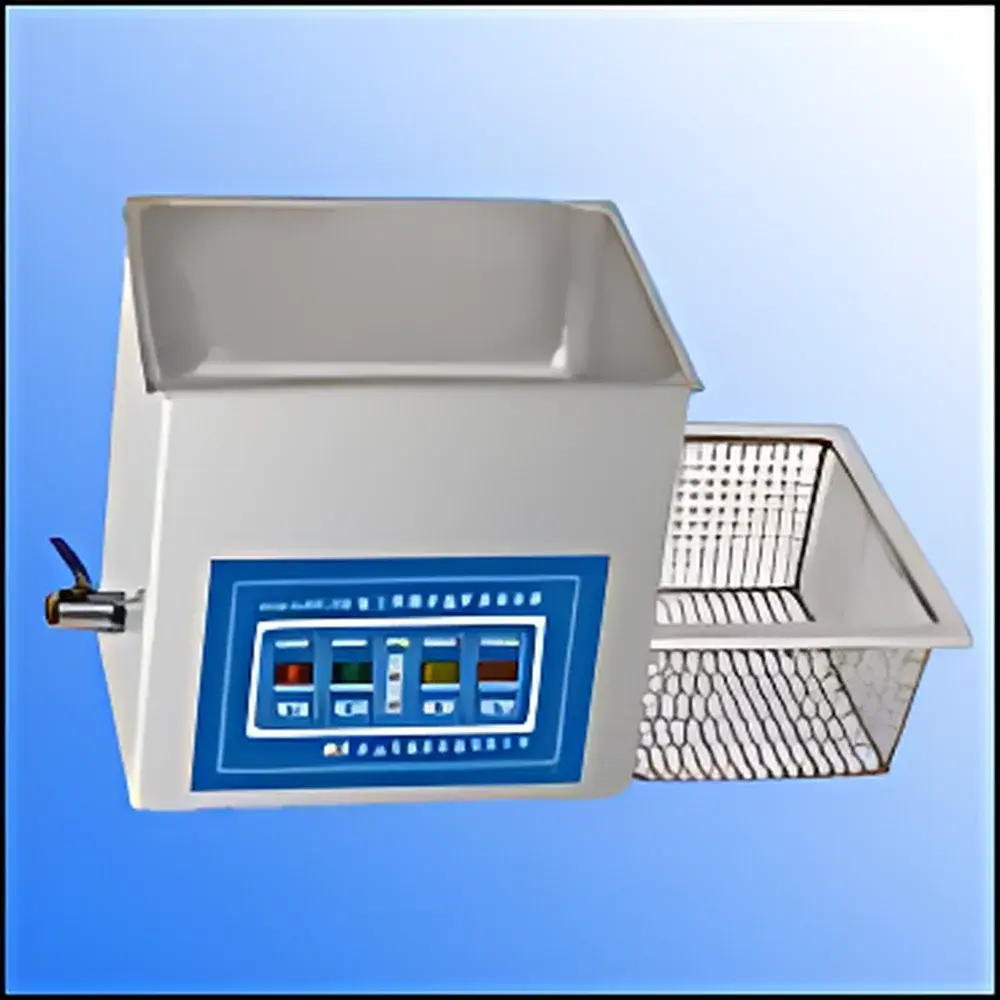
Shumei KQ5200DB Benchtop Digital Ultrasonic Cleaner
| Brand | Shumei |
|---|---|
| Origin | Jiangsu, China |
| Model | KQ5200DB |
| Type | General-purpose ultrasonic cleaner |
| Capacity | 10 L |
| Ultrasonic Frequency | 40 kHz |
| Ultrasonic Power | 200 W |
| Power Adjustment Range | 40–100% |
| Heating Power | 600 W |
| Temperature Control Range | 20–80 °C |
| Timer Range | 1–480 min |
| Drain Valve | Manual |
| Lid | Standard non-sound-dampening cover |
| Compliance | CE-marked for laboratory use (IEC 61010-1) |
Overview
The Shumei KQ5200DB is a benchtop digital ultrasonic cleaner engineered for reproducible, high-efficiency cleaning of precision laboratory components—including glassware, stainless-steel tools, optical lenses, microfluidic chips, and analytical sample holders. It operates on the principle of cavitation: high-frequency (40 kHz) ultrasonic energy induces rapid formation and collapse of microscopic vapor bubbles in aqueous or compatible solvent media, generating localized shockwaves and microstreaming that dislodge particulate contaminants, organic residues, and biofilm without mechanical abrasion. Designed for routine QC/QA labs, R&D facilities, and academic core instrumentation centers, the KQ5200DB delivers stable acoustic output across its 10-liter tank volume, supporting consistent cleaning validation under GLP-aligned workflows.
Key Features
- Digital microprocessor control with intuitive LED interface for precise parameter setting and real-time monitoring of time, temperature, and power level.
- Adjustable ultrasonic power output (40–100% in 10% increments), enabling optimization for delicate substrates (e.g., coated optics) or heavily soiled items (e.g., sintered filters).
- Integrated heating system (600 W) with PID-controlled temperature regulation (20–80 °C), facilitating enhanced cleaning efficacy for waxy, viscous, or thermally labile residues.
- Extended timer range (1–480 minutes) supports both rapid pre-rinse cycles and extended soak-and-clean protocols required for stubborn contamination removal.
- Stainless-steel tank (300 × 240 × 150 mm internal dimensions) with corrosion-resistant finish ensures long-term durability and compatibility with common cleaning solutions (e.g., alkaline detergents, ethanol/water mixtures, low-concentration acids).
- Standard removable mesh basket for secure part placement and uniform energy distribution; no integrated sound-dampening lid—suitable for ventilated fume hood or open-bench operation where acoustic attenuation is not required.
Sample Compatibility & Compliance
The KQ5200DB accommodates a wide range of laboratory items up to 300 mm in length, including volumetric flasks, pipette tips, HPLC vials, crucibles, forceps, and semiconductor wafers (with appropriate masking). Its 40 kHz frequency balances penetration depth and surface cleaning resolution—ideal for removing sub-10 µm particles from macro-scale surfaces while minimizing erosion risk on soft metals or polymer coatings. The unit complies with IEC 61010-1:2010 for electrical safety in laboratory equipment and meets CE marking requirements for EMC and low-voltage directives. While not certified for sterile processing per ISO 13485 or FDA 21 CFR Part 820, it supports cleaning steps preceding autoclaving or ethylene oxide sterilization in validated workflows. Users are advised to verify solution compatibility and perform residue testing per ASTM D2616 or USP when qualifying cleaning protocols.
Software & Data Management
The KQ5200DB operates via embedded firmware without external PC connectivity or proprietary software. All operational parameters are retained in non-volatile memory after power cycling, ensuring repeatable settings across shifts. Though lacking USB/RS-232 interfaces or audit trail functionality, its deterministic digital controls support manual documentation of cleaning cycles—enabling traceability when logged alongside batch records or SOPs. For regulated environments requiring electronic records, integration with external data loggers (e.g., calibrated temperature probes connected to validated DAQ systems) is feasible. The device does not implement FDA 21 CFR Part 11-compliant user authentication or electronic signature features; such capabilities would require third-party validation of procedural controls.
Applications
- Cleaning of HPLC/GC autosampler vials, syringe filters, and column hardware prior to reuse or calibration.
- Preparation of electron microscopy grids and TEM specimen holders to eliminate hydrocarbon contamination.
- Removal of solder flux, cutting oil, and metal fines from precision machined components in materials science labs.
- Routine decontamination of reusable cell culture inserts, transwell membranes, and electrophoresis combs.
- Supporting ASTM E1796 and ISO 14644-1 particle-counting cleanroom maintenance protocols through standardized cleaning of sampling equipment.
- Processing of geological core samples and mineral fragments prior to XRD or SEM-EDS analysis.
FAQ
What is the recommended cleaning solution for general laboratory use?
A neutral pH, non-ionic detergent (e.g., Alconox® Liquinox® or Deconex® 12 Basic) diluted at 0.5–2% v/v in deionized water is optimal for most applications. Avoid chloride-containing or highly acidic solutions unless verified compatible with stainless-steel tank integrity.
Can the KQ5200DB be used with flammable solvents?
No. This unit lacks explosion-proof certification and is rated for aqueous or water-miscible solutions only. Flammable solvents (e.g., acetone, IPA above 25% v/v) pose fire hazard and may damage internal electronics.
Is the heating function independent of ultrasonic activation?
Yes. Heating can operate without ultrasonics engaged—useful for pre-warming solutions or rinsing cycles. However, simultaneous heating and sonication is standard for maximum cleaning efficiency.
How often should the tank water be changed?
Daily replacement is recommended for routine use. For high-throughput or heavily contaminated loads, change after each batch to prevent cross-contamination and maintain cavitation efficiency.
Does the unit include a degassing mode?
No dedicated degas cycle is provided. Users should manually degas solutions by running the unit at 40% power for 5–10 minutes before loading samples, especially when using freshly prepared or cold liquids.



