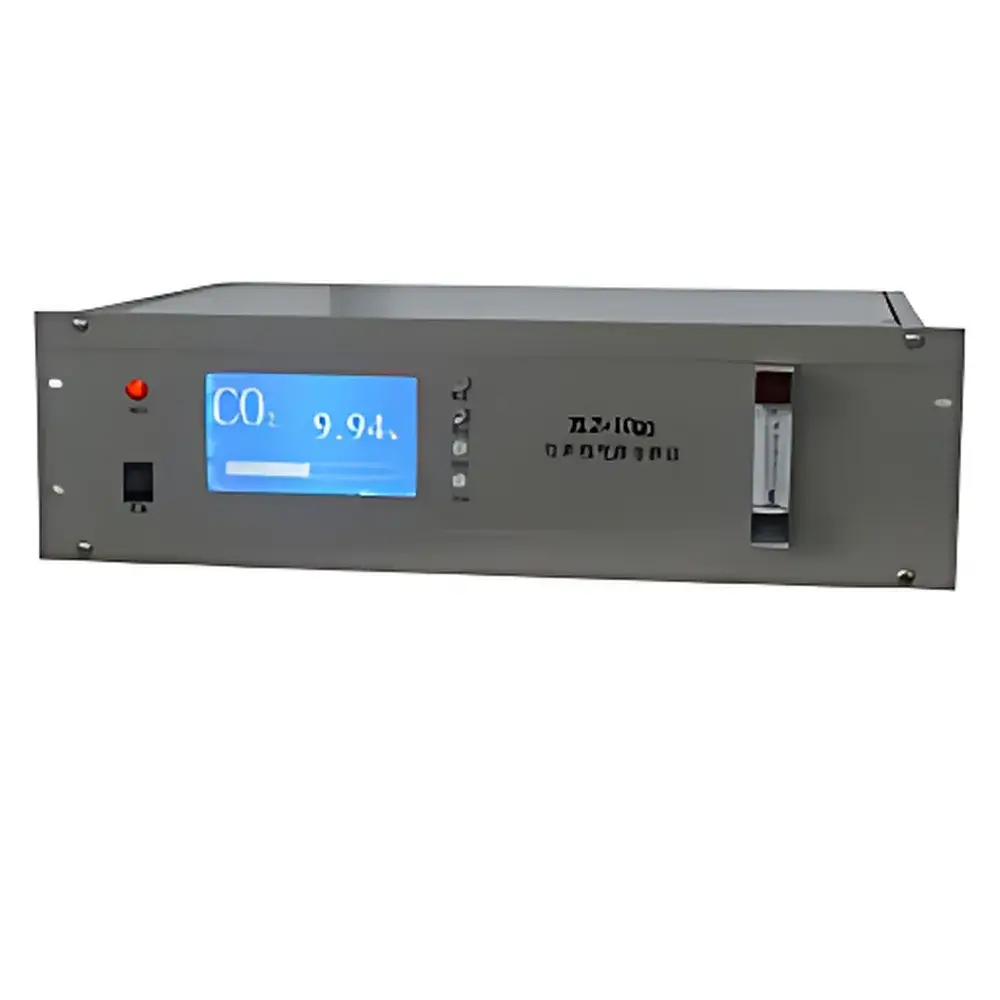
SIELINS XLZ-900 Online Bioprocess Off-Gas Analysis System
| Brand | SIELINS |
|---|---|
| Origin | Beijing, China |
| Model | XLZ-900 |
| Output | 4–20 mA analog signal per gas component |
| Alarm Output | Dry contact (NO/NC) for concentration threshold violation |
| Communication Interface | RS-485 (Modbus RTU) |
| Application Domain | Microbial fermentation off-gas monitoring (O₂, CO₂, exhaust airflow) |
| Compliance Context | Designed for integration into GMP-compliant biomanufacturing environments with audit-ready data logging capability |
Overview
The SIELINS XLZ-900 Online Bioprocess Off-Gas Analysis System is an industrial-grade, real-time gas composition monitoring platform engineered for continuous measurement of oxygen (O₂) and carbon dioxide (CO₂) concentrations in the exhaust stream of aerobic microbial fermentation vessels. Based on paramagnetic (O₂) and non-dispersive infrared (NDIR) detection principles, the system delivers stable, drift-compensated readings under dynamic process conditions typical of pharmaceutical antibiotic production, amino acid (e.g., monosodium glutamate) biosynthesis, and beverage fermentation (e.g., beer brewing). Its architecture supports closed-loop integration with distributed control systems (DCS) or programmable logic controllers (PLC), enabling direct correlation between respiratory quotient (RQ = CO₂/O₂), metabolic activity, and critical process endpoints such as nutrient depletion or culture viability decline. Unlike batch-sampled laboratory analyzers, the XLZ-900 operates with a dedicated heated sample line and particulate filtration module to prevent condensation, biofilm accumulation, or sensor fouling—ensuring >95% uptime in 24/7 bioreactor operations.
Key Features
- Multi-gas detection: Simultaneous O₂ (0–25% v/v, ±0.1% absolute accuracy) and CO₂ (0–100% v/v, ±0.5% full scale) quantification using factory-calibrated, temperature-stabilized sensors
- Process-hardened sampling interface: Integrated 120 °C heated capillary line with stainless-steel filter (1 µm pore size) and automatic moisture trap purge cycle
- Dual-output architecture: Isolated 4–20 mA analog outputs per gas channel (HART-compatible), plus two programmable dry-contact relay outputs for high/low concentration alarms
- Embedded intelligence: Onboard microcontroller performs real-time RQ calculation, moving-average smoothing (configurable 1–60 s window), and zero/span drift compensation using reference gas pulses
- Industrial communication: RS-485 serial interface compliant with Modbus RTU protocol; optional Ethernet gateway available for OPC UA integration
- GMP-aligned data handling: Internal SD card logs timestamped gas values at user-defined intervals (1–300 s); log files exportable as CSV with ISO 8601 timestamps and UTC synchronization support
Sample Compatibility & Compliance
The XLZ-900 is validated for use with exhaust gases from stirred-tank bioreactors (1–20,000 L working volume), including those employing Bacillus subtilis, Escherichia coli, Corynebacterium glutamicum, and Saccharomyces cerevisiae. It accommodates inlet gas temperatures up to 60 °C and pressures within ±10 kPa(g) of ambient. All wetted materials comply with USP Class VI biocompatibility standards; sensor housings are rated IP65 for installation in ISO Class 8 cleanroom utility corridors. The system meets IEC 61000-6-2 (immunity) and IEC 61000-6-4 (emission) requirements for industrial environments. While not certified as standalone FDA 21 CFR Part 11-compliant equipment, its data logging firmware supports ALCOA+ principles (Attributable, Legible, Contemporaneous, Original, Accurate, Complete, Consistent, Enduring, Available) when deployed with validated electronic record systems.
Software & Data Management
The XLZ-900 operates autonomously without external PC dependency. Configuration and diagnostics are performed via a local 4.3-inch resistive touchscreen with intuitive menu navigation and multilingual UI (English, Chinese, Spanish). All calibration events—including zero adjustment with nitrogen and span verification with certified gas mixtures—are digitally signed and stored with operator ID, date/time, and deviation metrics. Audit trails are retained for ≥12 months on internal memory. For enterprise-level integration, the optional SIELINS BioLink™ software suite (Windows-based) provides historical trend visualization, alarm event correlation with DCS tags, and automated report generation aligned with Annex 11 and WHO TRS 937 guidelines. Raw data exports include metadata headers compliant with ISA-88 and ISA-95 object models.
Applications
- Real-time monitoring of respiratory quotient (RQ) during fed-batch penicillin G production to trigger glucose feed rate adjustments
- Early detection of contamination events in C. glutamicum MSG fermentation via anomalous CO₂ surge patterns preceding pH shift
- Validation of sterilization-in-place (SIP) efficacy by tracking O₂ ingress during cooling phase of bioreactor cycles
- Metabolic flux analysis in academic labs studying yeast ethanol overflow metabolism under controlled aeration gradients
- Regulatory submission support: Providing auditable off-gas datasets for EMA CHMP assessment of process consistency in Type II API dossiers
FAQ
What gas species does the XLZ-900 measure by default?
The standard configuration measures O₂ and CO₂. Custom configurations supporting additional gases (e.g., NH₃, ethanol vapor) are available upon request and require sensor hardware revision.
Is field calibration possible without sending the unit to service center?
Yes—zero calibration with certified N₂ and span calibration with traceable CO₂/N₂ mixture can be executed on-site using the built-in calibration wizard and optional portable gas cylinder manifold.
How is sensor drift managed during extended unattended operation?
The system performs automatic baseline correction every 24 hours using internal reference cells and applies adaptive filtering algorithms to suppress noise from compressor pulsation or valve switching transients.
Can the XLZ-900 interface with DeltaV or Siemens PCS7 DCS platforms?
Yes—via Modbus RTU over RS-485, with pre-engineered device description (DD) files provided for seamless tag mapping and alarm forwarding into DCS event journals.
Does the system meet explosion-proof requirements for Zone 1 hazardous areas?
No—the XLZ-900 is rated for general-purpose industrial use (non-hazardous location). For Zone 1 deployment, it must be installed in an IS-rated analyzer shelter with purge/pressurization per IEC 60079-13.
Related Products