
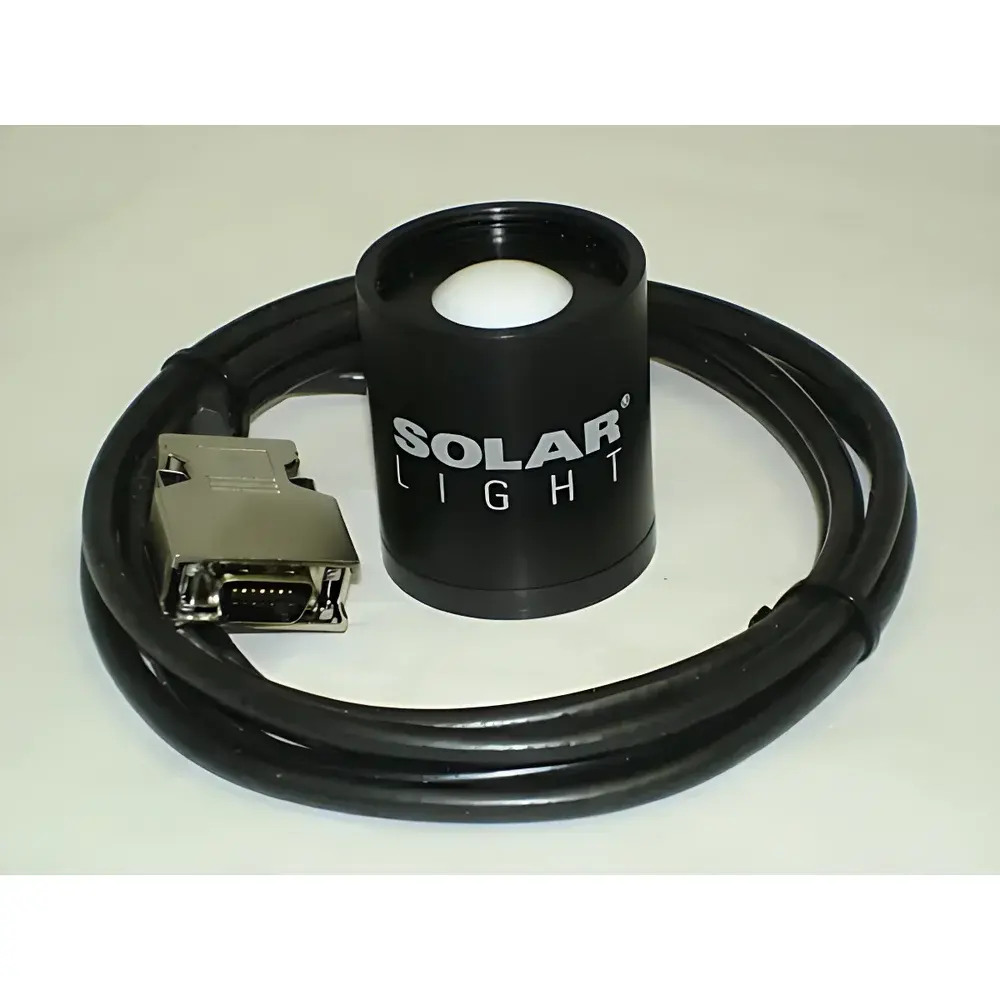
Solar Light PMA2110 UVA Radiometer
| Brand | Solar Light |
|---|---|
| Origin | USA |
| Model | PMA2110 |
| Spectral Range | 320–400 nm |
| Cosine Error | ≤5% at angles <60° |
| Measurement Range | 0.001–200 mW/cm² (or 0.01–2000 W/m²) |
| Resolution | 0.001 mW/cm² / 0.01 W/m² |
| Operating Temperature | 0–50 °C |
| Detector Diameter | 40.6 mm |
| Height | 45.8 mm |
| Weight | 200 g |
| Cable | Retractable, 0.3–1.5 m |
| Temperature Coefficient | <0.1 %/°C |
| Environmental Rating | Indoor use only |
Overview
The Solar Light PMA2110 UVA Radiometer is a precision-calibrated, handheld optical sensor engineered for quantitative measurement of ultraviolet-A (UVA) irradiance and radiant exposure in laboratory, industrial, and clinical settings. Based on a thermopile or photodiode detector architecture (calibrated traceably to NIST standards), the PMA2110 delivers high linearity and spectral selectivity across the biologically relevant UVA band (320–400 nm). Its optical design incorporates a sintered polytetrafluoroethylene (PTFE) diffuser engineered to approximate a Lambertian cosine response—critical for accurate integration of diffuse or extended-source radiation fields. Unlike broadband UV meters, the PMA2110 employs spectrally filtered detection to minimize out-of-band responsivity, reducing stray-light-induced error to negligible levels (<0.5% contribution from UVB or visible wavelengths under typical source spectra). The instrument outputs real-time irradiance in mW/cm² or W/m² and integrates dose in J/cm² or kJ/m²—enabling compliance with ISO 17025-accredited radiometric workflows.
Key Features
- Optimized spectral response: 320–400 nm full-width half-maximum (FWHM), aligned with CIE S 019/E:2021 UVA weighting function
- High-fidelity cosine correction: ≤5% angular deviation up to ±60° incidence—validated per ISO/CIE 13822 and ASTM E3135
- Wide dynamic range: 0.001–200 mW/cm² (0.01–2000 W/m²) with 16-bit analog-to-digital resolution
- Stable thermal performance: temperature coefficient <0.1 %/°C ensures minimal drift during ambient fluctuations (0–50 °C)
- Compact, ergonomic probe head: 40.6 mm diameter × 45.8 mm height; mass 200 g; integrated retractable cable (0.3–1.5 m)
- No internal battery or display—designed exclusively for integration with Solar Light’s PMA series metering platforms (e.g., PMA2100, PMA2200) supporting analog voltage output (0–2 V) and digital RS-232 communication
Sample Compatibility & Compliance
The PMA2110 is compatible with all common UVA-emitting sources used in photobiology, materials science, and industrial processing—including low-pressure fluorescent lamps (e.g., F20T12/BL), medium-pressure mercury vapor lamps, metal halide lamps, xenon arc lamps, and natural daylight. Its spectral and angular performance meets requirements for ISO 17025-compliant calibration laboratories performing UV-A irradiance validation per ISO 15858 (UV curing), ISO 24444 (SPF testing), and IEC 62471 (photobiological safety). While not intrinsically certified for GLP or GMP environments, its traceable calibration certificate (NIST-traceable reference standard), documented uncertainty budget (<±3.5% k=2), and audit-ready calibration history support FDA 21 CFR Part 11–aligned data integrity when paired with compliant data acquisition software.
Software & Data Management
The PMA2110 operates as a transducer module within Solar Light’s proprietary PMA Control Suite (v5.2+), which supports real-time irradiance logging, time-integrated radiant exposure calculation, statistical reporting (mean, SD, min/max), and export to CSV, Excel, or XML formats. The software implements electronic signature capture, user-access control tiers, and audit-trail generation—fully compliant with ALCOA+ principles for regulated environments. Raw analog output permits integration into third-party DAQ systems (e.g., LabVIEW, MATLAB) via standard 0–2 V scaling (1 mW/cm² = 10 mV), enabling custom protocol development for accelerated weathering studies or photostability testing per ICH Q1B.
Applications
- UV-curing process validation and in-line monitoring in ink, coating, and adhesive manufacturing
- SPF and broad-spectrum sunscreen efficacy testing per ISO 24444 and COLIPA guidelines
- Clinical phototherapy dosimetry for UVA-based treatments (e.g., PUVA)
- Material degradation assessment under simulated solar exposure (ASTM G154, ISO 4892-3)
- Environmental UV-A monitoring in occupational health and safety programs (ACGIH TLV® verification)
- Calibration transfer between reference-grade spectroradiometers and field-deployable sensors
FAQ
Is the PMA2110 suitable for outdoor solar UV-A measurement?
No—the probe is rated for indoor use only and lacks environmental sealing against moisture or direct precipitation. Outdoor deployment requires a weatherproof housing and thermal stabilization per ISO 17166-1.
Can the PMA2110 be recalibrated by the end user?
Recalibration must be performed by an ISO/IEC 17025-accredited laboratory using NIST-traceable reference sources. Field zeroing is not supported.
Does the PMA2110 comply with FDA 21 CFR Part 11?
The hardware itself is not Part 11–certified, but when operated with PMA Control Suite v5.2+ on validated Windows platforms, it supports electronic signatures, audit trails, and role-based access control required for regulated submissions.
What is the recommended calibration interval?
Annual calibration is advised for routine quality control applications; semi-annual calibration is recommended for GxP-regulated use or high-usage environments (>200 h/year).
How does the PMA2110 differ from broadband UV meters?
Unlike unfiltered silicon photodiode meters, the PMA2110 uses optical bandpass filtering and PTFE diffusion to reject UVB and visible contributions—ensuring metrological accuracy for UVA-specific applications where spectral selectivity is critical.






