
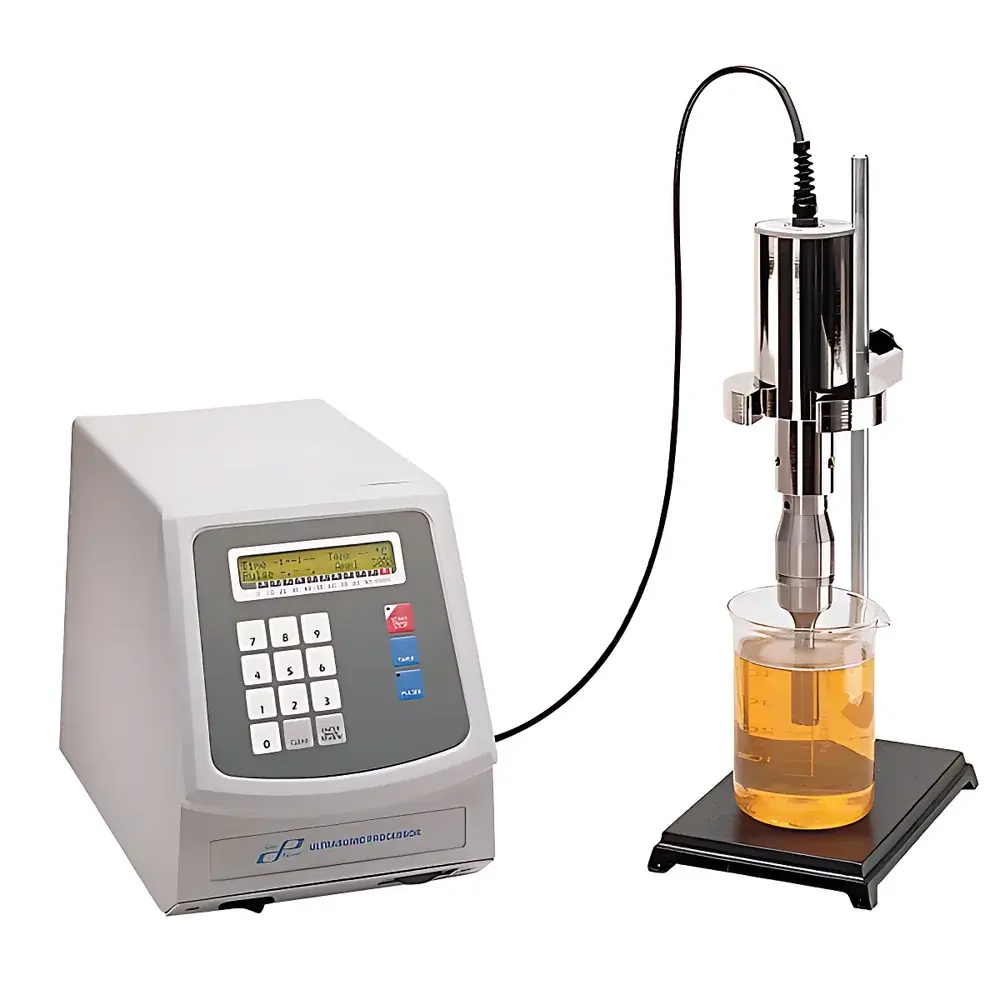
Sonics® Vibra-Cell™ VCX500/VCX750 Ultrasonic Liquid Processor (Cole-Parmer® OEM Distribution)
| Brand | Cole-Parmer |
|---|---|
| Origin | USA |
| Model | 04711-65 (750 W), 04711-75 (500 W) |
| Output Power | 500 W / 750 W |
| Frequency | 20 kHz |
| Probe Tip Diameter Options | 2, 3, 6, 13, 19, 25 mm |
| Sample Volume Range | 250 µL – 1000 mL (batch) |
| Timer Range | 1 s – 10 h |
| Pulse Mode | On/Off duration adjustable from 0.1 s to 10 s |
| Transducer | CV33 PZT ceramic, sealed housing, 63.5 mm Ø × 183 mm L, 900 g |
| Standard Probe | 13 mm Ti-6Al-4V titanium alloy, 136 mm L, 340 g |
| Dimensions (Generator) | 235 × 190 × 340 mm |
| Weight (Generator) | 7 kg |
| Input Power | 220 V, 50 Hz |
| Compliance | Designed for GLP/GMP-aligned workflows |
Overview
The Sonics® Vibra-Cell™ VCX500 and VCX750 Ultrasonic Liquid Processors—distributed globally by Cole-Parmer®—represent the industrial benchmark in high-intensity ultrasonic homogenization and cell disruption. Engineered on the foundational principle of piezoelectric-driven cavitation at a fixed resonant frequency of 20 kHz, these processors deliver controlled mechanical energy via titanium alloy probes to induce shear forces, microstreaming, and transient cavitation within liquid samples. Unlike basic ultrasonic baths or low-power sonicators, the Vibra-Cell™ platform employs active feedback control architecture to maintain precise amplitude stability across variable load conditions—critical for reproducible lysis, nanoparticle dispersion, emulsification, and chromatin shearing in molecular biology and bioprocessing applications.
Key Features
- Optotune™ Adaptive Resonance Tracking: Continuously monitors transducer impedance and automatically adjusts drive frequency to sustain optimal coupling efficiency—eliminating manual tuning and ensuring consistent energy delivery regardless of sample viscosity, temperature, or volume changes.
- Real-Time Amplitude Compensation: Closed-loop amplitude control maintains user-defined tip displacement (µm) throughout the entire sonication cycle—even during probe erosion or thermal drift—enabling strict protocol adherence across batches.
- Dual Digital Monitoring System: Integrated wattmeter displays instantaneous power (W) delivered to the probe; energy meter logs cumulative energy (J) applied—both visible in real time on the three-digit LED display.
- Programmable Pulse Architecture: Independent ON/OFF timers allow duty-cycle optimization from 0.1 s to 10 s per phase—essential for thermally sensitive samples such as protein complexes, viral vectors, or primary cells.
- Robust Transducer Design: Hermetically sealed CV33 PZT transducer with aerospace-grade titanium housing resists moisture ingress, particulate contamination, and chemical corrosion—validated for uninterrupted operation over 10,000 hours.
- Comprehensive Safety & Control: Overload protection circuitry halts operation upon current anomaly detection; 10-hour total process timer prevents unintended extended cycling; footswitch and remote start options support hands-free, ergonomic lab integration.
Sample Compatibility & Compliance
The VCX500/VCX750 accommodates diverse biological and material science workflows—from sub-microliter nucleic acid shearing in microcentrifuge tubes to continuous-flow processing of mammalian cell cultures at 19 L/h. Compatible probe diameters (2–25 mm) enable scalable treatment across volumes ranging from 250 µL (microprobe) to 1000 mL (large-volume cup horn). Optional non-contact cooling cups, insulated acoustic hoods, and temperature-controlled jackets facilitate ISO 17025-compliant validation studies. The system’s deterministic parameter logging—including timestamped amplitude, power, energy, pulse profile, and runtime—supports traceability requirements under FDA 21 CFR Part 11, EU Annex 11, and GLP/GMP quality systems when paired with validated software interfaces.
Software & Data Management
While the standalone VCX500/VCX750 operates via intuitive front-panel controls, optional RS-232 or USB connectivity enables integration with laboratory information management systems (LIMS) and electronic lab notebooks (ELN). Third-party automation platforms can trigger run sequences, capture real-time metrics, and archive session logs—including operator ID, method name, probe ID, and environmental metadata—for audit-ready documentation. All firmware adheres to IEC 61000-4 electromagnetic compatibility standards and includes built-in self-diagnostic routines that verify transducer resonance integrity prior to each activation cycle.
Applications
- Mammalian, bacterial, yeast, and plant cell lysis for protein extraction and organelle isolation
- Chromatin immunoprecipitation (ChIP) and ATAC-seq library preparation via controlled DNA fragmentation
- Nanomaterial dispersion in aqueous and organic media (e.g., graphene oxide, liposomes, polymeric micelles)
- Emulsification of pharmaceutical suspensions and vaccine adjuvant formulations
- Disaggregation of amyloid fibrils and inclusion bodies in recombinant protein refolding studies
- Preparation of standardized reference materials for particle size distribution analysis (ISO 13320)
FAQ
What is the difference between the VCX500 (04711-75) and VCX750 (04711-65)?
The VCX500 delivers up to 500 W nominal output power; the VCX750 provides up to 750 W—optimized for higher-viscosity samples, larger batch volumes, or accelerated processing kinetics.
Can I use non-Sonics probes with this generator?
No. Only Sonics-certified titanium alloy probes (model-specific threading and impedance matching) are supported to ensure mechanical integrity, thermal safety, and amplitude fidelity.
Is the system compatible with cold room or glovebox environments?
Yes—when equipped with optional extension rods, insulated probes, and external cooling jackets, the VCX series operates reliably at ambient temperatures from 4 °C to 40 °C.
How often does the transducer require recalibration?
The CV33 transducer requires no field recalibration; its resonant frequency stability is guaranteed for 5 years under normal operating conditions per ISO 9001 manufacturing certification.
Does the unit meet electrical safety standards for international laboratories?
Yes—the generator complies with UL 61010-1, CE EN 61010-1, and RoHS Directive 2011/65/EU, with full test reports available upon request.
Related Products




