
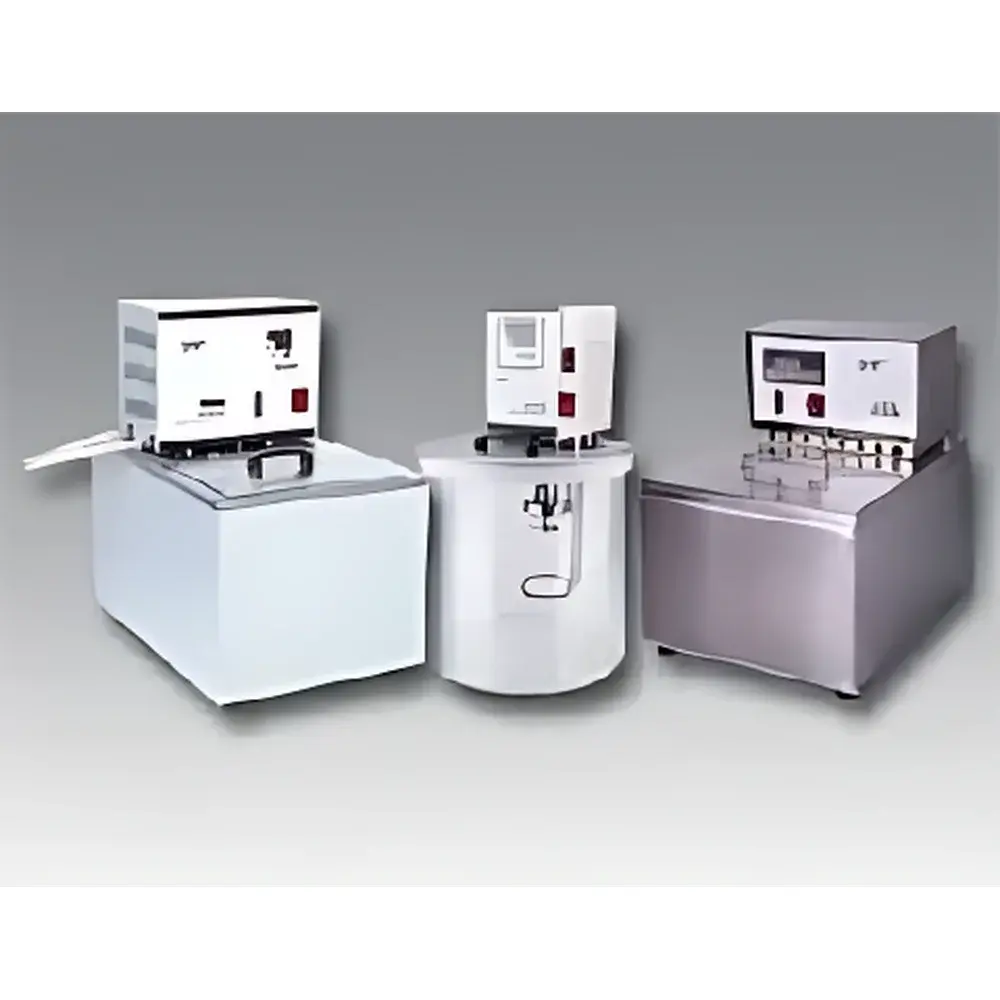
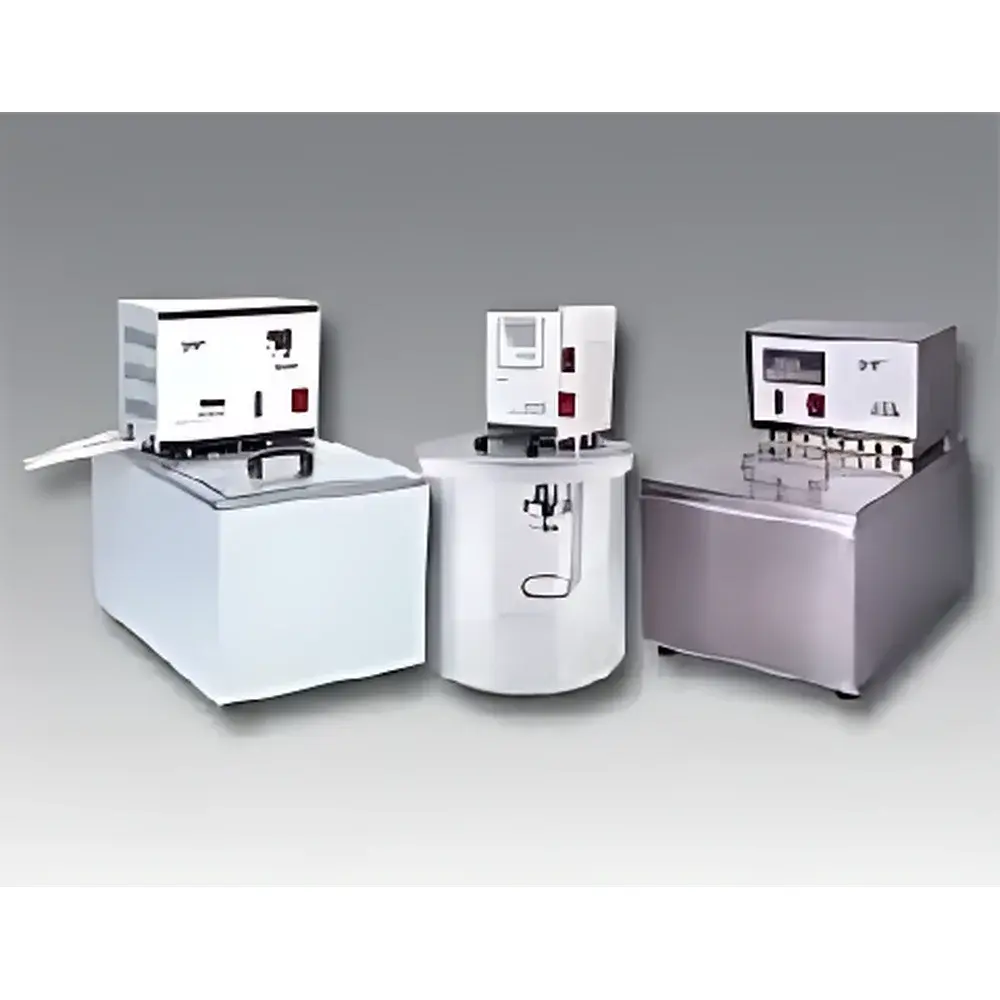
SOPTOP DC-Series Dual-Function Refrigerated/Heating Circulating Bath with Internal & External Recirculation
| Brand | SOPTOP |
|---|---|
| Model | DC-1006 / DC-2006 / DC-3006 / DC-4006 / DC-8006 |
| Origin | Shanghai, China |
| Bath Volume | 20 L |
| Temperature Range | −5 °C to 95 °C |
| Temperature Stability | ±0.05 °C |
| Control Mode | Refrigeration & Heating Dual-Function |
| Circulation Type | Internal & External Recirculation |
| Display Resolution | 0.1 °C |
| Construction | Stainless Steel Inner Tank & Housing |
| Insulation | High-Density Polyurethane Foam |
| Pump Flow Rate (≥20 L models) | 10 L/min |
| Pump Flow Rate (<20 L models) | 8 L/min |
| Refrigeration System | Twin-Compressor Cascade Design |
| Sensor | Imported Pt100 RTD |
| Handle | Foldable Dual-Side Ergonomic Handles |
| Mobility | Heavy-Duty Locking Casters (DC-30 Series & ≤−40 °C Models) |
Overview
The SOPTOP DC-Series Dual-Function Refrigerated/Heating Circulating Bath is an engineered solution for precise temperature control in laboratory and analytical applications requiring both active cooling and heating within a single, compact unit. Based on the principle of forced liquid circulation through a thermally insulated bath reservoir, the system maintains setpoint accuracy via closed-loop feedback control using a high-stability Pt100 resistance temperature detector and microprocessor-based PID regulation. Its dual-compressor cascade refrigeration architecture enables rapid thermal response across extended operating ranges—from sub-zero conditions down to −80 °C (model-dependent) up to 95 °C—while minimizing thermal overshoot and ensuring long-term repeatability. Designed for integration into external systems such as spectrophotometers, rotary evaporators, or reaction calorimeters, the DC-Series supports both internal bath homogenization and external fluid recirculation via a dedicated pump circuit with adjustable flow output.
Key Features
- High-precision temperature control with stability of ±0.05 °C and 0.1 °C display resolution, validated under steady-state conditions per ISO 17025 traceable protocols.
- Twin-compressor cascade refrigeration system optimized for low-temperature performance, delivering efficient heat exchange and reduced mechanical vibration compared to single-stage alternatives.
- Stainless steel inner tank and exterior housing (AISI 304 grade), corrosion-resistant and compatible with water, ethanol–water mixtures, silicone oils, and other common heat-transfer fluids.
- Dual-mode recirculation: internal stirring ensures uniform axial and radial temperature distribution; external port enables connection to jacketed reactors, condensers, or custom thermal manifolds.
- Ergonomic design includes foldable side handles and heavy-duty locking casters (standard on DC-3006 and lower-temperature variants), facilitating safe relocation without disassembly.
- Advanced thermal insulation using high-density polyurethane foam minimizes ambient heat ingress and cold loss, improving energy efficiency and operational consistency over extended duty cycles.
Sample Compatibility & Compliance
The DC-Series accommodates a broad range of sample vessels and auxiliary equipment—including glassware, metal jackets, and polymer-lined reactors—without compromising thermal fidelity. Its stainless steel construction meets material compatibility requirements for GLP-compliant laboratories handling aqueous, organic, or mildly aggressive media. While not intrinsically rated for hazardous area use, the unit complies with IEC 61010-1:2010 safety standards for electrical equipment used in laboratory environments. Temperature calibration procedures align with ASTM E1137/E1137M for liquid-in-glass and digital thermometers, supporting routine verification against NIST-traceable references. Data logging functionality (via optional RS485/Modbus interface) facilitates audit readiness for FDA 21 CFR Part 11–governed workflows when paired with compliant software platforms.
Software & Data Management
The embedded controller provides local setpoint programming, real-time temperature monitoring, and alarm thresholds for over-temperature, low-fluid, or compressor fault conditions. Optional communication modules enable remote parameter adjustment and data acquisition through industry-standard protocols (Modbus RTU over RS485). When integrated with laboratory information management systems (LIMS) or SCADA environments, time-stamped temperature records—including ramp rates, dwell durations, and deviation alerts—can be archived with full audit trail capability. Firmware updates are delivered via secure USB interface, maintaining version control and regulatory alignment throughout the instrument lifecycle.
Applications
- Temperature stabilization of analytical instruments: UV-Vis spectrophotometers, HPLC column ovens, and FTIR accessories.
- Controlled-rate cooling/heating of chemical reactions in jacketed glass reactors or pilot-scale synthesis vessels.
- Calibration of temperature-sensitive sensors, transducers, and reference standards across metrology labs.
- Thermal conditioning of biological samples during enzymatic assays or cell culture incubation support systems.
- Material testing environments requiring stable thermal loading for rheological, viscometric, or thermal expansion studies.
FAQ
What is the minimum achievable temperature for the DC-2006 model?
The DC-2006 achieves a nominal minimum temperature of −20 °C under standard ambient conditions (25 °C, 50% RH) with water-based coolant.
Can this bath operate continuously at 95 °C?
Yes—the heating system is rated for uninterrupted operation at maximum setpoint, provided proper ventilation and coolant level are maintained.
Is external recirculation flow rate adjustable?
Flow is fixed per model specification (8 L/min or 10 L/min); fine-tuning requires an inline needle valve or external flow controller.
Does the unit include factory calibration documentation?
Each unit ships with a manufacturer’s calibration certificate referencing Pt100 sensor linearity and temperature stability test results at three points (0 °C, 25 °C, 70 °C).
What maintenance intervals are recommended for the refrigeration system?
Annual inspection of condenser coils, refrigerant charge verification, and pump impeller integrity assessment are advised per ISO 5171 guidelines.



