
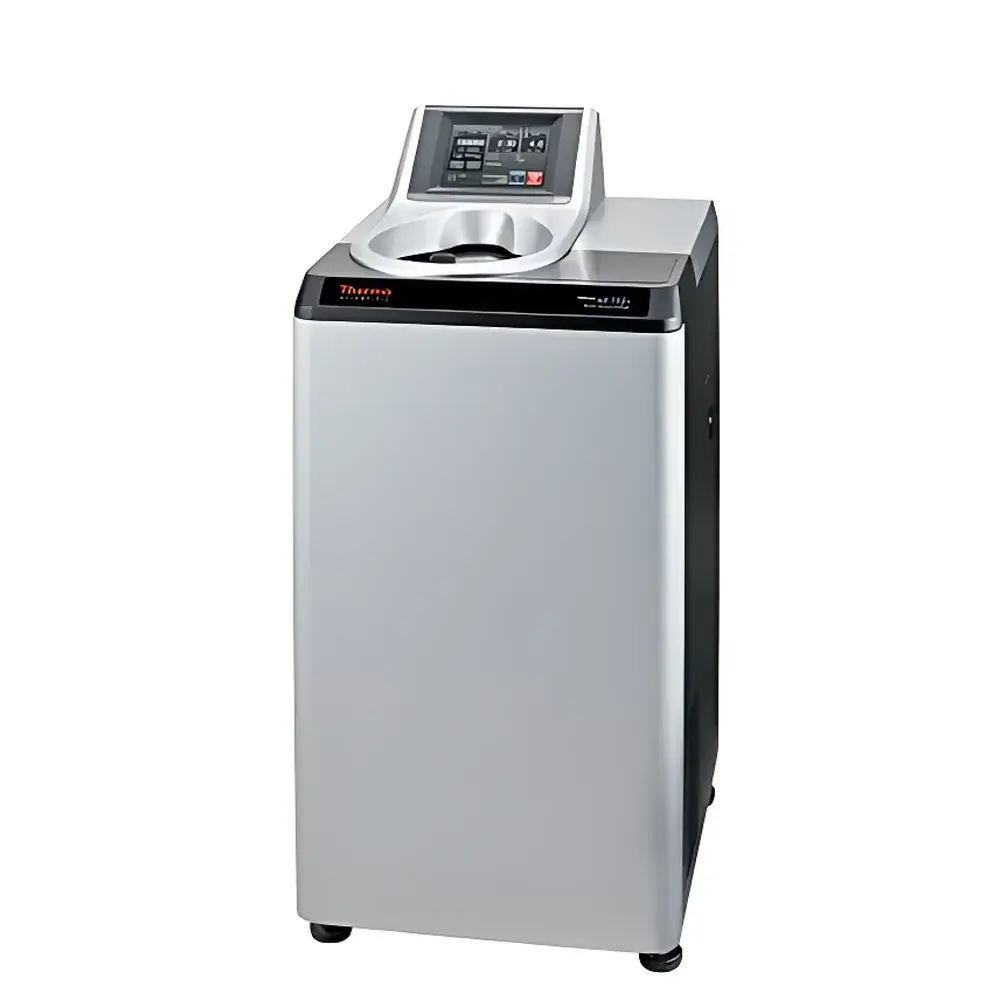
Sorvall™ MX Plus Series Floor-Model Micro-Ultracentrifuge
| Brand | Thermo Fisher Scientific |
|---|---|
| Origin | USA |
| Manufacturer | Thermo Fisher Scientific |
| Product Category | Imported Instrument |
| Model Numbers | 50135643, 50135648 |
| Instrument Type | Floor-Model Ultracentrifuge |
| Speed Range | Up to 150,000 rpm (Model-Dependent) |
| Maximum RCF | 1,048,000 × g |
| K-Factor Range | As low as 14–35 (Rotor-Dependent) |
| Noise Level | <45 dBA |
| Footprint | 0.53 m² (5.7 ft²) |
| Rotor Compatibility | Fixed-angle, swinging-bucket, vertical rotors |
| Tube Capacity | 0.2–30 mL |
| Sample Types | Viruses (HIV, SRSV, rotavirus), organelles (ribosomes, mitochondria, microsomes), lipoproteins, nanoparticles, nucleic acids |
| Drive System | Brushless DC motor with imbalance detection and auto-shutdown |
| Compliance | Designed for GLP/GMP environments |
Overview
The Thermo Scientific™ Sorvall™ MX Plus Series floor-model micro-ultracentrifuge is engineered for high-throughput, high-resolution separation of subcellular components and macromolecular complexes under stringent laboratory conditions. Utilizing advanced rotor dynamics and precision-machined titanium and aluminum alloy rotors, the system operates on the principle of sedimentation velocity and equilibrium ultracentrifugation—enabling isolation of particles ranging from 10 nm to several hundred nanometers in hydrodynamic radius. With maximum rotational speeds of 150,000 rpm (model-dependent) and peak relative centrifugal forces up to 1,048,000 × g, the MX Plus delivers exceptional resolution for applications requiring minimal pelleting time and maximal recovery fidelity. Its compact footprint (0.53 m²) and ultra-low acoustic signature (<45 dBA) make it suitable for shared core facilities, biosafety level 2 (BSL-2) laboratories, and space-constrained cleanrooms without compromising operational integrity or user comfort.
Key Features
- High-speed capability: Select models achieve 120,000 rpm or 150,000 rpm, enabling rapid sedimentation of small particles including viral capsids, exosomes, and ribonucleoprotein complexes.
- Optimized K-factor performance: Rotors are designed with low sedimentation path lengths and minimized dead volume, yielding K-factors as low as 14–35—critical for reducing run times while preserving sample integrity.
- Floor-standing architecture with integrated vibration damping: Robust steel chassis and active suspension minimize transmission of mechanical resonance to adjacent instrumentation or work surfaces.
- Intelligent drive system: Brushless DC motor with real-time imbalance monitoring, automatic deceleration, and rotor-specific acceleration profiles ensure consistent torque delivery and extended service life.
- Thermal management: Dual-zone refrigeration system maintains precise temperature control (0–40 °C) across all operating speeds, minimizing thermal gradients within the chamber during extended runs.
- Modular rotor ecosystem: Supports interchangeable fixed-angle, swinging-bucket, and vertical rotors—all certified for full-speed operation and traceable via serialized rotor IDs.
Sample Compatibility & Compliance
The MX Plus accommodates a broad spectrum of biological and synthetic samples—including infectious agents (e.g., HIV, rotavirus, SRSV), membrane-bound organelles (mitochondria, microsomes, lysosomes), nucleic acid complexes, lipoprotein fractions (HDL, LDL, VLDL), and engineered nanoparticles (liposomes, polymeric micelles). All rotors comply with ISO 15197:2022 (rotor safety certification) and meet ASTM F2119-21 requirements for ultracentrifuge rotor qualification. The instrument’s firmware architecture supports GLP/GMP workflows through configurable user access levels, electronic logbooks, and optional 21 CFR Part 11-compliant software add-ons for audit trail generation and digital signature enforcement.
Software & Data Management
Operation is managed via an intuitive touchscreen interface with embedded method storage (≥1,000 protocols), parameter locking, and password-protected administrator mode. Raw run data—including speed, RCF, time, temperature, vacuum status, and rotor ID—is automatically timestamped and exportable in CSV or XML format. When integrated with Thermo Fisher Connect™ Laboratory Software Suite, the MX Plus supports centralized fleet monitoring, predictive maintenance alerts, and secure cloud-based protocol synchronization across multi-site installations. Audit trails include operator ID, method version, calibration history, and deviation flags—fully aligned with ALCOA+ data integrity principles.
Applications
- Virology: Purification and concentration of enveloped and non-enveloped viruses for structural studies, vaccine development, and infectivity assays.
- Cell biology: Isolation of functional ribosomal subunits, mitochondrial inner/outer membranes, and synaptic vesicle fractions.
- Nanomedicine: Characterization and purification of lipid nanoparticles (LNPs) and extracellular vesicles for therapeutic delivery validation.
- Clinical diagnostics: Fractionation of plasma-derived lipoproteins and circulating nucleic acid carriers for biomarker discovery.
- Structural biology: Preparation of highly purified macromolecular assemblies prior to cryo-EM grid preparation or X-ray crystallography screening.
FAQ
What is the maximum RCF achievable with the Sorvall MX Plus?
Maximum RCF is 1,048,000 × g, attained using the T-150 rotor at 150,000 rpm.
Does the MX Plus support temperature-controlled runs at high speeds?
Yes—the dual-stage compressor system maintains setpoint accuracy within ±0.5 °C across the full speed range (up to 150,000 rpm) and ambient temperatures up to 30 °C.
Are rotors sold separately, and do they require recalibration after installation?
All rotors are sold individually and are pre-calibrated at the factory; no field recalibration is required. Each rotor carries a unique serial number linked to its certified performance envelope.
Can the MX Plus be integrated into a LIMS environment?
Yes—via RS-232, USB, or Ethernet interfaces, the instrument supports HL7 and ASTM E1384-compliant data export for seamless LIMS ingestion.
Is rotor imbalance detection automated and fail-safe?
Yes—the system continuously monitors vibration signatures during acceleration and deceleration; any detected imbalance triggers immediate ramp-down and visual/audible alerts before reaching unsafe thresholds.



