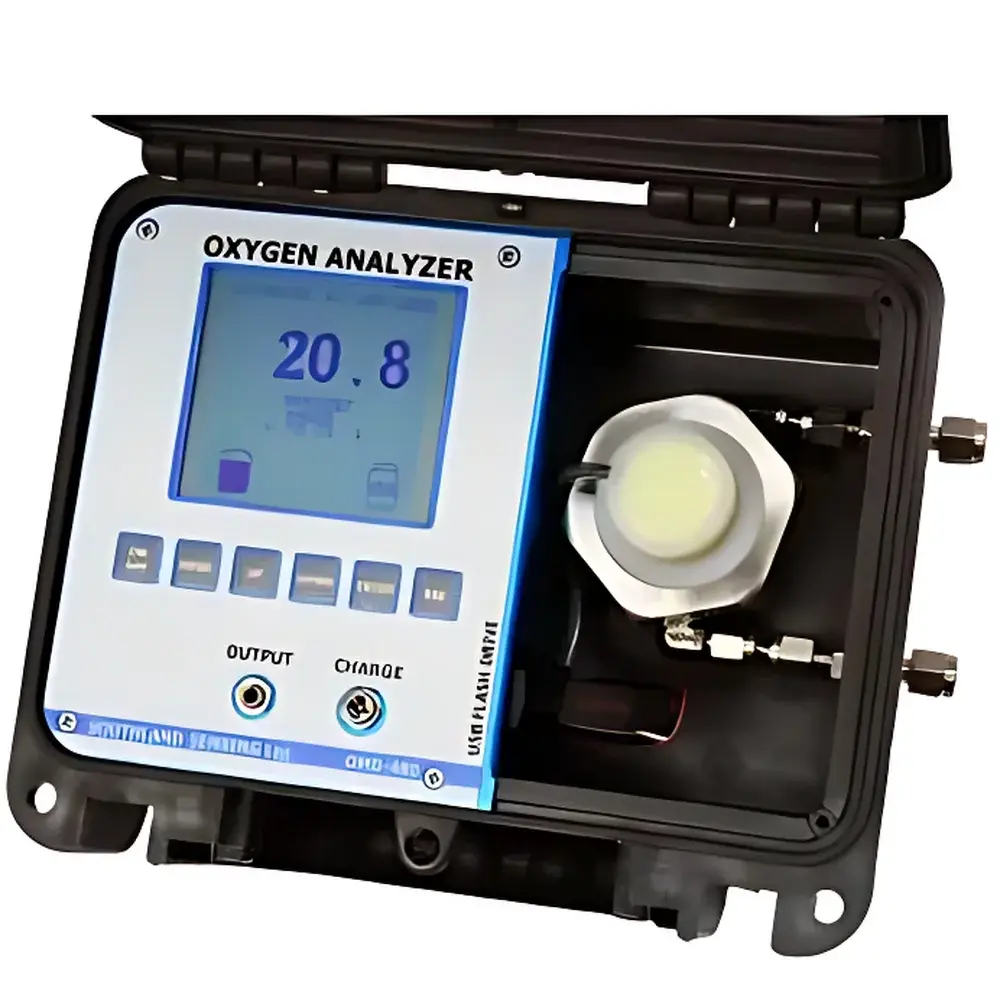
Southland Sensing MOMD-480 Portable Oxygen Analyzer
| Brand | Southland Sensing |
|---|---|
| Model | MOMD-480 |
| Origin | USA (California) |
| Measurement Principle | Electrochemical Fuel Cell |
| Range Options | 0–1%, 0–5%, 0–10%, 0–25%, 0–100% O₂ (selectable) |
| Accuracy | < ±1% FS |
| Response Time | ≤10 s to T90 |
| Operating Temperature | 0–50 °C |
| Gas Pressure Range | 0–50 PSI (inlet) |
| Power | Rechargeable Li-ion battery + 100–240 VAC adapter |
| Dimensions | 8.80 × 7.50 × 3.90 in (223.5 × 190.5 × 99.1 mm) |
| Weight | 4.8 lb (2.18 kg) |
| Enclosure Material | Polypropylene |
| Sensor Lifetime | 60 months |
| Analog Output | 0–1 VDC |
| Data Logging | USB flash drive (up to 8 GB, supports >50 years of timestamped data at 1-min intervals) |
| Display | Backlit high-contrast LCD |
| Warranty | 12 months |
| Compliance | Designed for GLP-compliant field use |
Overview
The Southland Sensing MOMD-480 Portable Oxygen Analyzer is an industrial-grade, handheld electrochemical gas analyzer engineered for rapid, reliable, and repeatable measurement of oxygen concentration across five selectable ranges (0–1%, 0–5%, 0–10%, 0–25%, and 0–100% O₂). Built around the proprietary SSO2 precision fuel cell sensor—designed and manufactured in Southland’s ISO 9001-certified facility in California—the instrument operates on the principle of galvanic oxygen sensing: molecular O₂ diffuses through a selective membrane and undergoes a controlled electrochemical reduction at the cathode, generating a current linearly proportional to partial pressure. This analog signal is conditioned, digitized, and displayed with high stability and minimal drift. The MOMD-480 is not intended for ambient air monitoring or medical diagnostics; rather, it serves as a calibrated verification tool for controlled process environments where oxygen contamination or depletion must be quantified with metrological confidence.
Key Features
- SSO2 electrochemical fuel cell sensor with 5-year rated lifetime and zero routine maintenance—no electrolyte refills, electrode polishing, or membrane replacement required
- Five factory-calibrated range options, user-selectable via front-panel interface without hardware modification
- High-fidelity analog output (0–1 VDC) compatible with PLCs, SCADA systems, and third-party data acquisition modules
- Integrated backlit LCD display with intuitive menu navigation and real-time status indicators (battery level, sensor health, alarm thresholds)
- Rugged polypropylene housing rated IP65 for resistance to dust, moisture, and incidental chemical exposure
- Rechargeable lithium-ion battery supporting ≥12 hours of continuous operation; universal AC adapter (100–240 VAC) included
- USB-based data logging architecture enabling secure, timestamped storage of measurement records directly to removable flash media
Sample Compatibility & Compliance
The MOMD-480 is validated for use with dry, non-corrosive, non-condensing gas streams—including nitrogen, argon, helium, CO₂, and synthetic air—within a maximum inlet pressure of 50 PSI. It is unsuitable for sampling gases containing H₂S, Cl₂, SO₂, or high concentrations of hydrocarbons, which may poison the fuel cell. All sensors are individually calibrated using NIST-traceable standards prior to shipment. The analyzer complies with ASTM D6349 (Standard Test Method for Determination of Oxygen in Gaseous Samples by Electrochemical Sensors) and supports documentation workflows aligned with ISO 8573-3 for compressed air purity certification. While not FDA 21 CFR Part 11–validated out-of-the-box, its audit-ready data logs (with operator ID fields and tamper-evident timestamps) facilitate integration into GLP/GMP quality systems when deployed with controlled access protocols.
Software & Data Management
Data collection is performed exclusively via industry-standard USB mass storage protocol—no proprietary drivers or software installation required. A single 8 GB USB flash drive stores over 50 years of minute-interval measurements (26.3 million records), each tagged with date/time stamp, selected range, raw mV output, temperature-compensated %O₂ value, and sensor status flag. Files export natively as CSV for direct import into Excel, LabVIEW, or LIMS platforms. Firmware updates are delivered via same USB interface and include cryptographic signature verification to ensure integrity. No cloud connectivity or remote telemetry is implemented—data sovereignty and network isolation are preserved by design.
Applications
- Glovebox and inert-atmosphere chamber leak verification (detection limit down to 10 ppm O₂ equivalent in 0–1% range mode)
- Air separation plant purity validation during liquid nitrogen or oxygen production cycles
- Head-space analysis in pharmaceutical blister packaging and modified-atmosphere food packaging lines
- CO₂ quality assurance for beverage carbonation systems per USP specifications
- Oxygen ingress monitoring during bright annealing of stainless steel and titanium alloys
- Shielding gas purity verification in orbital TIG and laser welding of reactive metals (e.g., Zr, Ta, Ni-based superalloys)
FAQ
What calibration standards are used for factory calibration?
All MOMD-480 units are calibrated using NIST-traceable certified gas mixtures (e.g., 0.5% O₂ in N₂, 21% O₂ in N₂) under controlled temperature and pressure conditions. Calibration certificates include uncertainty budgets per ISO/IEC 17025 guidelines.
Can the instrument measure oxygen in high-humidity gas streams?
No. Condensation or sustained relative humidity >80% will impair sensor response and accelerate electrolyte depletion. Use only with dried or desiccated sample gas; optional in-line permeation dryer accessories are available.
Is sensor cross-sensitivity to CO or NO₂ documented?
The SSO2 sensor exhibits negligible interference from CO (<0.1% signal offset at 1000 ppm) and NO₂ (<0.3% at 50 ppm), per Southland Sensing Technical Bulletin TB-047. Full interference matrix testing reports are available upon request.
Does the USB data logger support password protection or encryption?
No. Data files are stored in plain-text CSV format for maximum interoperability. Encryption or access control must be implemented at the host system level per organizational IT policy.
What is the recommended recalibration interval under normal industrial use?
Annual verification against certified span gas is advised. For critical applications (e.g., pharmaceutical inerting), semi-annual verification or post-event calibration (after exposure to over-range O₂ or mechanical shock) is recommended.
Related Products