
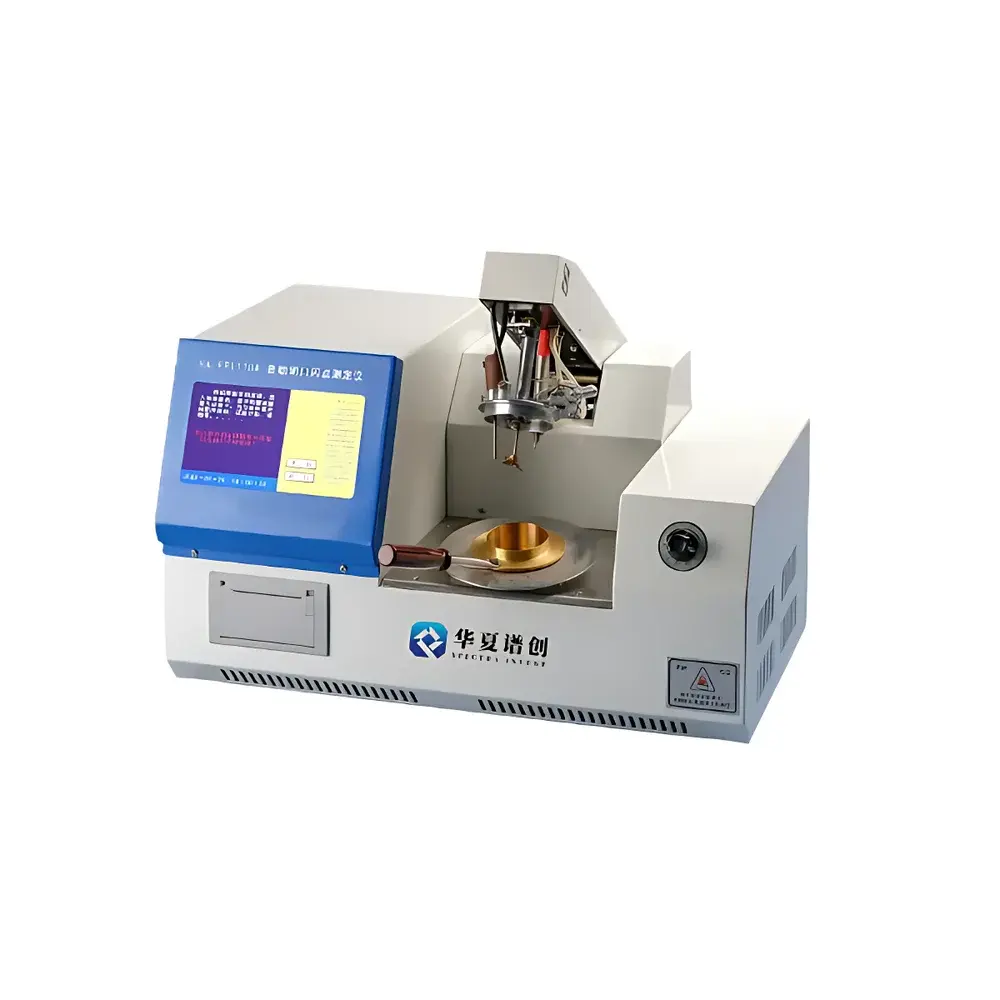
SPECTRA INVENT HX-FP1110A Automatic Closed-Cup Flash Point Tester
| Brand | SPECTRA INVENT |
|---|---|
| Origin | Beijing, China |
| Manufacturer Type | Authorized Distributor |
| Country of Origin | China |
| Model | HX-FP1110A |
| Detection Method | Closed-Cup (Pensky-Martens) |
| Operation Mode | Fully Automatic |
| Temperature Range | Ambient to 350°C |
| Ignition Source | Electronic Spark & Adjustable Gas Flame |
| Repeatability | ≤2°C |
| Applicable Standard | GB/T 261-2008 |
Overview
The SPECTRA INVENT HX-FP1110A Automatic Closed-Cup Flash Point Tester is a precision-engineered instrument designed for the accurate determination of flash point values of petroleum products—including transformer oils, lubricants, diesel fuels, and base stocks—under strictly controlled closed-cup conditions. It operates in full compliance with the Pensky-Martens closed-cup method as defined in GB/T 261-2008, which aligns closely with internationally recognized standards such as ASTM D93 and ISO 2719. The device utilizes a thermostatically regulated heating bath, integrated temperature feedback control, and real-time vapor concentration monitoring via automated ignition sequencing. Its core measurement principle relies on detecting the lowest temperature at which vapors above a sample ignite momentarily when exposed to an externally applied ignition source under sealed conditions—ensuring high reproducibility and minimal operator influence.
Key Features
- Fully automatic operation sequence: lid closure, programmed heating ramp, timed ignition attempt, flash detection, and result reporting—all executed without manual intervention.
- High-resolution 7-inch color TFT LCD touchscreen interface with intuitive Chinese-language menu navigation, supporting parameter entry for sample ID, ambient pressure, test date/time, and target pre-heat temperature.
- Dual ignition options: programmable electronic spark ignition (low-energy, non-contact, maintenance-free) and adjustable gas flame ignition (for validation or comparative testing per regulatory requirements).
- Real-time graphical display of temperature vs. time profile during testing, enabling visual verification of heating rate conformity to GB/T 261-2008 specifications (e.g., 5–6°C/min initial ramp, reduced rate near expected flash point).
- Integrated atmospheric pressure sensor with automatic correction algorithm; users may also manually input local barometric pressure for standardized flash point reporting.
- Forced-air cooling system enables rapid cooldown between tests, improving throughput in high-volume laboratory environments.
- Compliance-ready data handling: built-in storage for up to 120 test records with timestamp, operator ID (optional), sample ID, raw temperature data, and final flash point value.
Sample Compatibility & Compliance
The HX-FP1110A is validated for use with transparent and opaque liquid petroleum products having initial boiling points above 40°C and flash points below 350°C. Typical applications include insulating oils (IEC 60296), aviation turbine fuels (ASTM D1655 Annex A1), marine distillate fuels (ISO 8217), and industrial lubricants. All operational logic and thermal profiles conform to GB/T 261-2008, and the instrument’s mechanical design satisfies the physical requirements of ASTM D93 Method A and ISO 2719 Clause 6. While not certified to IEC 61000-4 electromagnetic compatibility standards out-of-box, its RS-232/RS-485 serial interfaces support integration into GLP-compliant laboratory networks where audit trails and electronic signatures are managed at the LIMS level.
Software & Data Management
The embedded firmware supports bidirectional communication via standard RS-232 or RS-485 interfaces. Raw test logs—including time-stamped temperature readings at 1-second intervals, ignition event timestamps, detected flash temperatures, and user-entered metadata—are exportable in CSV format. When connected to a host PC running compliant laboratory software, the instrument accepts remote parameter configuration (e.g., ramp rate override, delay before first ignition, maximum test duration). Audit trail functionality is implemented at the host system layer; the HX-FP1110A itself maintains immutable internal logs with write-once timestamping. Data retention complies with minimum archival expectations under CNAS-CL01:2018 and supports retrospective review for QA/QC investigations.
Applications
- Quality assurance of new and in-service transformer oils in power generation and transmission facilities.
- Batch release testing of diesel fuel blends prior to distribution (GB 19147, EN 590).
- Flash point verification of aviation turbine fuel (Jet A-1) in refinery and airport fuel farms.
- Routine screening of used industrial lubricants for contamination by low-flash solvents or degradation byproducts.
- Research and development of bio-based lubricants and synthetic ester formulations requiring precise volatility characterization.
- Third-party certification laboratories performing contract testing under CNAS accreditation scope.
FAQ
Does the HX-FP1110A comply with ASTM D93?
Yes—the instrument implements the Pensky-Martens closed-cup methodology in accordance with ASTM D93 Method A, including specified stirrer speed, test cup geometry, and ignition timing protocols.
Can it be used for samples with suspended solids or high viscosity?
No—it is intended for homogeneous liquids only; particulate-laden or highly viscous samples (e.g., asphalt, heavy fuel oil) require pretreatment or alternate methods (e.g., Cleveland Open Cup, ASTM D92).
Is GLP-compliant electronic recordkeeping supported?
The unit provides traceable raw data and configurable user fields; full 21 CFR Part 11 compliance requires integration with validated LIMS or ELN software that manages digital signatures and change control.
What maintenance is required for the gas flame ignition system?
Annual inspection of gas line integrity, nozzle cleaning, and flame calibration using certified reference oil (e.g., NIST SRM 2721) is recommended.
How is temperature accuracy verified?
Users should perform periodic calibration using traceable PT100 reference thermometers immersed adjacent to the test cup sensor, per GB/T 261 Annex C procedures.
Related Products






