
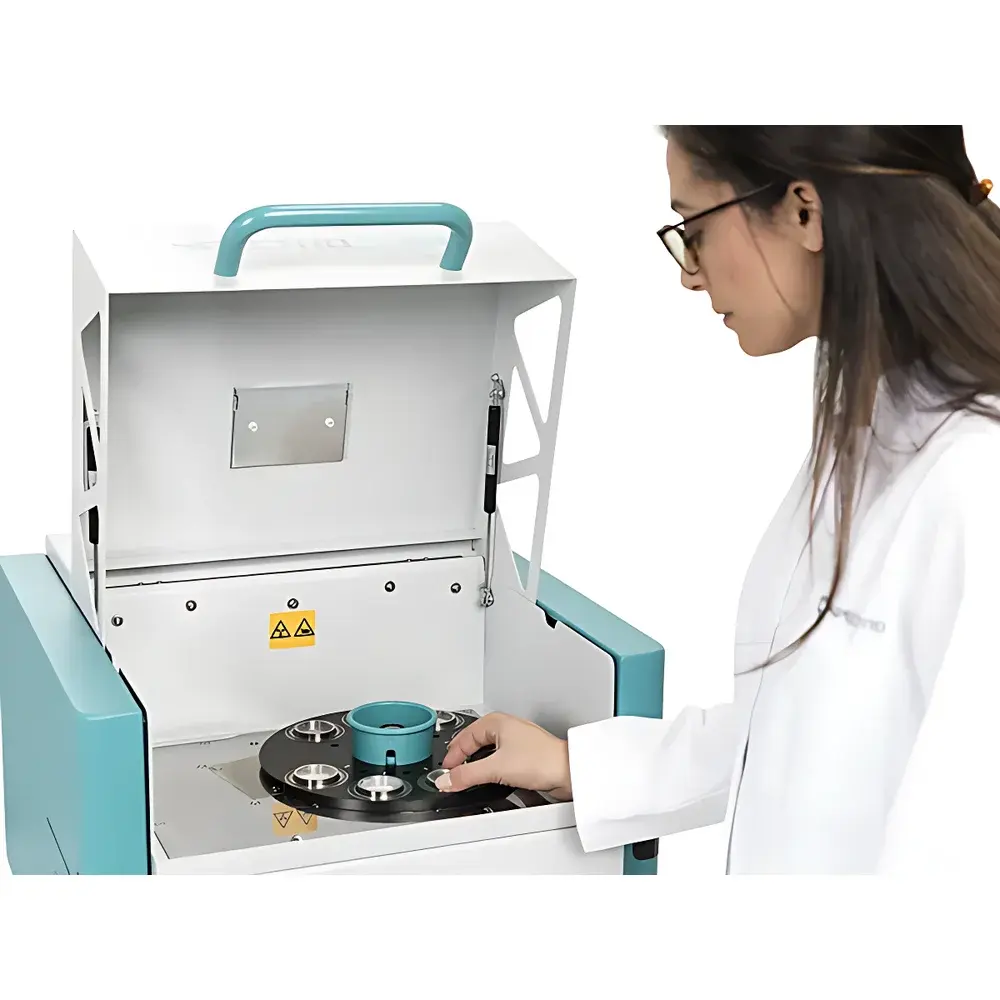
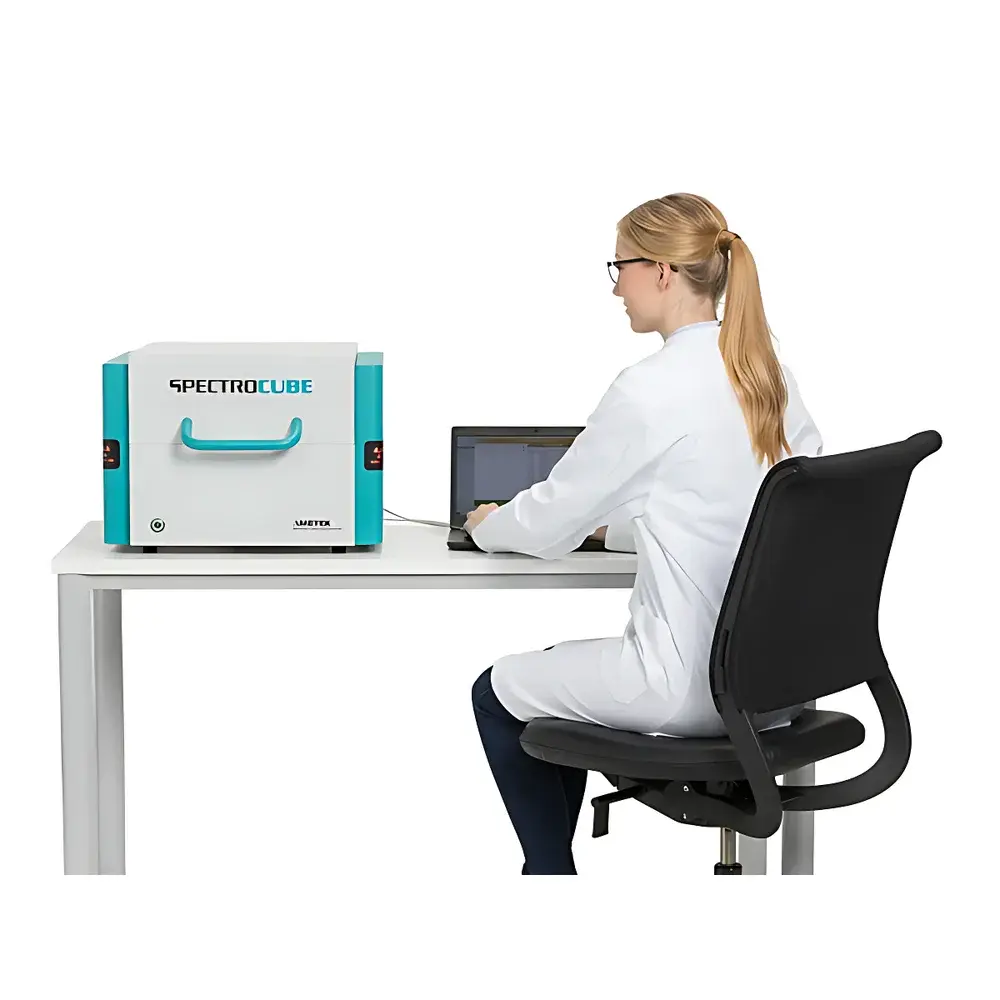
SPECTRO CUBE Polarized Energy Dispersive X-Ray Fluorescence Spectrometer
| Brand | SPECTRO |
|---|---|
| Origin | Germany |
| Model | SPECTRO CUBE |
| Instrument Type | Polarized ED-XRF |
| Elemental Range | Na to U |
| Detection Range | ppm to 100% |
| Energy Resolution | 130 eV |
| Detector | Silicon Drift Detector (SDD) |
| Form Factor | Benchtop/Floor-standing |
| Application Scope | General-purpose |
| Compliance Support | RoHS, ELV, ASTM D7464, ISO 8258, USP <232>/<233>, EPA Method 6200 |
Overview
The SPECTRO CUBE Polarized Energy Dispersive X-Ray Fluorescence (ED-XRF) Spectrometer is an engineered solution for high-precision, non-destructive elemental analysis across diverse industrial and regulatory environments. Built upon polarization-based excitation geometry, the instrument minimizes background scatter—particularly from light matrix elements—thereby enhancing peak-to-background ratios and improving detection limits for trace elements without requiring vacuum or helium purge. Its core architecture integrates a high-brightness microfocus X-ray tube with a precisely aligned polarizer crystal and a large-area, high-count-rate silicon drift detector (SDD), enabling simultaneous multi-element quantification from sodium (Na) to uranium (U) in solid, liquid, and powdered samples. Designed for laboratory, quality control, and regulatory screening workflows, the SPECTRO CUBE delivers certified analytical performance under ISO/IEC 17025–compliant conditions and supports full auditability required for GLP and GMP environments.
Key Features
- Polarized excitation optics reduce spectral background by up to 90%, significantly improving signal-to-noise ratio for low-Z elements (e.g., Mg, Al, Si, P, S, Cl) and enabling reliable detection at sub-ppm levels in favorable matrices.
- High-resolution SDD detector with 130 eV Mn Kα resolution ensures accurate peak deconvolution in complex spectra, critical for overlapping lines in alloys, catalysts, and heterogeneous environmental samples.
- Microfocus X-ray source with 0.2 mm focal spot enables spatially resolved analysis of small or irregularly shaped specimens—including jewelry, electronic components, and coated substrates—without sample homogenization.
- Benchtop/floor-standing modular design accommodates samples up to 300 × 300 × 150 mm (L×W×H); motorized sample stage allows reproducible positioning for sequential multi-point measurements.
- Single universal calibration protocol validated across >30 certified reference materials (CRMs), covering metals, polymers, soils, fuels, and ceramics—eliminating routine recalibration for routine QC applications.
- Ruggedized mechanical construction, including temperature-stabilized detector housing and vibration-damped optical bench, ensures long-term stability and <0.5% RSD over 8-hour continuous operation.
Sample Compatibility & Compliance
The SPECTRO CUBE accepts flat, curved, granular, viscous, and layered samples with minimal preparation—no pelletizing, fusion, or acid digestion required. It complies with international regulatory frameworks including RoHS Directive 2011/65/EU, WEEE, ELV, China RoHS II, and REACH SVHC screening protocols. Analytical methods are pre-validated per ASTM D7464 (sulfur in diesel), ASTM D6443 (Ca, Zn, P in lubricants), ISO 8258 (control charting for QC), and USP / for elemental impurities in pharmaceuticals. All measurement data include full spectral acquisition (full-spectrum storage), enabling retrospective reprocessing and method adaptation as regulatory thresholds evolve—such as newly listed substances under EU SCIP or updated EPA TSCA requirements.
Software & Data Management
The proprietary SPECTRO XRF Suite provides intuitive, role-based workflow navigation with embedded method wizards for rapid setup of RoHS screening, precious metal assay, fuel analysis, or custom calibration. Each analysis session records complete metadata: tube parameters, live-time, dead-time, ambient temperature, detector bias voltage, and raw spectrum (16-bit, 4096-channel). Software supports 21 CFR Part 11–compliant user access controls, electronic signatures, and immutable audit trails—including operator actions, calibration updates, and result modifications. Data export formats include CSV, XML, and ASTM E1358-compliant .spc files; integration with LIMS via OPC UA or RESTful API is supported. Firmware and application modules (e.g., “Fuel Analyzer”, “Jewelry Mode”, “Soil Screening”) are field-upgradable via secure digital signature verification.
Applications
- Precious Metals & Jewelry: Quantitative analysis of Au, Ag, Pt, Pd, Rh, Cu, Ni, Zn in karat gold, platinum alloys, and electroplated articles; detection of prohibited fillers (e.g., tungsten in counterfeit gold bars) using spectral fingerprinting.
- RoHS & Environmental Compliance: Rapid screening of Pb, Cd, Hg, Cr(VI), Br (as PBB/PBDE), and additional restricted substances (e.g., Co, Sb, Se, As) in plastics, PCBs, and packaging materials.
- Fuels & Lubricants: Direct sulfur determination in gasoline, diesel, and biofuels per ASTM D7464; wear metal analysis (Fe, Cu, Al, Si, Cr, Ni, V) in engine oils and hydraulic fluids.
- Geochemical & Mining: Field-deployable quantification of base metals (Cu, Zn, Ni), critical raw materials (Li, Co, Nb, Ta), and contaminants (As, U, Th) in ores, tailings, and soil extracts.
- Catalysts & Ceramics: Stoichiometric evaluation of mixed-metal oxides (e.g., Ni–Mo–Al₂O₃, Co–Ce–ZrO₂) and refractory compositions without dissolution artifacts.
FAQ
Does the SPECTRO CUBE require vacuum or helium purging for light element analysis?
No. Polarized excitation and optimized detector geometry enable reliable quantification of Na, Mg, Al, Si, P, and S in air atmosphere, eliminating consumables and maintenance associated with gas-purge systems.
Can it analyze irregularly shaped or non-flat samples?
Yes. The large sample chamber (300 × 300 × 150 mm) and programmable XYZ stage support height variation up to ±25 mm; optional sample holders accommodate rings, wires, fragments, and irregular geometries.
How is calibration traceability maintained?
All factory calibrations are traceable to NIST SRMs and BAM reference materials; users receive full uncertainty budgets per element and matrix per ISO/IEC 17025 Annex A.3 documentation.
Is spectral reprocessing supported after data acquisition?
Yes. Raw spectra are stored in full resolution; users may apply alternative background models, peak fitting algorithms, or matrix corrections retrospectively without re-measurement.
What cybersecurity measures are implemented in the instrument software?
Firmware and software employ TLS 1.2+ encryption, signed firmware updates, hardware-enforced secure boot, and configurable password policies aligned with IEC 62443-3-3 Level 2 requirements.
Related Products






