
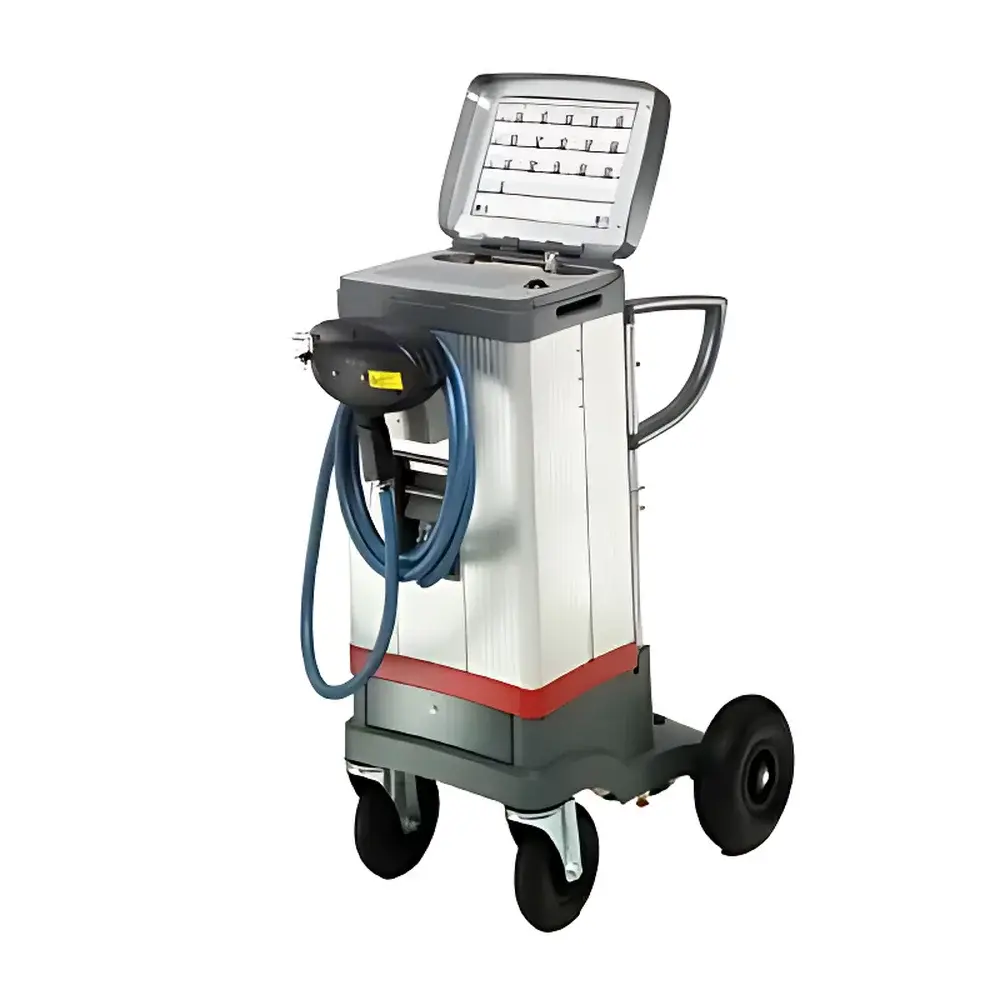
SPECTROTEST CCD Portable Spark Optical Emission Spectrometer
| Brand | SPECTRO |
|---|---|
| Origin | Germany |
| Model | TEST |
| Instrument Type | Portable / Mobile |
| Excitation Source | Spark |
| Detector | CCD (Charge-Coupled Device) |
| Focal Length | 400 mm |
| Grating Groove Density | 3600 lines/mm |
| Wavelength Range | 185–520 nm |
| Spectral Coverage | Full-Spectrum |
| Compliance | CE, RoHS, ISO/IEC 17025-compatible operation |
Overview
The SPECTROTEST CCD is a high-performance portable spark optical emission spectrometer (OES) engineered for precise, on-site elemental analysis of metallic alloys. Based on the fundamental principle of spark-induced plasma emission spectroscopy, the instrument excites solid metal samples using a controlled high-voltage spark discharge, generating characteristic atomic emission lines across the ultraviolet to visible spectrum (185–520 nm). These spectral signatures are dispersed by a high-resolution 3600 lines/mm holographic grating and captured simultaneously by a thermally stabilized CCD detector array — enabling full-spectrum acquisition without mechanical scanning. Unlike sequential or PMT-based systems, the CCD architecture delivers inherent multi-element capability, high signal-to-noise ratio, and excellent long-term intensity stability. Designed and manufactured in Germany by SPECTRO Analytical Instruments, the SPECTROTEST CCD integrates laboratory-grade optical performance — including a 400 mm Paschen-Runge mounting — into a rugged, field-deployable platform suitable for QC labs, foundries, scrap yards, construction sites, and maintenance workshops.
Key Features
- Full-spectrum CCD detection with simultaneous acquisition of all elements in the 185–520 nm range, eliminating sequential wavelength scanning delays
- Robust optical bench with fixed grating and sealed CCD chamber — resistant to dust, vibration, and thermal drift
- Integrated ICAL (Intelligent Calibration Logic) system: continuously monitors and compensates for environmental fluctuations (e.g., ambient temperature shifts, mechanical stress), maintaining calibration integrity without manual re-standardization
- Modular spark/arc excitation gun: tool-free electrode and clamp exchange; rapid switch between spark (for quantitative C, P, S, B, Sn, As analysis in steels) and arc (for rapid grade identification and sorting)
- Ergonomic transport trolley: fully integrated, three-segment disassembly for air freight compliance; height-adjustable operation interface with integrated battery compartment and cable management
- High-efficiency pulsed spark source with adaptive energy control: optimized for low-power operation and extended battery life — up to several hundred sparks per charge
Sample Compatibility & Compliance
The SPECTROTEST CCD supports flat, curved, and irregular metallic surfaces — including pipes, rods, wires, castings, and machined parts — via interchangeable clamps and spring-loaded electrodes. Surface preparation requirements align with ASTM E415 and ISO 11577 for spark OES analysis. The instrument meets EU CE marking directives (2014/30/EU EMC, 2014/35/EU LVD), RoHS 2011/65/EU, and supports GLP/GMP workflows through audit-trail-enabled software logging. While not certified as a medical device or for regulated pharmaceutical release testing, its analytical performance conforms to routine quality control specifications outlined in ASTM E1086 (stainless steels), ASTM E1479 (aluminum alloys), and ISO 14284 (steel sampling and analysis).
Software & Data Management
Controlled via Windows-based SPECTRO Analytical Software (SAS), the system provides intuitive method setup, real-time spectral visualization, and automated grade matching using APF (Analytical Program Finder) logic. APF autonomously identifies sample matrix (e.g., Fe-, Al-, Cu-, Ni-base) from initial spectral data and selects the optimal calibration curve and interference correction algorithm — reducing operator dependency during unknown material screening. All measurement parameters, spectral raw data, calibration history, and user actions are timestamped and stored in encrypted SQLite databases compliant with FDA 21 CFR Part 11 requirements when configured with electronic signature modules. Export formats include CSV, XML, and PDF reports compatible with LIMS integration.
Applications
- In-process verification of alloy composition in casting, forging, and fabrication facilities
- Positive material identification (PMI) for ASME B31.3 and API RP 578 compliance in oil & gas infrastructure
- Scrap metal sorting and recycling stream optimization
- On-site failure analysis and root cause investigation of component fractures or corrosion
- Verification of heat treatment lot traceability and supplier material certifications
- Field inspection of weld deposits, cladding layers, and repair overlays
FAQ
What sample preparation is required before analysis?
Minimal surface cleaning (e.g., grinding or milling to remove oxide layers and contaminants) is required. Flatness and conductivity must meet ASTM E415 guidelines; curvature compensation is supported for pipes ≥25 mm diameter.
Can the instrument analyze light elements such as carbon, phosphorus, and sulfur in steel?
Yes — the 185 nm UV transmission optics and spark excitation enable reliable quantification of C, P, S, B, Sn, and As in ferrous matrices, with detection limits typically ≤10 ppm for carbon under optimized conditions.
Is external cooling or compressed air required for operation?
No — the CCD detector is thermoelectrically cooled; the spark source operates without external gas purge or forced-air cooling, ensuring true battery-powered portability.
How frequently must the instrument be recalibrated?
ICAL technology minimizes drift-related recalibration needs; standard practice is quarterly verification with certified reference materials (CRMs), with full recalibration recommended annually or after major hardware service.
Does the system support remote diagnostics or firmware updates?
Yes — via secure HTTPS connection, authorized service engineers can perform remote health checks, log analysis, and controlled firmware upgrades while preserving calibration validity and audit trail integrity.



