
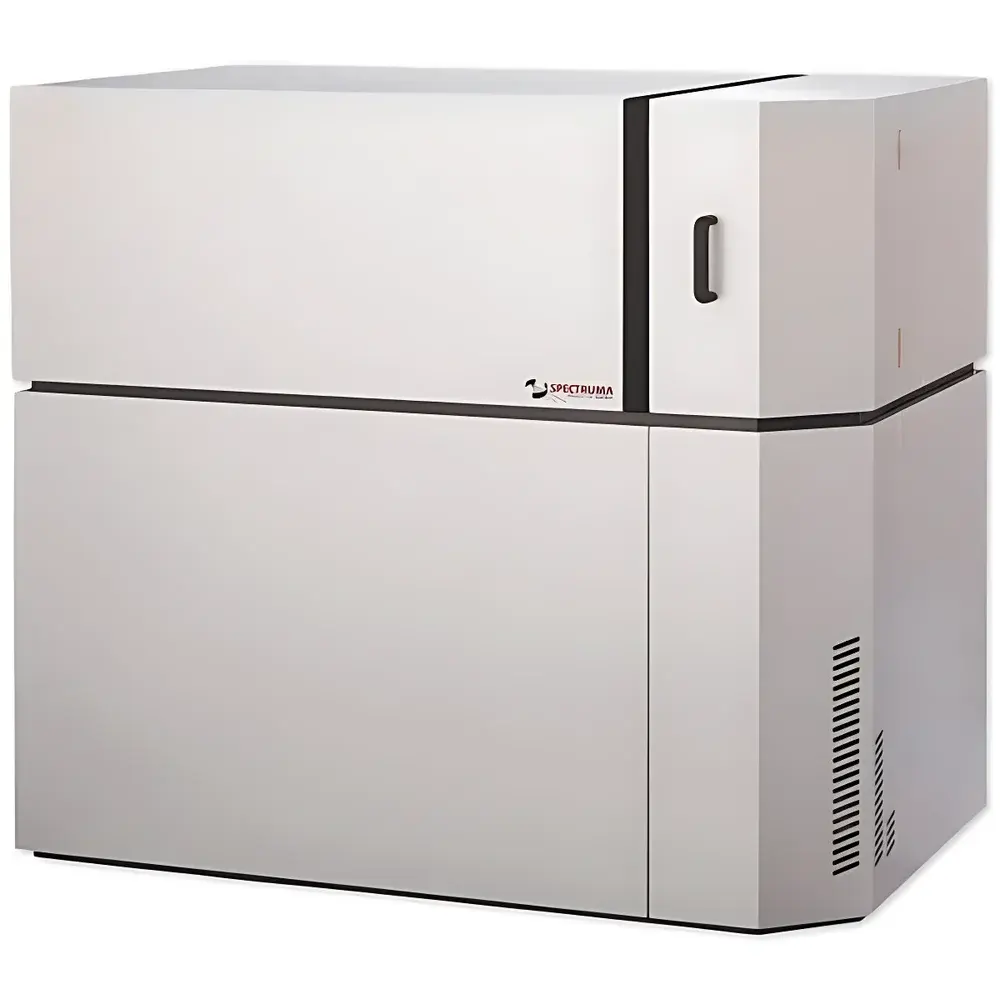
SPECTRUMA GDA 750 HR High-Resolution Glow Discharge Optical Emission Spectrometer
| Origin | Germany |
|---|---|
| Manufacturer Type | Authorized Distributor |
| Origin Category | Imported Instrument |
| Model | GDA 750 HR |
| Price Range | USD 195,000 – 260,000 |
Overview
The SPECTRUMA GDA 750 HR is a high-resolution glow discharge optical emission spectrometer (GDOES) engineered for quantitative depth profiling and bulk compositional analysis of conductive and non-conductive solid materials. Operating on the principle of radiofrequency (RF) or pulsed DC glow discharge plasma sputtering coupled with simultaneous multi-element optical emission detection, the GDA 750 HR enables direct solid sampling without dissolution or matrix-matching requirements. Its robust RF power supply supports stable plasma generation over insulating layers—enabling accurate analysis of ceramics, oxide films, painted coatings, and glass substrates. The instrument’s vacuum architecture incorporates an oil-free turbomolecular pump to eliminate hydrocarbon contamination, ensuring ultra-low background intensities and enhanced signal-to-noise ratio for trace-level detection in thin-film and interface studies. Designed for R&D laboratories requiring high spatial resolution and analytical flexibility, the GDA 750 HR delivers sub-100 nm depth resolution with profiling depths up to 200 µm—making it suitable for advanced metallurgical characterization, surface engineering validation, and functional coating development.
Key Features
- RF-powered glow discharge source enabling direct analysis of non-conductive samples (e.g., oxides, nitrides, polymers, ceramics, and lacquered metals)
- Simultaneous detection of up to 79 elements via photomultiplier tube (PMT) channels with optimized spectral line selection for major, minor, and trace constituents
- Optional high-resolution SPECTRUMA CCD optical system for extended elemental coverage and flexible line selection without hardware reconfiguration
- Oil-free turbomolecular vacuum pumping system ensuring hydrocarbon-free sputtering environment and improved long-term calibration stability
- Pulsed and continuous discharge modes for optimized sputter rate control, reduced thermal load, and enhanced depth resolution in layered structures
- Automated sample handling with motorized XYZ stage supporting irregularly shaped and curved specimens (e.g., turbine blades, gear teeth, coated wires)
Sample Compatibility & Compliance
The GDA 750 HR accommodates a broad range of solid-state materials including ferrous and non-ferrous alloys, refractory metals, sintered carbides, electroplated layers, PVD/CVD coatings, anodized aluminum, and dielectric thin films. Its RF excitation capability eliminates the need for conductive backing or carbon coating—critical for maintaining native surface chemistry during analysis. The system complies with ISO/IEC 17025 requirements for testing laboratories and supports audit-ready documentation for GLP and GMP environments. Depth profile data meets ASTM E3061–17 (Standard Practice for Quantitative Analysis of Metallic Coatings by Glow Discharge Optical Emission Spectrometry) and ISO 14707:2021 (Metallic and other inorganic coatings — Glow discharge optical emission spectrometry for depth profile analysis). All calibration protocols are traceable to NIST SRM reference materials.
Software & Data Management
Controlled via SPECTRUMA’s proprietary GD-Analyzer software, the GDA 750 HR provides intuitive method setup, real-time spectrum visualization, and automated quantification using matrix-matched or fundamental parameter-based calibration models. The software includes built-in uncertainty estimation per layer, drift correction algorithms, and cross-platform export (CSV, XML, SPC) compatible with LIMS integration. Audit trail functionality records all user actions, parameter changes, and calibration events in accordance with FDA 21 CFR Part 11 requirements. Batch processing tools support comparative depth profiling across multiple samples, while scripting interfaces allow custom reporting for internal QA/QC workflows.
Applications
- Depth-resolved quantification of Zn, Al, Cr, Ni, and Sn in galvanized, aluminized, and electroplated steel substrates
- Interface analysis of diffusion barriers (e.g., TiN/Ta in semiconductor interconnects) and oxidation kinetics in high-temperature alloys
- Thickness and stoichiometry verification of anti-reflective, hard, and decorative PVD coatings on automotive and aerospace components
- Bulk composition verification of powder metallurgy parts, additive manufacturing builds, and recycled metal feedstocks
- Failure analysis of delamination, interfacial corrosion, and hydrogen embrittlement in multi-layered systems
FAQ
Can the GDA 750 HR analyze insulating materials such as glass or ceramic without conductive coating?
Yes—the integrated RF glow discharge source generates stable plasma directly on non-conductive surfaces, eliminating the need for carbon or metal sputter-coating and preserving original surface chemistry.
What is the typical depth resolution achievable with the GDA 750 HR?
Under optimized RF pulsing and low-power sputtering conditions, depth resolution below 10 nm is routinely achieved at the near-surface region; average resolution across multilayer stacks ranges from 2–15 nm depending on material sputter yield and interface sharpness.
Is the instrument compatible with regulatory-compliant data integrity standards?
Yes—GD-Analyzer software supports electronic signatures, role-based access control, and full audit trail logging compliant with FDA 21 CFR Part 11, EU Annex 11, and ISO/IEC 17025 documentation requirements.
How many elements can be quantified simultaneously in a single run?
Up to 79 elements are supported via PMT configuration; the optional CCD optics module enables dynamic reconfiguration of spectral lines without hardware modification, supporting virtually unlimited elemental combinations across successive analyses.
Does the system require liquid nitrogen or external cryogenic cooling?
No—the detector subsystem operates at ambient temperature with thermoelectric stabilization; no cryogens or external chillers are required for routine operation or high-sensitivity trace detection.




