
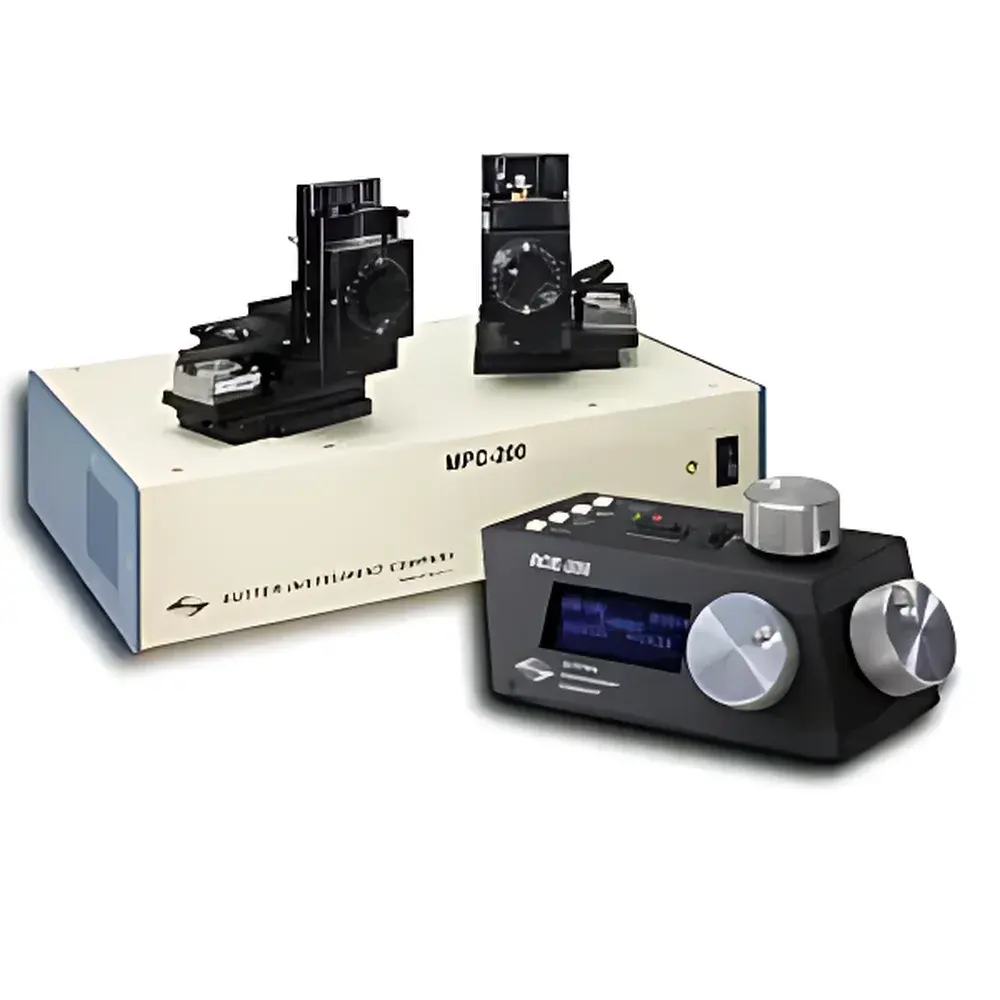
Sutter MPC-200 / MPC-385 / MPC-325 Micromanipulator
| Brand | Sutter |
|---|---|
| Origin | USA |
| Model | MPC-200 / MPC-385 / MPC-325 |
| Drive Type | Motorized (DC servo) |
| Position Resolution | ≤ 10 nm (closed-loop) |
| Travel Range (X/Y/Z) | 25 mm × 25 mm × 25 mm (standard) |
| Repeatability | ±0.1 µm |
| Max Load Capacity | 250 g |
| Compatibility | Standard micropipette holders (e.g., Sutter MO-103, MO-203), compatible with upright & inverted microscopes |
| Interface | Analog voltage input (±10 V), RS-232, optional USB-to-serial adapter |
| Operating Temperature | 15–30 °C |
| Humidity | 20–80% RH (non-condensing) |
Overview
The Sutter MPC-200, MPC-385, and MPC-325 are high-precision motorized micromanipulators engineered for demanding electrophysiological applications—particularly whole-cell patch-clamp, sharp-electrode intracellular recording, and single-cell microinjection. These instruments operate on a closed-loop DC servo motor architecture, delivering sub-micrometer positional stability and nanometer-scale resolution in all three orthogonal axes (X, Y, Z). Unlike open-loop stepper-based systems or temperature-sensitive hydraulic manipulators, the MPC series employs real-time position feedback via integrated optical encoders, minimizing thermal drift and ensuring long-term positional fidelity during extended recordings (>1 hr). Designed as streamlined derivatives of the industry-standard MP-285, the MPC models retain core motion control performance—including programmable acceleration profiles, velocity ramping, and backlash compensation—while optimizing cost-efficiency for labs prioritizing reliability and reproducibility over advanced multi-channel synchronization or automated protocol scripting.
Key Features
- Three-axis motorized control with independent fine/coarse adjustment modes—coarse travel up to 25 mm per axis, fine resolution ≤10 nm (closed-loop)
- Optically encoded position feedback ensures <±0.1 µm repeatability and eliminates step-loss under load
- Low-inertia, low-backlash mechanical design minimizes vibration transmission to pipettes during approach and seal formation
- Compatible with standard Sutter micropipette holders (MO-103, MO-203) and widely adopted microscope stages (Olympus BX, Nikon Eclipse, Zeiss Axio series)
- Analog ±10 V input support enables seamless integration with commercial patch-clamp amplifiers (e.g., Axon Multiclamp 700B, HEKA EPC10) for coordinated voltage-controlled positioning
- RS-232 serial interface allows bidirectional communication with acquisition software (e.g., pCLAMP, PatchMaster) for time-synchronized movement logging and GLP-compliant audit trails
Sample Compatibility & Compliance
The MPC series accommodates glass micropipettes (tip OD 1.0–1.5 mm), borosilicate capillaries, and patch-clamp electrodes across standard taper geometries. Its rigid aluminum alloy frame and kinematic mounting system ensure mechanical stability under varying thermal and acoustic conditions typical of core electrophysiology suites. The devices comply with IEC 61000-4 electromagnetic compatibility standards and meet UL/CSA safety requirements for laboratory instrumentation. While not certified for ISO 13485 medical device use, their design adheres to principles aligned with Good Laboratory Practice (GLP) and current Good Manufacturing Practice (cGMP) documentation workflows—particularly when paired with software supporting 21 CFR Part 11-compliant electronic signatures and audit trail generation.
Software & Data Management
Sutter provides the freely distributed MPC Control Utility—a lightweight Windows application enabling manual jog control, preset position recall (up to 16 locations), and basic macro sequencing. For advanced integration, third-party drivers (LabVIEW, MATLAB, Python via PySerial) support custom automation of electrode approach trajectories, contact detection routines, and stimulus-synchronized movement. All position data can be timestamped and exported in CSV format, facilitating correlation with electrophysiological traces in Clampex or Igor Pro. When used within validated environments, the system supports traceable calibration logs and user-access-level permissions through host acquisition platforms compliant with FDA 21 CFR Part 11 Annex 11 requirements.
Applications
- Whole-cell and perforated-patch clamp recordings from neurons, cardiomyocytes, and primary cultured cells
- Sharp-electrode intracellular recording in brain slice preparations and invertebrate ganglia
- Single-cell microinjection of dyes, plasmids, or CRISPR-Cas9 ribonucleoprotein complexes
- Controlled positioning of stimulating electrodes in dual-patch or field stimulation configurations
- Correlative live-cell imaging where precise pipette placement must coincide with confocal or two-photon excitation volumes
FAQ
What distinguishes the MPC-385 from the MPC-325 and MPC-200?
The MPC-385 includes integrated analog voltage output for real-time position monitoring, while the MPC-325 adds RS-232 firmware update capability and enhanced thermal compensation algorithms. The MPC-200 is the entry-tier model with identical mechanics but simplified electronics and no analog output.
Can the MPC series be used with inverted microscopes?
Yes—the manipulators feature adjustable mounting brackets compatible with standard dovetail and magnetic base configurations used on Nikon Ti, Leica DMi8, and Zeiss Axio Observer platforms.
Is closed-loop feedback active during both coarse and fine movement modes?
Yes—position sensing remains continuous across all motion speeds and ranges, ensuring consistent accuracy regardless of selected scale.
Does Sutter provide calibration certificates traceable to NIST standards?
Calibration reports documenting encoder linearity, repeatability, and cross-axis orthogonality are available upon request and conform to ISO/IEC 17025 guidelines when performed by authorized service centers.
How is drift performance quantified under physiological recording conditions?
Typical thermal drift is 4-hour experiments.




