
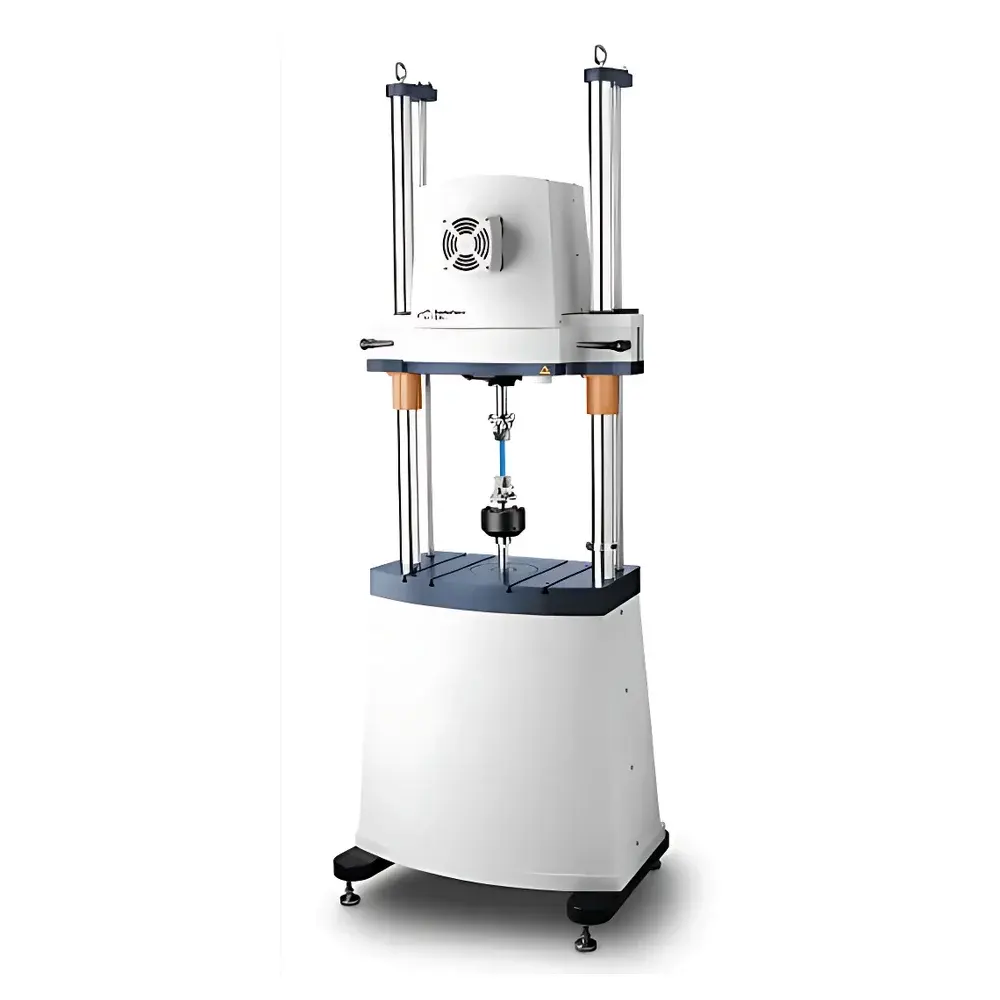
TA Instruments ElectroForce® 3300 Series Mechanical Testing System
| Brand | TA Instruments |
|---|---|
| Origin | USA |
| Model | ElectroForce® 3300 |
| Frequency Range | 0.0001 – 100 Hz |
| Load Capacity Options | ±1000 N or ±3000 N (axial) |
| Torsion Options | ±14 N·m or ±25 N·m |
| Linear Stroke Extension Option | +150 mm |
| Force Resolution | ±0.02 N to ±3000 N |
| Drive Type | High-Performance Linear Electromagnetic Motor |
| Encoder Resolution | High-Resolution Optical Encoder (up to 62 revolutions for torsion) |
Overview
The TA Instruments ElectroForce® 3300 Series Mechanical Testing System is a high-precision, servo-electromagnetic platform engineered for dynamic mechanical characterization of materials, components, and biomedical devices under controlled force, displacement, and strain conditions. Unlike hydraulic or electromechanical screw-driven testers, the ElectroForce 3300 employs a direct-drive linear electromagnetic motor architecture—eliminating backlash, friction, and maintenance-intensive components—to deliver true closed-loop control across an exceptionally broad frequency spectrum (0.0001 Hz to 100 Hz). This enables rigorous time-dependent testing protocols including cyclic fatigue, creep, stress relaxation, hysteresis analysis, and multi-axis mechanical spectroscopy. The system’s modular frame design supports axial-only, axial-torsional, and extended-stroke configurations—making it suitable for ASTM E466, ISO 1099, ASTM F2118, and ISO 14879-1 compliant testing in R&D, quality assurance, and regulatory submission environments.
Key Features
- Electromagnetic actuation with zero mechanical transmission losses—ensuring high-fidelity waveform fidelity and phase accuracy even at sub-mHz frequencies.
- Selectable axial load frames: ±1000 N and ±3000 N configurations, each with interchangeable force transducers calibrated to NIST-traceable standards.
- Integrated torsion module options: ±14 N·m and ±25 N·m electromagnetic torque motors, coupled with optical encoders resolving up to 62 full rotations with <0.01° angular repeatability.
- Extended stroke option adds 150 mm of linear travel—enabling large-deformation testing of elastomers, stents, or soft tissue analogs without hardware reconfiguration.
- Motorized crosshead positioning with tool-free locking mechanism and micrometer-level fine adjustment—reducing setup time while maintaining positional reproducibility within ±1 µm.
- T-slot base plate with standardized mounting patterns for rapid integration of environmental chambers, fluid baths, or custom fixtures.
Sample Compatibility & Compliance
The ElectroForce 3300 accommodates specimens ranging from micro-scale biomaterials (e.g., suture threads, hydrogel films) to macro-scale orthopedic implants and polymer composites. Its modular fixture ecosystem includes pneumatic, wedge-grip, pin-loaded, and custom-machined solutions compatible with ASTM D638, ISO 527, ASTM F2129, and USP geometries. Optional environmental modules—such as −70 °C to +300 °C temperature chambers, saline immersion baths, and sterile bioreactor interfaces—support GLP-compliant long-term fatigue studies per ISO 14242-1 and FDA guidance for implantable device longevity assessment. All force and displacement channels meet ISO/IEC 17025 calibration traceability requirements, and system validation documentation aligns with IQ/OQ/PQ protocols for regulated laboratories.
Software & Data Management
Control and analysis are performed via TRIOS™ Software—a platform validated under FDA 21 CFR Part 11 with full audit trail, electronic signature, and role-based access control. Test method templates support pre-defined sequences for sinusoidal, triangular, ramp-hold, and random waveform profiles—including user-defined harmonic superposition for complex loading spectra. Real-time data acquisition operates at up to 10 kHz sampling rate, with synchronized capture of force, displacement, torque, angle, temperature, and auxiliary analog inputs. Export formats include ASTM E1432-compliant .tdms, HDF5, and CSV; raw datasets retain full metadata (calibration coefficients, environmental conditions, operator ID) for traceability. Optional DMA module extends capabilities to viscoelastic parameter extraction (E′, E″, tan δ) using dynamic mechanical analysis algorithms per ASTM D4065.
Applications
- Fatigue life prediction of cardiovascular stents, dental implants, and spinal fixation devices under physiological loading waveforms.
- Mechanical property mapping of thermoplastic elastomers, shape-memory polymers, and hydrogels across temperature and hydration states.
- Creep and stress relaxation quantification for adhesives, sealants, and packaging films per ASTM D2990.
- Multi-axial biomechanical testing of tendon-bone complexes, cartilage explants, and engineered tissue constructs.
- High-cycle vibration durability assessment of MEMS components, battery electrode laminates, and aerospace composite joints.
FAQ
What is the minimum resolvable force on the ElectroForce 3300 system?
The system supports interchangeable load cells down to ±0.02 N full scale, enabling high-sensitivity measurement of soft biological tissues and microscale polymer films.
Can the ElectroForce 3300 perform simultaneous axial-torsional fatigue testing?
Yes—dual-axis control is achieved via synchronized command of the axial electromagnetic motor and optional torsional motor, with phase-shifted waveform generation and independent PID tuning per axis.
Is the system compatible with third-party environmental chambers?
All standard chamber interfaces use industry-standard flange dimensions and analog/digital I/O ports (0–10 V, RS-232, Ethernet/IP), allowing seamless integration with major OEM environmental systems.
Does TRIOS software support automated pass/fail criteria for fatigue test termination?
Yes—users can define real-time termination logic based on stiffness decay, cycle count, displacement drift, or energy dissipation thresholds, with configurable alerts and report generation.
How is system calibration maintained over extended testing campaigns?
TRIOS includes automated calibration verification routines that monitor transducer linearity, amplifier gain stability, and encoder resolution drift—triggering notifications when deviations exceed ISO 7500-1 Class 0.5 tolerances.



