
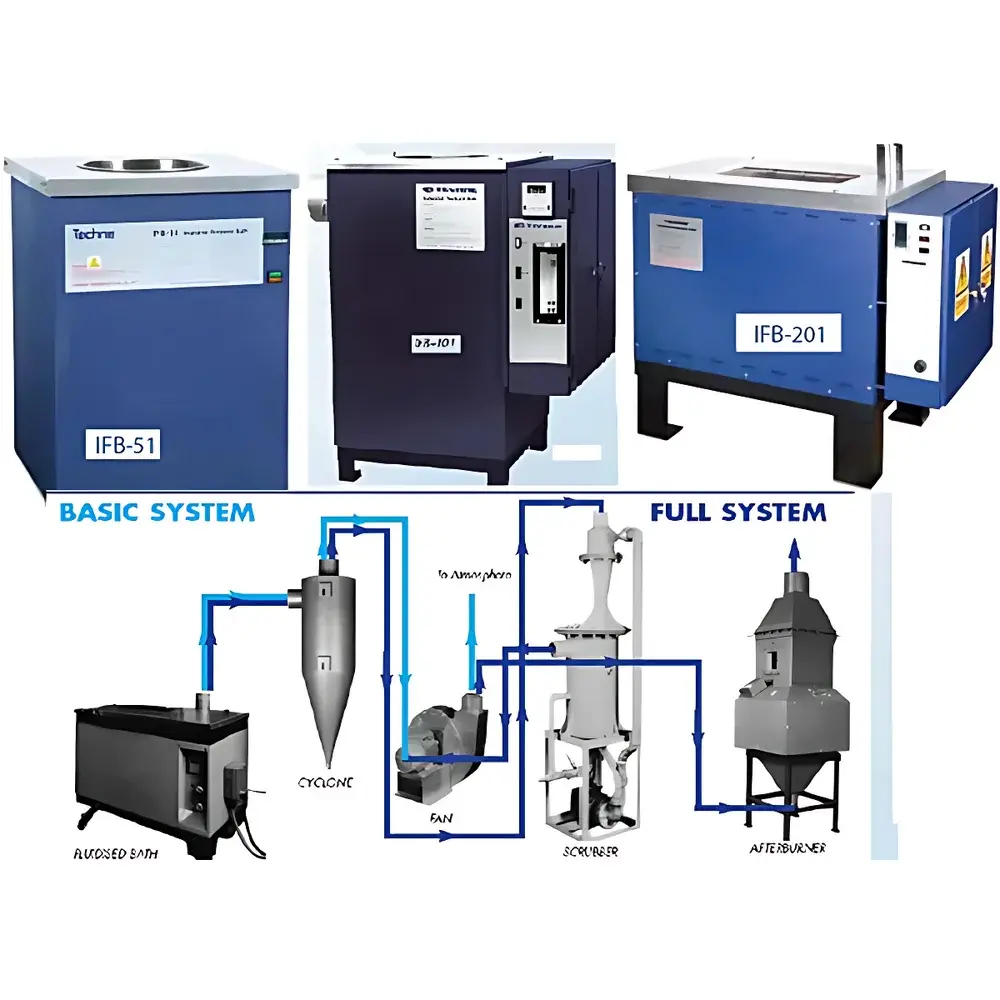
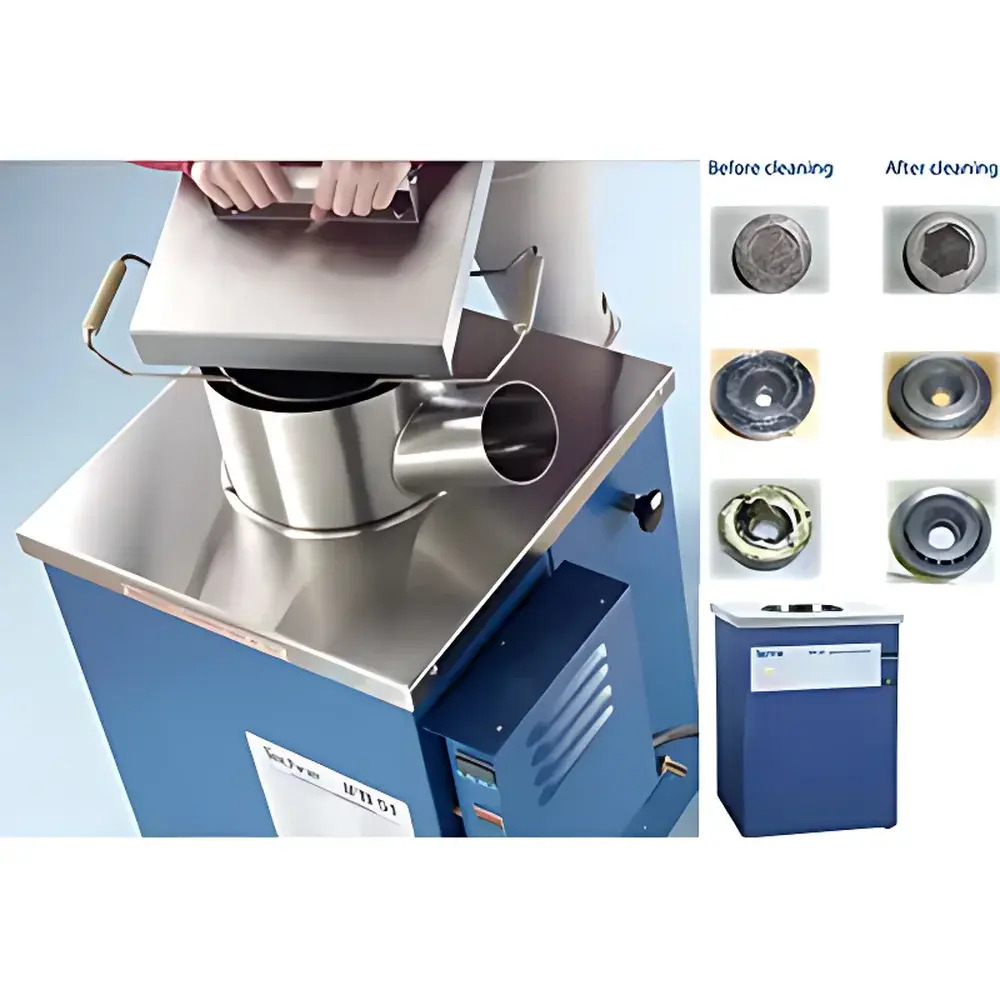
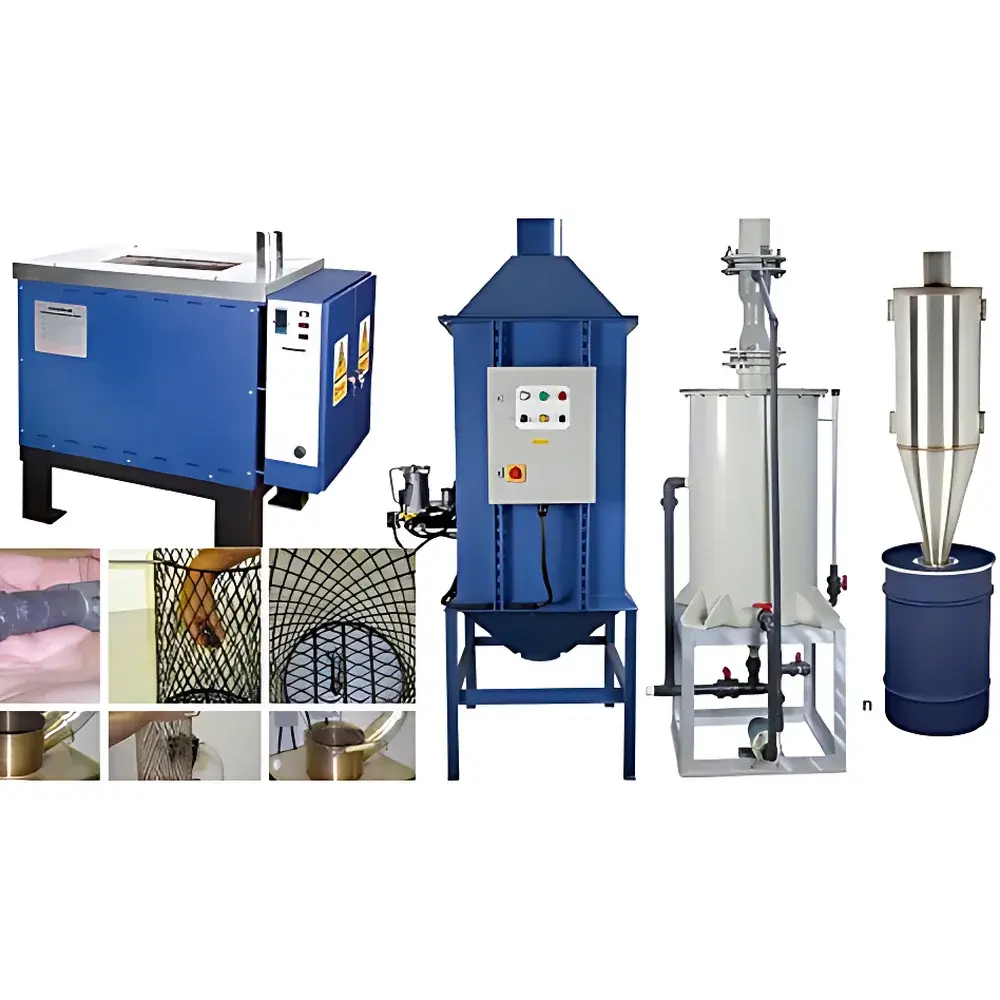
Techne IFB-52 Fluidized Bed Sand Bath
| Brand | Techne |
|---|---|
| Origin | USA |
| Model | IFB-52 |
| Temperature Range | 50–600 °C |
| Temperature Uniformity | ±1.0 °C |
| Heating Power | 25 kW·h (operational energy consumption) |
| Chamber Dimensions (D × H) | 25.9 cm × 66 cm |
| External Dimensions (L × W × H) | 104 cm × 61 cm × 54 cm |
| Voltage | 480 V, 3-phase |
| Weight (empty) | 84 kg |
| Weight (with alumina medium) | 200 kg |
| Air Inlet Pressure | 0.2 MPa |
| Air Flow Rate | 160 L/min |
| Control System | 3-term PID with K-type thermocouple |
Overview
The Techne IFB-52 Fluidized Bed Sand Bath is an industrial-grade thermal cleaning system engineered for the controlled, solvent-free pyrolytic removal of organic residues—including thermoplastics, thermosets, elastomers, coatings, adhesives, lubricants, and hydrocarbon-based contaminants—from metal tooling, molds, extrusion components, and precision instrumentation. Unlike conventional oven-based thermal desorption or abrasive mechanical cleaning, the IFB-52 utilizes a fluidized bed of high-purity aluminum oxide (Al₂O₃) particles heated to operational temperatures up to 600 °C. Compressed air or inert gas (e.g., nitrogen or argon) is introduced through a porous distribution plate at the base of the chamber, inducing turbulent suspension of the granular medium. This creates a homogeneous, high-heat-transfer thermal environment—functionally equivalent to a liquid bath—with exceptional spatial temperature uniformity (±1.0 °C) and rapid thermal response. The process operates under atmospheric pressure and relies on oxidative pyrolysis: organic material undergoes endothermic decomposition followed by exothermic oxidation, yielding CO₂, H₂O vapor, and trace ash—leaving substrates clean, dimensionally stable, and free from thermal shock-induced microcracking or metallurgical degradation.
Key Features
- Fluidized bed architecture ensures uniform heat transfer across complex geometries—including deep cavities, fine nozzles, threaded inserts, and micro-orifices—without mechanical abrasion or surface damage.
- 3-term PID temperature control with K-type thermocouple feedback delivers precise setpoint stability and repeatability across extended cycles (30 min to 2 hr typical).
- No consumables required: eliminates solvents, blasting media, acids, or hazardous chemicals—reducing disposal costs, regulatory burden, and occupational exposure risks.
- Energy-efficient operation: rated at 25 kW·h per standard cleaning cycle; optimized thermal mass and insulation minimize standby losses.
- Integrated safety system includes lid-mounted cyclone separator and exhaust fan to capture non-hazardous fumes and particulates during routine operation.
- Modular gas handling: compatible with compressed air, nitrogen, or argon supply lines; inlet pressure regulated to 0.2 MPa with flow metering up to 160 L/min.
- Robust stainless-steel construction with ceramic-insulated heating elements ensures long-term reliability in continuous production environments.
Sample Compatibility & Compliance
The IFB-52 accommodates a wide range of metallic substrates—including hardened steel, stainless alloys, titanium, and aluminum tooling—without compromising hardness, tensile strength, or dimensional integrity. It effectively removes PVC, PET, PEEK, fluoropolymers, epoxies, silicone rubbers, polyurethanes, and cured paint systems. For applications involving halogenated polymers (e.g., PVC), optional downstream abatement—such as acid gas scrubbers (HCl removal), afterburners (for VOC/soot suppression), or cyclonic alumina recovery units—is recommended to meet local emissions standards (e.g., EPA Method 25A, EN 13649, or ISO 14001 environmental management requirements). The system supports GLP-compliant documentation when integrated with validated data logging and audit-trail-capable controllers. All electrical components conform to IEC 61000-6-2 (EMC immunity) and IEC 60204-1 (machine safety).
Software & Data Management
While the IFB-52 operates via a dedicated front-panel PID controller, it supports analog output (4–20 mA) for integration into centralized SCADA or LIMS platforms. Optional data acquisition modules enable time-stamped recording of temperature profiles, airflow rates, and cycle duration—facilitating traceability for quality audits (e.g., ISO 9001, AS9100, or FDA 21 CFR Part 11 compliance when paired with electronic signature validation). Process parameters are stored in non-volatile memory and can be recalled via preset program numbers. No proprietary software installation is required; configuration remains accessible through physical interface only—minimizing cybersecurity attack surface and IT maintenance overhead.
Applications
- Cleaning injection molds, blow molds, and die-cast tooling in medical device and automotive manufacturing.
- Regeneration of extrusion screws, dies, and filtration screens in polymer processing lines.
- Preparation of surgical instrument components—including cardiovascular stent mandrels—prior to electropolishing or coating.
- Thermal conditioning of calibration standards for DSC, TGA, and DMA instruments.
- Controlled annealing and stress-relief heat treatment of precision machined parts.
- Supporting ASTM D5630 (ash content), ASTM D3418 (Tg by DSC), and ISO 11357 series thermal analysis protocols through stable, uniform bath conditions.
FAQ
What types of materials can be safely processed in the IFB-52 without damaging the aluminum oxide medium?
Alumina (Al₂O₃) is chemically inert toward most organics and stable up to 1700 °C. Routine cleaning of plastics, resins, oils, and greases does not degrade the medium. However, repeated exposure to halogenated compounds may necessitate periodic medium replacement or regeneration using the CN-100 cyclone recovery unit.
Is the IFB-52 suitable for cleaning aluminum or magnesium tooling?
Yes—provided operating temperature remains below the substrate’s solidus point (e.g., <450 °C for most Al alloys). The fluidized bed’s gentle thermal convection avoids localized overheating and minimizes intergranular oxidation risk.
Can the system operate under inert atmosphere for oxygen-sensitive substrates?
Yes. Nitrogen or argon purging is supported via standard inlet ports and pressure-regulated flow control. Oxygen concentration can be reduced to <100 ppm with appropriate gas monitoring and purge sequencing.
What maintenance intervals are recommended for long-term reliability?
Daily visual inspection of air distributor plate and cyclone; quarterly calibration of thermocouple and flow meter; annual verification of heater resistance and insulation integrity per manufacturer service protocol F-MAINT-IFB.
Does the IFB-52 require external ventilation ducting?
For non-halogenated polymer cleaning, the integrated cyclone and fan suffice. When processing PVC or other halogen-rich materials, connection to an FSSR1 scrubber or FSAB1 afterburner is mandatory to comply with OSHA PEL and local air quality ordinances.



