TeraSense Ultrafast Sub-THz Detector
| Brand | TeraSense |
|---|---|
| Origin | Russia |
| Model | Ultrafast |
| Spectral Range | 0.05–0.7 THz |
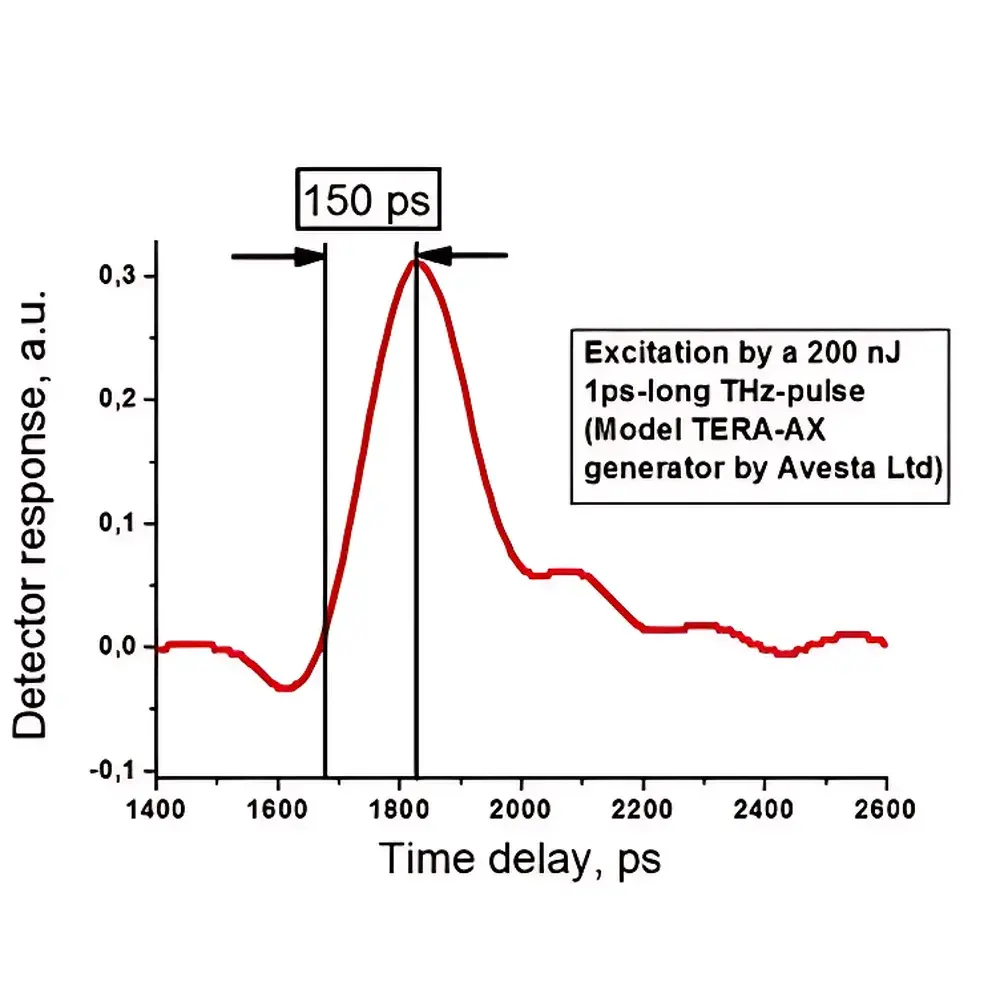
| Response Time | <150 ps |
| Responsivity (typ.) | 1 V/W |
| NEP | 1 nW/Hz⁰·⁵ |
| Active Area | 3 × 3.5 mm |
| Dimensions | 23 × 29 × 6.5 mm |
| Excitation Compatibility | 200 nJ, 1 ps Laser Pulses (0.1–3 THz Band) |
Overview
The TeraSense Ultrafast Sub-THz Detector is a solid-state, bias-free photoconductive detector engineered for time-resolved characterization of transient sub-terahertz radiation in the 0.05–0.7 THz band. Unlike conventional bolometric or pyroelectric detectors, this device operates on ultrafast carrier dynamics in low-temperature-grown gallium arsenide (LT-GaAs) or similar photoconductive substrates—enabling direct electrical readout of sub-picosecond THz transients without external amplification or DC bias. Its intrinsic response time of less than 150 ps supports time-domain spectroscopy (TDS), pump-probe experiments, and real-time monitoring of ultrafast electronic switching phenomena in semiconductor devices, metamaterials, and plasmonic structures. Designed for integration into femtosecond laser-driven THz generation setups, it delivers high signal-to-noise ratio detection under single-shot or repetitive excitation with 1 ps optical pulses (200 nJ energy), making it suitable for both laboratory-scale research and industrial THz source calibration workflows.
Key Features
- Sub-150 ps intrinsic temporal response—optimized for time-domain THz pulse analysis and transient carrier lifetime measurements
- Bias-free passive operation: eliminates noise contributions from power supplies and enables stable long-term measurements under ambient conditions
- High responsivity of 1 V/W (typ.) across the 0.05–0.7 THz band, enabling detection of weak pulsed THz fields without cryogenic cooling
- Low noise equivalent power (NEP) of 1 nW/Hz⁰·⁵—supporting high-fidelity amplitude and phase reconstruction in broadband THz-TDS systems
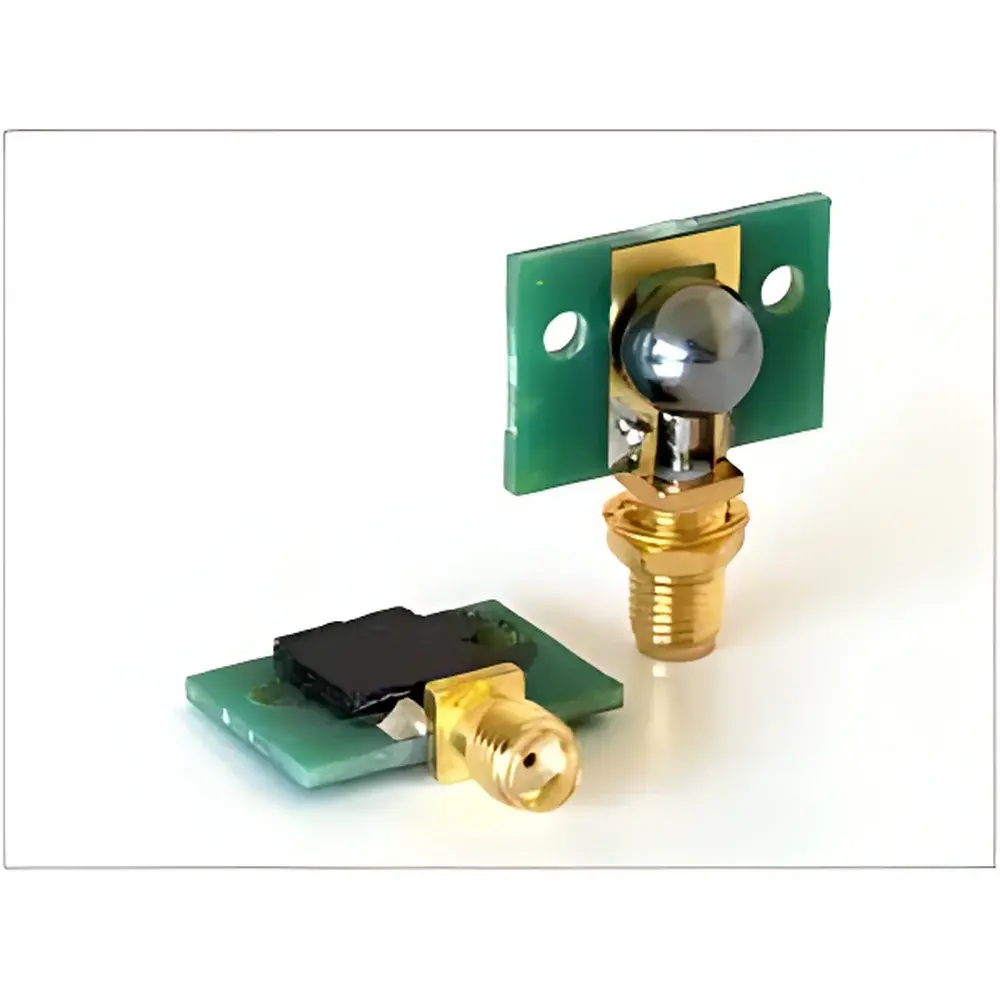
- Compact form factor (23 × 29 × 6.5 mm) with customizable output connectors (SMA or MMCX) and active area geometry (standard 3 × 3.5 mm)
- Compatible with standard 1 ps Ti:sapphire or fiber-based femtosecond laser systems operating at 800 nm or 1550 nm wavelengths
Sample Compatibility & Compliance
The detector is optimized for free-space THz beam coupling and integrates seamlessly with off-axis parabolic mirrors, silicon lenses, and wire-grid polarizers commonly used in THz optics benches. Its planar active region supports polarization-sensitive measurements when aligned with incident THz electric field orientation. While not certified to ISO/IEC 17025 for metrological traceability, the device conforms to standard laboratory safety practices for Class 1 optical equipment (IEC 60825-1) and meets electromagnetic compatibility requirements per CISPR 32. It is routinely deployed in environments compliant with GLP and academic GMP frameworks where instrument qualification, calibration history, and raw data traceability are maintained via external oscilloscope logging (e.g., Keysight Infiniium or Tektronix DPO70000 series).
Software & Data Management
As a passive analog sensor, the TeraSense Ultrafast Sub-THz Detector does not incorporate onboard firmware or digital interfaces. Output signals are delivered as voltage transients directly to high-bandwidth oscilloscopes (≥20 GHz analog bandwidth recommended). Raw waveform acquisition, time-zero alignment, FFT-based spectral extraction, and phase retrieval are performed using vendor-agnostic software platforms including MATLAB (with Signal Processing Toolbox), Python (NumPy/SciPy + PyTDC), or commercial THz analysis suites such as TeraView’s TeraStudio or Menlo Systems’ TeraScan Control. All acquired waveforms retain full timestamping and hardware synchronization metadata when captured via oscilloscope trigger outputs, satisfying audit requirements for FDA 21 CFR Part 11-compliant laboratories where electronic records and signatures are implemented.
Applications
- Time-domain spectroscopy (THz-TDS) for material characterization—including carrier mobility mapping in 2D semiconductors, phonon resonance identification in perovskites, and hydration state analysis in biomolecules
- Calibration and alignment of pulsed THz sources such as photoconductive antennas (PCAs), optical rectification crystals (e.g., ZnTe, GaP), and air-plasma emitters
- Ultrafast electronics validation—measuring transient response of THz modulators, graphene-based switches, and integrated plasmonic circuits
- Non-destructive evaluation (NDE) of multilayer polymer films and composite laminates where sub-surface delamination manifests as picosecond-scale echo delays
- Fundamental studies of light–matter interaction in topological insulators, superconductors, and strongly correlated electron systems under THz excitation
FAQ
Is the detector sensitive to continuous-wave (CW) THz radiation?
No—it is optimized for pulsed THz fields generated by femtosecond lasers; CW sensitivity is negligible due to its ultrafast carrier recombination kinetics.
Can the spectral response be tuned post-manufacture?
No—peak responsivity is defined during fabrication via antenna geometry and substrate doping profile; however, custom designs with shifted resonance bands are available upon request.
What oscilloscope specifications are required for optimal performance?
A minimum analog bandwidth of 20 GHz, sampling rate ≥50 GS/s, and RMS noise <1 mV (50 Ω input) are recommended to resolve sub-150 ps transients without temporal smearing.
Does the detector require optical triggering or gating?
No—its response is inherently gated by the 1 ps optical pump pulse; no external electro-optic or mechanical shuttering is needed.
Is vacuum or purged environment necessary for operation?
Not required for basic functionality; however, nitrogen purging or dry-air enclosure is advised when measuring below 0.3 THz to mitigate atmospheric water vapor absorption lines.