
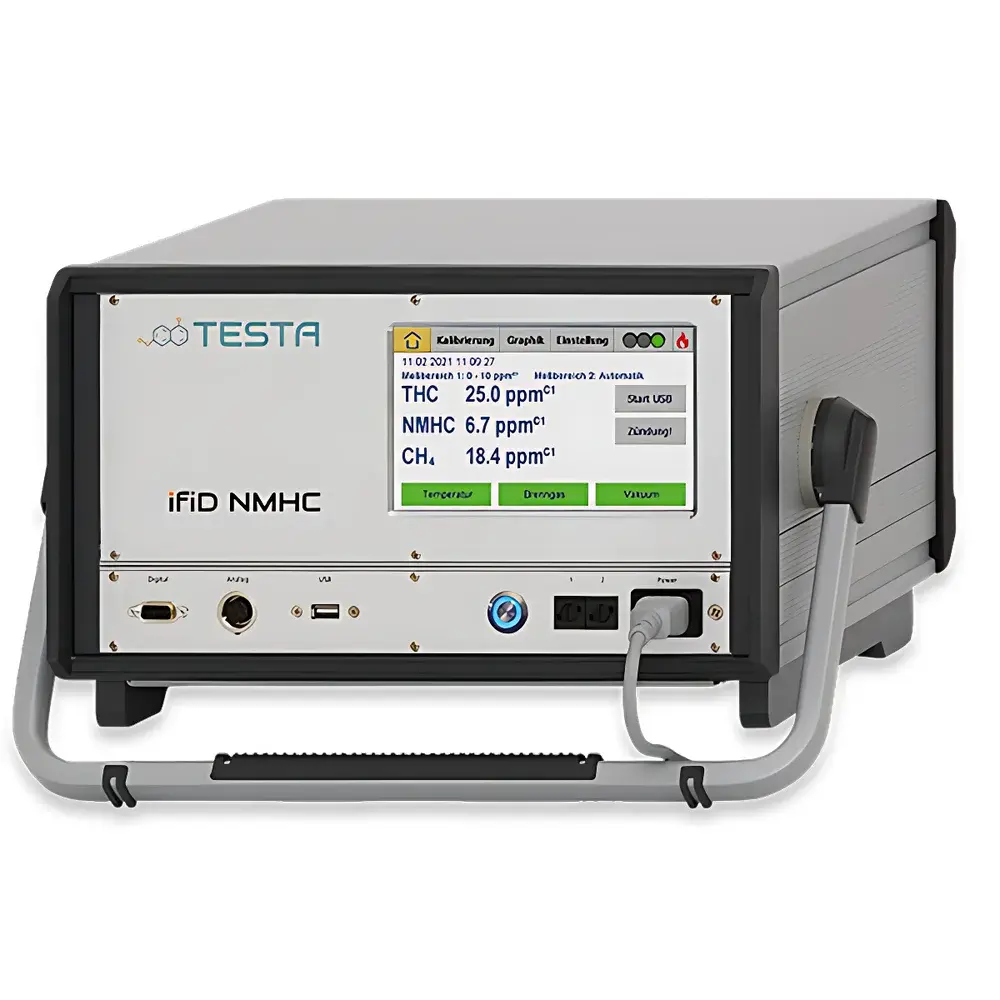
Testa iFiD NMHC Mobile Portable Non-Methane Hydrocarbons Analyzer
| Brand | Testa |
|---|---|
| Origin | Germany |
| Model | iFiD NMHC mobile |
| Detection Principle | Flame Ionization Detection (FID) |
| Instrument Type | Portable |
| Detection Range | 0–100,000 ppmC₁ |
| Response Time | 1 s (T₉₀) |
| Repeatability | ±1% of full scale |
| Zero Drift | ±1% FS over 24 h |
| Detector Temperature | 190 °C |
| Hot Filter Temperature | 300 °C |
| Preheat Time | 15 min |
| Power Supply | 100–240 V AC, 50–60 Hz, 350 W |
| Operating Temperature | 0–45 °C |
| Enclosure Rating | IP40 |
| Dimensions | 178 × 370 × 420 mm |
| Weight | 12 kg |
| Fuel Gas | H₂ (Grade 5) or He/H₂ mixture |
| Calibration Gases | C₃H₈, CH₄, C₂H₆ |
| Zero Gas | N₂ or synthetic air |
| Burner Air | Built-in pump |
| Fuel Consumption | 30 mL/min (H₂) |
| Calibration Gas Flow | 1 L/min |
| Pressure Compensation Range | −150 to +500 hPa |
| Analog Output | 0–20 mA / 0–10 V |
| Digital Interfaces | Ethernet, RS232 |
| Data Storage | Internal via USB |
| Remote Control | VNC-compatible (PC/iFiD host) |
Overview
The Testa iFiD NMHC Mobile is a field-deployable, flame ionization detector (FID)-based analyzer engineered for real-time, quantitative measurement of non-methane hydrocarbons (NMHC), methane (CH₄), and total hydrocarbons (THC) in ambient and process air streams. Designed in accordance with the fundamental principles of FID detection—where organic compounds undergo pyrolysis in a hydrogen-air flame, generating ions proportional to carbon mass—the instrument delivers high sensitivity, linear response across five decades, and exceptional stability in variable environmental conditions. Its compact, integrated architecture enables rapid deployment at fenceline monitoring sites, indoor air quality assessments, mobile emission surveys, and regulatory-compliant stack testing without requiring external gas supplies or laboratory infrastructure. The analyzer operates on the standardized definition of NMHC as THC minus CH₄, calculated in real time using dual-channel FID signal processing and internal hydrocarbon response factor compensation.
Key Features
- Simultaneous quantification of NMHC, CH₄, and THC on a single FID platform—eliminating cross-calibration drift and inter-instrument variability
- Integrated 7-inch TFT resistive touchscreen interface with intuitive navigation, real-time concentration trend graphs (mg/m³ and ppmC₁), and on-device data review
- Heated sampling path with 300 °C ceramic filter and thermal self-cleaning protocol to prevent condensable VOC deposition and maintain baseline integrity
- Single-range operation from 0 to 100,000 ppmC₁—no range switching, no dilution errors, and no manual gain adjustment required during field use
- Built-in pressure-compensated mass flow control (−150 to +500 hPa) ensuring stable sample introduction under varying stack or ambient backpressure conditions
- Onboard zero gas generation option (synthetic air or N₂-based) for automated zero checks without external cylinder dependency
- Comprehensive analog (0–20 mA / 0–10 V) and digital (Ethernet, RS232) I/O for seamless integration into SCADA, EMS, or continuous emission monitoring systems (CEMS)
Sample Compatibility & Compliance
The iFiD NMHC Mobile is validated for direct analysis of unfiltered or pre-filtered ambient air, ducted exhaust, and fugitive emissions containing volatile organic compounds (VOCs) including alkanes, alkenes, aromatics, and oxygenates. It complies with core methodological frameworks referenced in EN 12619:2013 (stationary source emissions — determination of total organic carbon), EPA Method 25A (determination of total gaseous organic emissions), and ISO 11843-7:2020 (capability of detection for instrumental methods). While not certified as a Class I, Division 1 device, its IP40 enclosure meets general-purpose industrial indoor/outdoor deployment requirements per IEC 60529. All firmware and data handling routines support audit-ready operation under GLP and ISO/IEC 17025-aligned quality management systems.
Software & Data Management
Data acquisition, visualization, and export are managed via embedded Linux-based firmware with VNC server capability—enabling remote desktop access from any standards-compliant client (Windows, macOS, Linux). Internal storage logs timestamped NMHC/CH₄/THC values at user-configurable intervals (1 s to 60 min), with raw FID current signals retained for retrospective reprocessing. USB export supports CSV and PDF report generation, including calibration history, zero/span verification logs, and diagnostic event timestamps. Firmware updates and configuration backups are performed via secure HTTP or local USB drive. Audit trail functionality records all parameter changes, calibration actions, and user logins—supporting traceability requirements under FDA 21 CFR Part 11 when deployed in regulated manufacturing environments.
Applications
- Fenceline monitoring of petrochemical, refinery, and chemical manufacturing facilities per EPA OTM-33 and EU IED Annex VII requirements
- Indoor air quality (IAQ) assessment in automotive paint booths, semiconductor cleanrooms, and pharmaceutical production suites
- Mobile source emissions screening—including vehicle exhaust, refueling operations, and portable generator testing
- Leak detection and repair (LDAR) program support with sub-second response for rapid plume localization
- Validation of abatement system performance (e.g., thermal oxidizers, carbon adsorption units) through inlet/outlet NMHC differentials
- Research-grade VOC speciation support when paired with optional GC pre-separation modules (not included)
FAQ
What detection principle does the iFiD NMHC Mobile employ?
It uses flame ionization detection (FID), a universal, carbon-mass-sensitive technique compliant with ASTM D6348 and ISO 13864 for total hydrocarbon quantification.
Is external zero gas required for routine operation?
No—optional built-in zero gas generation (N₂ or synthetic air) eliminates dependence on compressed gas cylinders; standard configuration accepts external zero gas via dedicated port.
Can the instrument operate continuously in high-humidity environments?
Yes—the heated 300 °C sampling filter and detector oven prevent water condensation and suppress quenching effects typical of unheated FIDs.
Does it support regulatory reporting formats such as EPA 40 CFR Part 60 or Part 75?
While not pre-certified for Part 75, its data structure, audit logging, and calibration traceability align with QA/QC protocols required for compliance reporting under 40 CFR Part 60 Subpart VV and EN 14181.
What maintenance intervals are recommended for field operation?
Filter replacement every 3 months under typical fenceline use; FID jet cleaning and detector alignment recommended annually or after 2,000 operating hours—service kits and procedures are documented in the IEC 62443-aligned maintenance manual.
Related Products







