
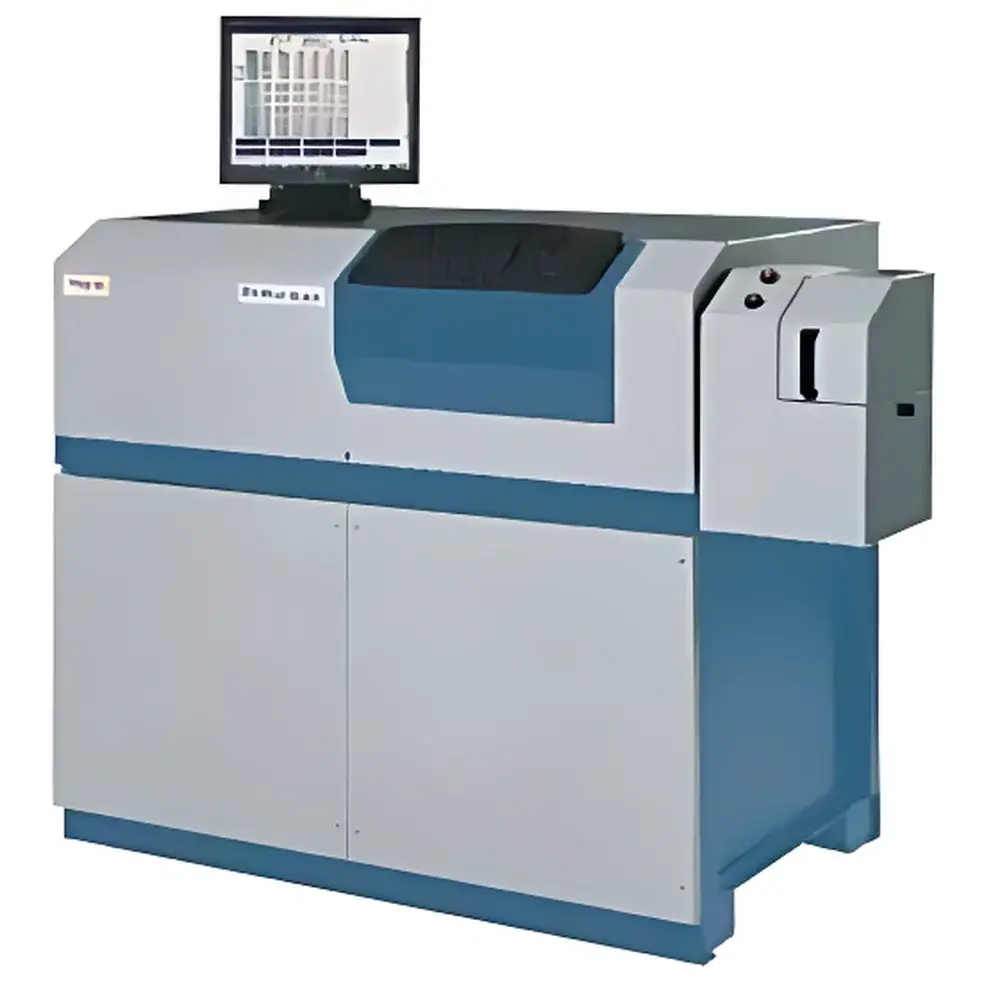
Thermo Fisher ARL 3460 Used Spark Optical Emission Spectrometer
| Brand | Thermo Fisher |
|---|---|
| Origin | USA |
| Model | ARL 3460 |
| Condition | Refurbished & Fully Qualified |
| Compliance | Meets ASTM E1184, ISO 11577, and EN 10052 for metallic alloy analysis |
| Software | ARL SpectraGraph v8.x (with full calibration history and audit trail) |
| Detector Type | Photomultiplier Tube (PMT) array |
| Excitation Source | High-energy spark discharge (400–1000 V, adjustable frequency) |
| Typical Analysis Time | 20–45 s per sample |
| Wavelength Range | 120–800 nm |
| Resolution | ≤ 0.01 nm at 200 nm |
| Sample Form | Solid metal discs or pins (Ø 25–40 mm, thickness ≥ 5 mm) |
| Gas Requirement | Argon purge (99.995% purity, flow rate 3–5 L/min) |
Overview
The Thermo Fisher ARL 3460 is a high-performance, benchtop spark optical emission spectrometer (OES) engineered for precise elemental analysis of solid metallic samples. Based on the principle of spark-induced atomic emission spectroscopy, the instrument vaporizes a micro-volume of the conductive sample surface using a controlled high-voltage spark discharge, generating excited atoms and ions that emit characteristic wavelengths upon relaxation. These emissions are dispersed via a fixed-grating Paschen-Runge optical system and quantified by an optimized photomultiplier tube (PMT) detector array. Designed for routine quality control in foundries, metal service centers, and aerospace manufacturing, the ARL 3460 delivers robust repeatability (RSD < 1.5% for major elements in certified reference materials) and long-term stability under continuous operation. Its rigid cast-iron optical bench and temperature-stabilized enclosure minimize thermal drift, ensuring consistent spectral alignment over extended analytical campaigns.
Key Features
- Fixed multi-channel PMT detection architecture with 60+ pre-aligned channels covering key elements from C, P, S, and N to trace-level Cr, Ni, Mo, Cu, Al, Ti, and rare earths in ferrous and non-ferrous alloys.
- High-energy digital spark source with programmable discharge parameters (voltage, frequency, integration time), enabling optimized excitation for hard-to-ionize elements and low-melting-point matrices such as aluminum and zinc alloys.
- Integrated argon purging system with flow monitoring and pressure regulation—essential for maintaining UV transmission below 200 nm (e.g., for carbon, phosphorus, sulfur, and nitrogen determination).
- Self-diagnostic optics chamber with automated wavelength calibration verification using internal Hg/Ne lamp and real-time intensity monitoring of reference lines.
- Rugged mechanical design compliant with IEC 61000-4 electromagnetic immunity standards; suitable for industrial lab environments with ambient temperature fluctuations (15–30 °C) and moderate vibration.
Sample Compatibility & Compliance
The ARL 3460 accepts flat, polished, conductive metal specimens—typically discs (Ø 25–40 mm, min. thickness 5 mm) or cylindrical pins—prepared per ASTM E407 and ISO 11577 surface finish requirements (Ra ≤ 0.8 µm). It supports standardized grade identification and composition verification across ASTM A751, ISO 17025-accredited workflows, and OEM-specific material release protocols (e.g., AMS 2301, DIN 50049). All refurbished units undergo full factory-equivalent qualification: optical alignment validation, detector gain calibration, spark source performance testing, and multi-point CRM verification (NIST SRM 1251–1256, BCS CRM 301–320 series). Documentation includes full traceability reports, compliance certificates, and instrument-specific uncertainty budgets per ISO/IEC 17025 Annex A.5.
Software & Data Management
ARL SpectraGraph v8.x provides intuitive method setup, real-time spectral visualization, and automated grade matching against user-defined libraries. The software supports GLP-compliant data handling: electronic signatures, 21 CFR Part 11–ready audit trails (including operator ID, timestamp, parameter changes, and result modifications), and encrypted raw-data archiving (.spc binary format). Export options include CSV, XML, and PDF reports conforming to ISO 14284 and EN 10204 Type 3.1 requirements. Remote diagnostics and firmware updates are enabled via secure SSH tunneling—no cloud dependency or third-party telemetry.
Applications
- Production QC of stainless steels, tool steels, superalloys, and aluminum casting alloys in foundry and forging facilities.
- Scrap sorting and positive material identification (PMI) in pipeline maintenance, nuclear component refurbishment, and pressure vessel fabrication.
- Research-grade quantitative analysis of interstitial elements (C, N, O, S, P) in high-purity titanium and nickel-based alloys for biomedical implant certification.
- Failure analysis laboratories performing root-cause investigation of hydrogen embrittlement, segregation, or inclusion-related fractures.
- Third-party testing labs delivering ISO/IEC 17025 accredited test reports for automotive OEM supplier audits (e.g., IATF 16949).
FAQ
Is the ARL 3460 compatible with modern LIMS and ERP systems?
Yes—via OPC UA or ODBC-compliant database export; no proprietary middleware required.
What is included in the refurbishment protocol?
Full optical recalibration, spark source rebuild, vacuum system leak test, PMT dark current optimization, and CRM-based accuracy validation with documented uncertainty.
Can the instrument analyze coated or plated samples?
Only after mechanical removal of non-conductive coatings; spark OES requires direct electrical contact and homogeneous bulk sampling.
Does the system support custom calibrations for proprietary alloys?
Yes—users may develop and validate custom calibrations using in-house CRMs, with full documentation of linearity, LOD/LOQ, and matrix-matched drift correction.
What maintenance intervals are recommended?
Optical cleaning every 6 months; spark stand electrode replacement every 10,000–15,000 sparks; annual full performance verification per ISO 17025 Clause 6.4.6.




