
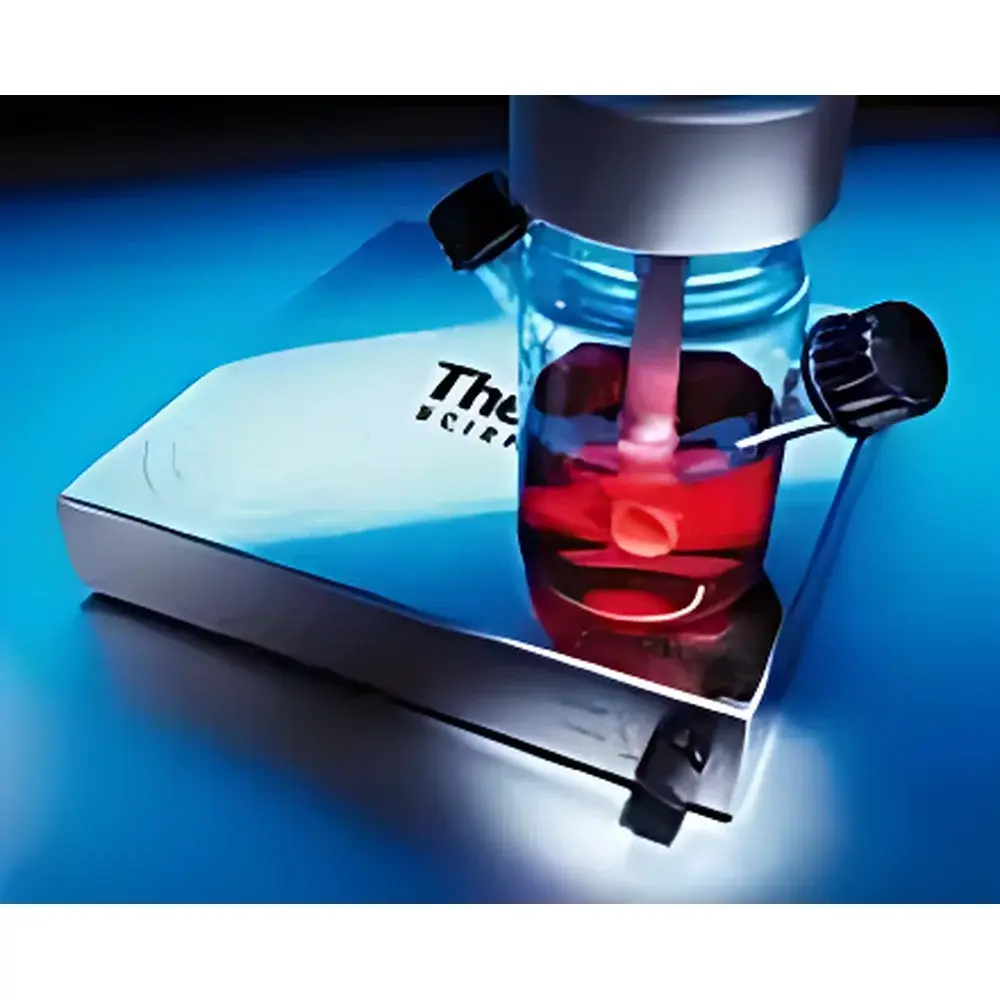
Thermo Fisher Cimarec Biosystem Direct and Cimarec Biosystem 4 Direct Magnetic Stirrers
| Brand | Thermo Fisher |
|---|---|
| Origin | Germany |
| Manufacturer | Thermo Fisher Scientific |
| Product Type | Magnetic Stirrer |
| Model | Cimarec Biosystem Direct / Cimarec Biosystem 4 Direct |
| Maximum Stirring Volume | 5 L (single-position) / 2 L per position (4-position) |
| Speed Range | 5–120 rpm |
| Temperature Control Range | −10 °C to +40 °C |
| Construction | Stainless Steel Housing |
| Environmental Rating | Up to 95% Relative Humidity |
Overview
The Thermo Fisher Cimarec Biosystem Direct and Cimarec Biosystem 4 Direct magnetic stirrers are precision-engineered laboratory instruments designed for reliable, low-shear mixing of aqueous and non-viscous solutions under controlled thermal conditions. Based on the principle of rotating magnetic fields generated by internal permanent magnets coupled with external stirring bars (flea magnets), these units deliver consistent torque transmission without mechanical shaft penetration—eliminating seal wear, contamination risk, and maintenance overhead associated with overhead or paddle-type stirrers. The system is optimized for applications requiring stable, quiet operation across extended durations, including cell culture media preparation, buffer equilibration, reagent dissolution, and cold-chain-compatible sample conditioning. Both models integrate a fully sealed stainless steel housing (AISI 304 grade), ensuring long-term corrosion resistance in humid or mildly aggressive chemical environments typical of analytical, QC, and life science laboratories.
Key Features
- Stainless steel construction with IP54-rated enclosure for durability and resistance to condensation, splashes, and routine decontamination protocols.
- Microprocessor-controlled speed regulation with digital feedback loop ensures ±2 rpm stability across the full 5–120 rpm range—even at minimum speed (5 rpm), enabling gentle suspension of sensitive biological particles or viscous gels.
- Integrated Peltier-based temperature control module maintains setpoints from −10 °C to +40 °C with ±0.5 °C accuracy at ambient 23 °C, supporting cryogenic buffer prep and thermally sensitive enzymatic reactions.
- Single-position (Cimarec Biosystem Direct) and four-position (Cimarec Biosystem 4 Direct) configurations allow scalable workflow deployment—each position operates independently with dedicated speed and temperature controls.
- Auto-start function engages upon placement of compatible stir bars; standby mode reduces power consumption during idle periods without compromising thermal hold stability.
- Front-panel LED display with intuitive rotary encoder interface provides real-time monitoring of speed, temperature, and operational status—no PC connection required for basic operation.
Sample Compatibility & Compliance
These stirrers accommodate standard glass, polypropylene, and borosilicate vessels (e.g., beakers, flasks, bottles) up to 5 L capacity (single unit) or 2 L per station (four-position model). Compatibility extends to common laboratory-grade magnetic stir bars (PTFE- or glass-coated, 20–60 mm length), with optimal performance observed using bar-to-volume ratios ≥1:250. The devices conform to IEC 61010-1:2010 safety standards for electrical equipment used in laboratory environments and meet EN 61326-1:2013 requirements for electromagnetic compatibility (EMC). While not classified as medical devices, their design supports GLP-compliant workflows when paired with validated stir bar materials and documented calibration procedures per ISO/IEC 17025 guidelines.
Software & Data Management
The Cimarec Biosystem series operates autonomously via embedded firmware and does not require proprietary software for core functionality. However, optional RS-232 or USB-to-serial interfaces (available via accessory kit) enable integration into centralized lab management systems. When connected, time-stamped operational logs—including speed, temperature setpoint, actual temperature, run duration, and error codes—can be exported in CSV format for audit trail generation. This capability supports adherence to FDA 21 CFR Part 11 requirements when implemented with appropriate user access controls, electronic signature validation, and data integrity safeguards defined in organizational SOPs.
Applications
- Preparation and homogenization of cell culture media, PBS, HEPES, and other isotonic buffers under sterile or clean-bench conditions.
- Controlled-rate dissolution testing of pharmaceutical excipients and active ingredients in early-stage formulation development.
- Low-temperature stabilization of protein samples during affinity chromatography column equilibration.
- Uniform dispersion of nanoparticles in aqueous suspensions prior to DLS or TEM analysis.
- Environmental chemistry workflows involving sequential extraction of soil/water matrices under regulated thermal profiles.
- Quality control of raw material viscosity consistency across batch releases in biomanufacturing settings.
FAQ
What is the maximum recommended vessel diameter for optimal magnetic coupling?
For consistent torque transfer and vortex minimization, use vessels with internal diameters ≤120 mm (single-position) or ≤85 mm per station (four-position model).
Can the unit maintain −10 °C while stirring viscous solutions?
Yes—the Peltier module delivers sufficient cooling capacity for aqueous solutions up to 50 cP at 20 °C; higher viscosities may reduce achievable minimum temperature due to heat generation from viscous drag.
Is calibration traceable to national standards?
Temperature and speed sensors are factory-calibrated against NIST-traceable references; users may perform field verification using calibrated thermistors and optical tachometers per internal SOPs.
Are stir bars included with the instrument?
No—stir bars must be selected separately based on application requirements (e.g., coated vs. uncoated, size, shape); Thermo Fisher offers certified PTFE-coated bars (Cat. No. 88850010) optimized for this platform.
Does the device support continuous operation over 72 hours?
Yes—designed for unattended 24/7 operation under nominal load; thermal management and fanless design ensure long-term reliability without performance degradation.



