
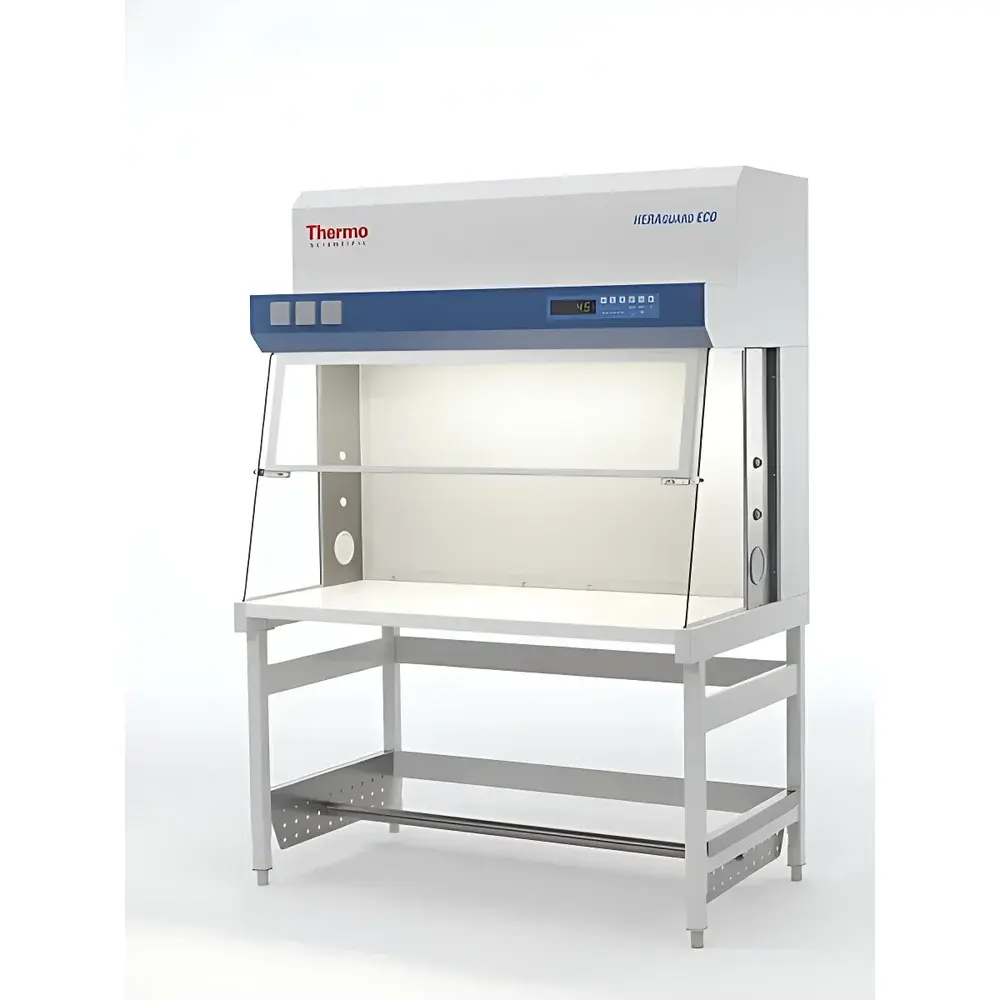
Thermo Fisher Heraguard™ ECO Horizontal Laminar Flow Clean Bench
| Brand | Thermo Fisher |
|---|---|
| Origin | Germany |
| Manufacturer Type | Original Equipment Manufacturer (OEM) |
| Country of Origin | Imported |
| Model Numbers | 51029701, 51029702, 51029703, 51029704 |
| Instrument Category | Horizontal Laminar Flow Clean Bench |
| User Configuration | Single-Sided Operation |
| Internal Width Options | 900 mm, 1200 mm, 1500 mm, 1800 mm |
| Standard Work Height | 650 mm |
| Extended Work Height | 950 mm |
| Compliance | GOST, CE (2006/95/EC |
| 2006/121/EC), EN 61010-1 | 2011, EN 61326:2006 |
| Drive System | Brushless DC Motor |
Overview
The Thermo Fisher Heraguard™ ECO Horizontal Laminar Flow Clean Bench is an engineered solution for non-sterile but particle-controlled laboratory environments where operator protection is not required, yet sample integrity and process reproducibility depend on consistent, unidirectional airflow. Unlike vertical flow hoods, this bench delivers ISO Class 5 (formerly Class 100) air quality across the work surface via a horizontal laminar flow path—air is drawn through a prefilter, conditioned, then passed through a certified HEPA filter (EN 1822 H14, ≥99.995% @ 0.1 µm) before exiting uniformly across the entire work area at a velocity of 0.3–0.5 m/s. The laminar profile minimizes turbulence-induced cross-contamination and ensures predictable particle removal from critical surfaces. Designed specifically for applications such as media preparation, cell culture setup, PCR reagent handling, and electronics assembly, the Heraguard ECO prioritizes energy efficiency without compromising airflow stability or filtration performance.
Key Features
- Brushless DC motor-driven blower system delivering up to 40% lower power consumption versus conventional AC-motor clean benches, validated by internal thermal load testing and field data from the University of Michigan’s Biotechnology Laboratory;
- Reduced heat emission improves ambient temperature stability in temperature-sensitive labs and lowers HVAC load;
- Four standard internal width configurations (900 mm, 1200 mm, 1500 mm, 1800 mm) with two ergonomic work height options (650 mm standard / 950 mm extended) to accommodate diverse user anthropometrics and workflow layouts;
- Full-height side windows constructed from optically clear, low-iron tempered glass provide uninterrupted lateral visibility and natural light penetration while maintaining structural integrity and UV resistance;
- Integrated LED task lighting with uniform illumination (>500 lux at work surface) and flicker-free operation compliant with EN 61000-3-2 harmonic current limits;
- Robust stainless steel 304 work surface with seamless welded corners and coved edges for easy decontamination and compliance with GLP cleaning protocols.
Sample Compatibility & Compliance
The Heraguard ECO supports open-vessel procedures involving non-hazardous biological, pharmaceutical, and microelectronic samples. It is not suitable for work with volatile chemicals, aerosol-generating procedures, or human pathogens requiring biosafety containment. All models meet mandatory EU regulatory requirements under Machinery Directive 2006/42/EC, Low Voltage Directive 2014/35/EU, EMC Directive 2014/30/EU, and RoHS Directive 2011/65/EU. Certification documentation includes CE marking per EN 61010-1:2011 (safety of electrical equipment for laboratory use) and EN 61326-1:2013 (EMC requirements for measurement and control equipment). GOST R certification confirms conformity for deployment in Russian Federation-accredited laboratories. While not classified as medical devices, its design aligns with ISO 14644-1:2015 airborne particulate cleanliness classes for cleanroom-associated equipment.
Software & Data Management
The Heraguard ECO operates as a standalone, hardware-controlled unit with no embedded firmware or network interface. Airflow velocity, filter status, and operational hours are monitored via analog gauges and mechanical timers calibrated to NIST-traceable standards. Filter service intervals are determined by pressure differential monitoring across the HEPA module using a calibrated manometer. For audit readiness, users may integrate the bench into facility-wide environmental monitoring systems via optional analog 4–20 mA output (available on request), enabling logging of static pressure drop trends in accordance with ISO 14644-3 Annex B for filter lifecycle validation. All maintenance records—including filter replacement dates, prefilter cleaning logs, and velocity verification reports—support GLP/GMP traceability when retained per institutional SOPs.
Applications
- Preparation of sterile culture media, buffers, and reagents in academic and industrial microbiology labs;
- Handling of sensitive semiconductor wafers and optical components during prototyping and packaging;
- Assembly and testing of diagnostic assay kits under controlled particulate conditions;
- Non-invasive instrumentation calibration where electrostatic discharge (ESD) control is secondary to airborne contamination mitigation;
- Teaching laboratories requiring durable, low-maintenance laminar flow infrastructure aligned with ANSI/ASHE Z9.14 ventilation guidelines for educational facilities.
FAQ
Does the Heraguard ECO provide personnel or environmental protection?
No. As a horizontal laminar flow device, it protects only the sample—not the operator or surrounding environment—from airborne particulates. It must not be used for work involving toxic, infectious, or volatile substances.
What is the recommended HEPA filter replacement interval?
Filter life depends on ambient air quality and usage frequency. Under typical lab conditions (8 hrs/day, ISO Class 8 ambient), replacement is advised every 18–24 months or when static pressure drop exceeds 250 Pa, per EN 1822 filter testing protocol.
Can the unit be installed in a room without dedicated exhaust ducting?
Yes. The Heraguard ECO recirculates filtered air forward across the work surface and does not require external ducting or room exhaust—making it suitable for modular or temporary lab setups.
Is the work surface resistant to common disinfectants?
Yes. The electropolished stainless steel 304 surface withstands repeated exposure to 70% ethanol, isopropyl alcohol, hydrogen peroxide vapor (≤100 ppm), and quaternary ammonium compounds per ASTM E2197-21 efficacy testing protocols.
How is airflow uniformity verified during commissioning?
Certified technicians perform ISO 14644-3 Annex C velocity mapping using NIST-traceable hot-wire anemometers at 100 mm intervals across the full work plane, ensuring ±15% deviation from mean velocity and confirming laminar flow profile per EN ISO 14644-3:2019.



