
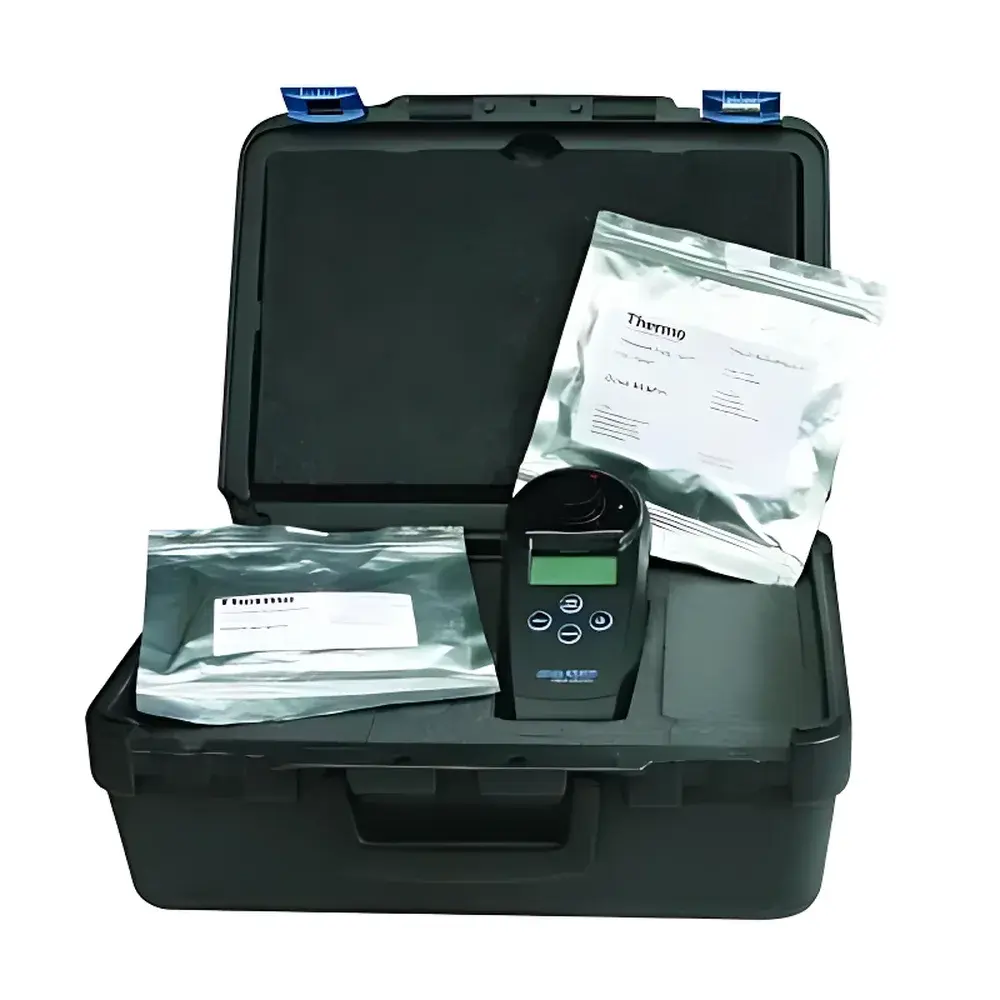
Thermo Fisher Orion AQ3170 Portable Residual and Total Chlorine Meter
| Brand | Thermo Fisher |
|---|---|
| Origin | USA |
| Manufacturer | Thermo Fisher Scientific |
| Instrument Type | Portable |
| Measurement Principle | Amperometric Electrochemical Sensor |
| Measurable Parameters | Free Chlorine, Total Chlorine, pH, Chlorine Dioxide, Cyanuric Acid |
| Free Chlorine Range | 0.02–4.0 mg/L (US EPA Validated Range: 0.03–2.0 mg/L) |
| Total Chlorine Range | 0.02–4.0 mg/L (US EPA Validated Range: 0.03–2.0 mg/L) |
| Chlorine Dioxide Range | 0–9 mg/L |
| pH Range | 5.9–8.2 |
| Cyanuric Acid Range | 5–90 mg/L |
| Sample Volume | 10 mL |
| Display | LCD |
| Power | 4×AAA batteries (≥3000 measurements, auto-off) |
| Ingress Protection | IP67 |
| Operating Environment | 0–50 °C, 0–90% RH (non-condensing at 30 °C) |
| Compliance | CE, TÜV, FCC Part 15 |
Overview
The Thermo Fisher Orion AQ3170 Portable Residual and Total Chlorine Meter is an EPA-validated, field-deployable electrochemical analyzer engineered for rapid, reliable quantification of free chlorine, total chlorine, pH, chlorine dioxide, and cyanuric acid in water matrices. It operates on amperometric sensor technology—where chlorine species undergo controlled reduction at a polarized working electrode, generating a current proportional to analyte concentration. This principle ensures high selectivity against common interferences (e.g., bromide, nitrate, organic matter) when used with the proprietary AQUAfast reagent system. Designed for compliance-critical applications—including drinking water distribution, wastewater effluent monitoring, recreational water management (pools, spas), and aquaculture—the AQ3170 delivers measurement traceability aligned with US EPA Methods 334.0 (free chlorine) and 334.1 (total chlorine), as implemented via certified reagent kits AC4P71 and AC4P72. Its compact, rugged chassis and sealed optical path eliminate the need for light-blocking caps during analysis—a key operational advantage over traditional colorimetric handhelds.
Key Features
- EPA-compliant measurement capability for free chlorine (0.03–2.0 mg/L) and total chlorine (0.03–2.0 mg/L), validated per Methods 334.0 and 334.1 using AC4P71 and AC4P72 reagents
- Multi-parameter functionality: simultaneous support for chlorine dioxide (0–9 mg/L), pH (5.9–8.2), and cyanuric acid (5–90 mg/L) without requiring separate instruments or dedicated hardware modules
- IP67-rated enclosure ensuring dust-tightness and submersion resistance up to 1 m for 30 minutes—suitable for harsh field conditions including rain, splashing, and humid environments
- Optimized human interface: large backlit LCD display, four-button navigation (Power, Mode, Zero, Read/Enter), and intuitive menu structure minimizing training requirements for field technicians
- Reagent longevity and stability: AQUAfast powdered and tablet-based reagents (AC4P71, AC4P72, AC2099, AC2098) maintain performance over extended shelf life; no refrigeration required
- Battery efficiency: 4×AAA alkaline cells support ≥3000 measurements with intelligent auto-power-off to conserve energy during idle periods
Sample Compatibility & Compliance
The AQ3170 is validated for use with potable water, treated wastewater, swimming pool water, cooling tower make-up water, and aquaculture recirculating systems. Sample turbidity and temperature effects are mitigated through integrated algorithmic compensation, and all calibrations are performed using NIST-traceable standards. The instrument complies with international regulatory frameworks governing environmental and public health testing: it meets CE marking requirements under the EU Electromagnetic Compatibility Directive and Low Voltage Directive; carries TÜV certification for electrical safety; and conforms to FCC Part 15 Subpart B for unintentional radiators. While not inherently 21 CFR Part 11 compliant (as it lacks electronic audit trail functionality), its data output supports GLP/GMP-aligned workflows when paired with Thermo Fisher’s optional AQLink software for secure export and documentation.
Software & Data Management
The AQ3170 operates as a standalone instrument with no onboard data logging. However, measurement results can be manually recorded or exported via optional connectivity solutions. When used with Thermo Fisher’s AQLink PC software (sold separately), users gain access to structured CSV export, calibration history tracking, and customizable report generation—including date/time stamps, operator ID fields, and method identification. All reagent lot numbers and expiration dates are documented in the user manual and printed on kit packaging to support full chain-of-custody documentation required under ISO/IEC 17025-accredited laboratories. Firmware updates are distributed through Thermo Fisher’s official support portal and require USB-to-serial adapter for installation.
Applications
- Drinking water utilities performing routine disinfectant residual verification at entry points, storage tanks, and distribution endpoints
- Wastewater treatment plants conducting final effluent compliance checks prior to discharge
- Public health departments auditing recreational water facilities for adherence to CDC Model Aquatic Health Code (MAHC) chlorine thresholds
- Aquaculture operations monitoring oxidative stress parameters in hatcheries and raceways to prevent gill damage and pathogen proliferation
- Industrial cooling water managers assessing biocide efficacy and corrosion inhibitor compatibility
- Environmental consultants executing field-based site assessments where rapid turnaround and instrument portability are mission-critical
FAQ
Does the AQ3170 require daily calibration?
No—calibration is performed only before initial use and after replacing sensors or reagents. The instrument uses factory-calibrated electrodes and standardized reagent chemistry; zero and span adjustments are executed via built-in protocols using blank water and certified reference standards.
Can the same sample vial be reused across multiple parameter measurements?
Yes, provided the vial is thoroughly rinsed with deionized water between tests and dried with lint-free tissue. Cross-contamination is prevented by sequential reagent addition and timed reaction intervals specified in the user manual.
Is the AC4P71 reagent compatible with total chlorine measurement?
No—AC4P71 is formulated exclusively for free chlorine determination. Total chlorine requires AC4P72, which includes potassium monopersulfate (MPS) to oxidize combined chlorine species prior to amperometric detection.
What is the expected service life of the chlorine sensor?
Under normal field use (≤5 measurements/day), the amperometric sensor maintains stable response for 12–18 months. Performance degradation is indicated by reduced slope in calibration curves or increased zero drift beyond ±0.02 mg/L.
Does the instrument meet ISO 9001 or ISO 17025 requirements?
The AQ3170 itself is not certified to ISO 9001 or ISO/IEC 17025, but it is designed to support laboratories seeking accreditation under these standards—particularly through documented reagent traceability, defined calibration procedures, and consistent measurement repeatability within published ranges.
Related Products







