
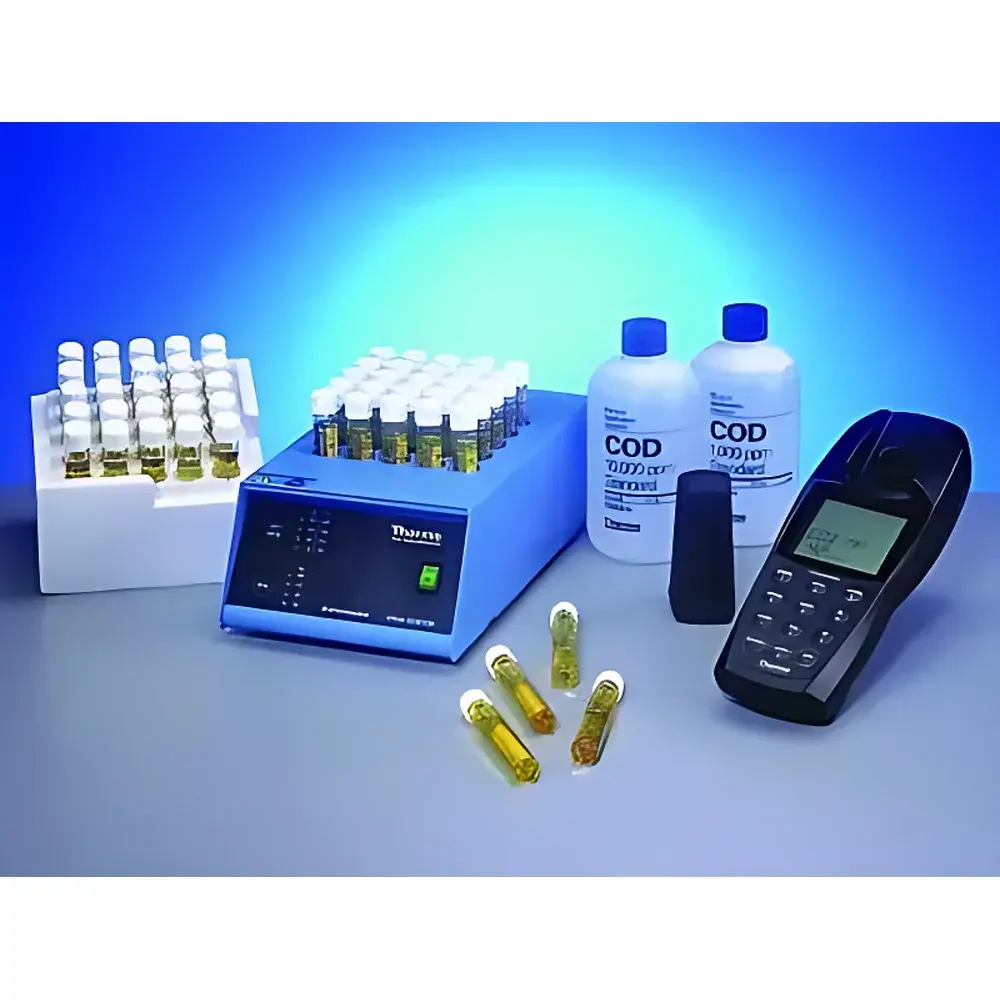
Thermo Fisher Orion AQ4001 COD Measurement System
| Brand | Thermo Fisher |
|---|---|
| Origin | USA |
| Manufacturer | Thermo Fisher Scientific |
| Product Type | Imported |
| Model | AQ4001 COD |
| Instrument Category | Portable |
| COD Range | 0–150 / 0–1500 / 0–15000 mg/L |
| Detection Limits | 1.5 / 15 / 150 mg/L |
| Detector | Photodiode |
| Wavelength Selection | 420, 520, 580, 610 nm (auto-selected) |
| Cuvette Sizes | 13 mm, 16 mm, 24 mm |
| Units | mg/L, ppm, Absorbance, % Transmittance |
| Ingress Protection | IP67 |
| Digestion Unit | AQUAfast COD165 |
| Power Supply | 100–220 V, 50–60 Hz |
| Heating Power | 400 W |
| Weight | 3.6 kg |
| Dimensions (L×W×H) | 155 × 95 × 275 mm |
| Temperature Control | PID microelectronic controller |
| Sensor | Pt100 Class A |
| Digestion Temperatures | 100, 120, 150, 160, 165 °C |
| Digestion Times | 30, 60, 120 min or continuous |
| Ramp Time | 10 min (20 → 165 °C) |
| Temp. Stability | ±0.5 °C |
| Temp. Accuracy | ±1 °C |
| Digestion Well Diameter | 16 mm |
| Number of Wells | 25 |
| Over-Temperature Protection | Yes |
Overview
The Thermo Fisher Orion AQ4001 COD Measurement System is a field-deployable, EPA-compliant solution for quantitative determination of Chemical Oxygen Demand (COD) in wastewater, surface water, and industrial effluents. It integrates the AQ4000 portable spectrophotometer with pre-formulated, sealed vial-based COD reagents and the AQUAfast COD165 digestion block—enabling full implementation of the standardized open-reflux dichromate method (APHA 5220B, ISO 6060, ASTM D1252). Unlike closed-vessel microwave systems or permanganate-based alternatives, this configuration delivers high oxidation efficiency (>80% for most organic compounds) via potassium dichromate under controlled acidic reflux conditions. The system is engineered for precision in both laboratory and uncontrolled environmental settings, with rigorous thermal regulation, optical stability, and traceable calibration protocols aligned with GLP and regulatory audit requirements.
Key Features
- Full compliance with U.S. EPA Method 410.4 and ISO 6060 for COD determination using dichromate oxidation
- Triple-range pre-packaged reagent vials (0–150 mg/L, 0–1500 mg/L, 0–15000 mg/L), minimizing analyst exposure to concentrated sulfuric acid and Cr(VI)
- AQ4000 photometer featuring auto-wavelength selection across four fixed bands (420, 520, 580, 610 nm), optimized for dichromate reduction endpoint detection
- IP67-rated housing ensures operational reliability during outdoor sampling campaigns, including rain, dust, and incidental submersion
- COD165 digestion block with Pt100 Class A temperature sensor and PID-controlled heating—capable of maintaining ±0.5 °C stability at 165 °C over extended cycles
- 25-position digestion capacity with uniform thermal distribution; programmable time/temperature profiles support method flexibility (e.g., 120 min @ 150 °C per ISO 6060)
- Onboard data storage for up to 100 measurement records, including sample ID, date/time stamp, wavelength used, and raw absorbance values
- 10,000-hour battery life (typical usage), enabling multi-day field deployments without external power
Sample Compatibility & Compliance
The AQ4001 system accommodates diverse aqueous matrices—including municipal wastewater, landfill leachate, food processing effluent, and pretreated industrial discharges—provided chloride interference is mitigated (<2000 mg/L Cl⁻) using mercury-free or low-chloride reagent options where applicable. All digestion and photometric steps adhere to quality assurance frameworks required under 40 CFR Part 136 and EU Directive 2000/60/EC. The instrument’s firmware supports user-defined calibration curves and verification standards traceable to NIST SRM 2671a (COD Standard Solution). Data integrity meets FDA 21 CFR Part 11 criteria when paired with Thermo Fisher’s optional LIMS-integrated software suite, including electronic signatures, audit trails, and secure export logs.
Software & Data Management
No proprietary desktop software is required for basic operation; however, the AQ4000 photometer supports USB and Bluetooth connectivity for seamless transfer of CSV-formatted datasets to laboratory information management systems (LIMS) or Excel-based QA/QC workbooks. Firmware version 2.4+ enables automatic unit conversion (mg/L ↔ ppm), background correction, and blank subtraction routines. For regulated environments, optional Thermo Fisher TraceFinder™ integration provides full 21 CFR Part 11 compliance—including role-based access control, immutable audit trails, and electronic record archiving. All stored results include metadata: operator ID, digestion parameters, cuvette size, and wavelength applied—facilitating retrospective validation and method transfer documentation.
Applications
- Regulatory compliance monitoring for NPDES permits and discharge reporting
- Process control in wastewater treatment plants (influent, effluent, sludge supernatant)
- Benchmarking biodegradability indices (BOD₅/COD ratios) in preliminary treatability studies
- Field verification of online COD analyzers during commissioning or maintenance events
- Educational laboratories conducting APHA-standardized water chemistry experiments
- Emergency response teams assessing post-spill organic loading in receiving waters
FAQ
Does the AQ4001 system meet U.S. EPA approval for regulatory reporting?
Yes—the AQ4001 implements EPA Method 410.4 using certified reagents and validated digestion parameters; final reports require lab-specific QC documentation per 40 CFR Part 136.
Can chloride interference be corrected without mercury sulfate?
Mercury-free reagent kits are available for low-chloride applications (<1000 mg/L); for higher chloride matrices, users must apply dilution or adopt the chloride correction protocol outlined in APHA 5220B.
Is the COD165 digestion block compatible with other reagent formats?
The COD165 is designed exclusively for 16-mm round digestion vials; it does not support rectangular cells or non-Thermo Fisher-certified consumables.
What is the typical measurement turnaround time per sample?
From sample addition to result display: ≤120 minutes, including 2-hour digestion at 165 °C and photometric readout—no cooling delay required due to integrated heat dissipation design.
How is calibration verified across the three COD ranges?
Each range includes NIST-traceable secondary standards; users perform daily verification using one standard per range, with acceptance criteria defined as ±5% of certified value per ISO/IEC 17025.







