
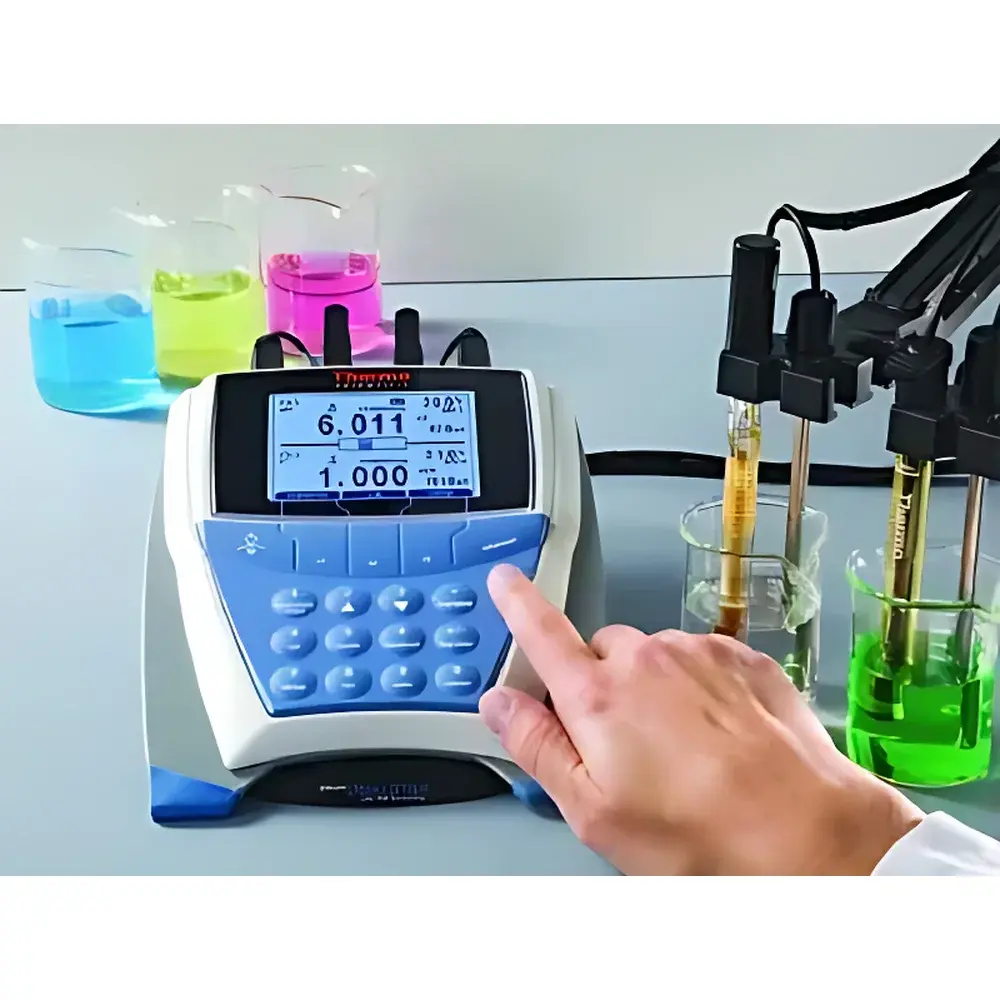
Thermo Fisher Orion Dual Star D10P-29 Copper Ion Selective Electrode Meter
| Brand | Thermo Fisher |
|---|---|
| Origin | USA |
| Manufacturer | Thermo Fisher Scientific |
| Import Status | Imported |
| Model | D10P-29 |
| Price | Upon Request |
| Electrode | 9629BNWP Copper ISE |
| Measurement Range | 6.4×10⁻⁴ – 6354 ppm Cu²⁺ |
| pH Range | 2–12 |
| Temp. Range | 0–80°C continuous / 80–100°C intermittent |
| Reproducibility | ±4% |
| Electrode Dimensions | 110 mm length, 13 mm body dia., 16 mm cap dia., 1 m cable |
| Instrument Resolution | 1–3 sig. fig. (ion), 0.001 pH |
| Accuracy | ±0.001 pH |
| Calibration Points | 2–6 (ion), 1–6 (pH) |
| Data Storage | 1000 entries with timestamp |
| GLP Compliance | Yes |
| Connectivity | RS232, optional USB |
| IP Rating | IP54 |
| Certifications | CE, CSA, UL, TÜV, FCC Class A |
Overview
The Thermo Fisher Orion Dual Star D10P-29 Copper Ion Selective Electrode Meter is a high-precision, dual-channel benchtop analyzer engineered for quantitative determination of free and labile Cu²⁺ ions in aqueous environmental, industrial, and regulatory-compliant water samples. It operates on the potentiometric principle using ion-selective electrode (ISE) technology—specifically the 9629BNWP solid-contact copper-selective electrode—which generates a Nernstian potential response proportional to the logarithm of copper ion activity in solution. The instrument integrates rigorous electrochemical measurement protocols with built-in temperature compensation (via the included 927007MD thermistor probe) and automatic calibration management to ensure traceable, reproducible results across diverse matrix conditions—from raw surface water and wastewater effluents to treated drinking water and process streams in semiconductor or electroplating facilities.
Key Features
- Dual-channel architecture supporting simultaneous measurement of copper ion concentration and pH—or two independent ISE parameters—using separate BNC, reference electrode, and MiniDIN ATC inputs per channel.
- Comprehensive ISE methodology suite including single/dual standard addition/subtraction, sample addition/subtraction, and automated blank correction—critical for low-concentration or high-ionic-strength matrices where junction potential drift may occur.
- GLP-compliant data integrity: password-protected method configuration, user-specific access control, full audit trail metadata (operator ID, date/time stamp, electrode ID, calibration history), and 1000-point internal storage with export via RS232.
- Graphical calibration curve visualization on the backlit LCD display, enabling real-time assessment of electrode performance, linearity (R²), and detection limit estimation.
- Flexible unit reporting: concentration values displayed in ppm, mg/L, mol/L, %, or unitless format; configurable resolution (1–3 significant figures) aligned with reporting requirements per ISO 5667-3 or EPA Method 200.7.
- Rugged industrial design rated IP54 for dust and splash resistance; certified to CE, UL, CSA, TÜV, and FCC Class A standards for laboratory and field-deployable use.
Sample Compatibility & Compliance
The D10P-29 system is validated for direct analysis of clarified aqueous samples within pH 2–12 and temperature range 0–80°C (continuous). For elevated temperatures (80–100°C), intermittent operation is supported with appropriate thermal shielding and electrode conditioning. Sample types include municipal and industrial wastewater, groundwater, surface water, potable water, leachates, and process rinse baths. To mitigate interference from complexing agents (e.g., EDTA, NH₃) or competing cations (e.g., Ag⁺, Hg²⁺, Pb²⁺), the protocol mandates use of 5 M NaNO₃ ionic strength adjuster (940011) and standardized sample pretreatment per ASTM D1068 or ISO 11733. All measurements adhere to Good Laboratory Practice (GLP) and are compatible with 21 CFR Part 11–compliant workflows when paired with Thermo Fisher’s optional software and electronic signature modules.
Software & Data Management
Data acquisition and reporting are fully traceable through the instrument’s embedded firmware. Each stored reading includes timestamp, channel identifier, measured mV, calculated concentration, temperature, electrode ID, and active calibration curve parameters. Export is supported via bidirectional RS232 to LIMS or spreadsheet applications; optional USB adapter enables firmware updates and method synchronization. Twenty preconfigured or user-defined methods can be saved per channel—each retaining unique calibration coefficients, ISE slope tolerances, and unit preferences. Temperature calibration is adjustable at a single isothermal point, ensuring consistency across seasonal ambient variations in regulated testing environments.
Applications
- Regulatory compliance monitoring under US EPA Clean Water Act discharge permits and EU Water Framework Directive (WFD) Annex VIII criteria.
- Drinking water quality verification per WHO Guidelines for Drinking-water Quality and NSF/ANSI Standard 61.
- Leachate characterization in landfill monitoring programs (EPA SW-846 Method 1311).
- Process control in printed circuit board (PCB) manufacturing, metal finishing, and mining hydrometallurgical circuits.
- Research-scale speciation studies where Cu²⁺ activity—not total copper—is the physicochemically relevant parameter.
- Method validation and interlaboratory comparison exercises requiring documented uncertainty budgets per ISO/IEC 17025.
FAQ
What electrode is required for copper measurement with the D10P-29?
The 9629BNWP copper ion-selective electrode is mandatory; it features a polyvinyl chloride (PVC) membrane doped with copper(II)-selective ionophore and integrated solid-state reference system.
Can the D10P-29 measure other ions besides copper?
Yes—it is fully compatible with Thermo Fisher’s portfolio of ISEs, including those for lead, fluoride, nitrate, ammonium, sodium, potassium, bromide, and chloride—without hardware modification.
Is temperature compensation automatic?
Yes—the system accepts input from the included 927007MD temperature probe and applies Nernst equation correction in real time during both calibration and sample measurement.
How is calibration traceability maintained?
Each calibration event is logged with date/time, operator ID, standard concentrations used, electrode ID, slope (%Nernst), and offset (mV); all data fields are exportable and auditable per GLP requirements.
Does the instrument support regulatory data integrity standards?
It meets core GLP requirements out-of-the-box and supports 21 CFR Part 11 compliance when integrated with Thermo Fisher’s optional secure software suite and networked authentication infrastructure.
Related Products







