
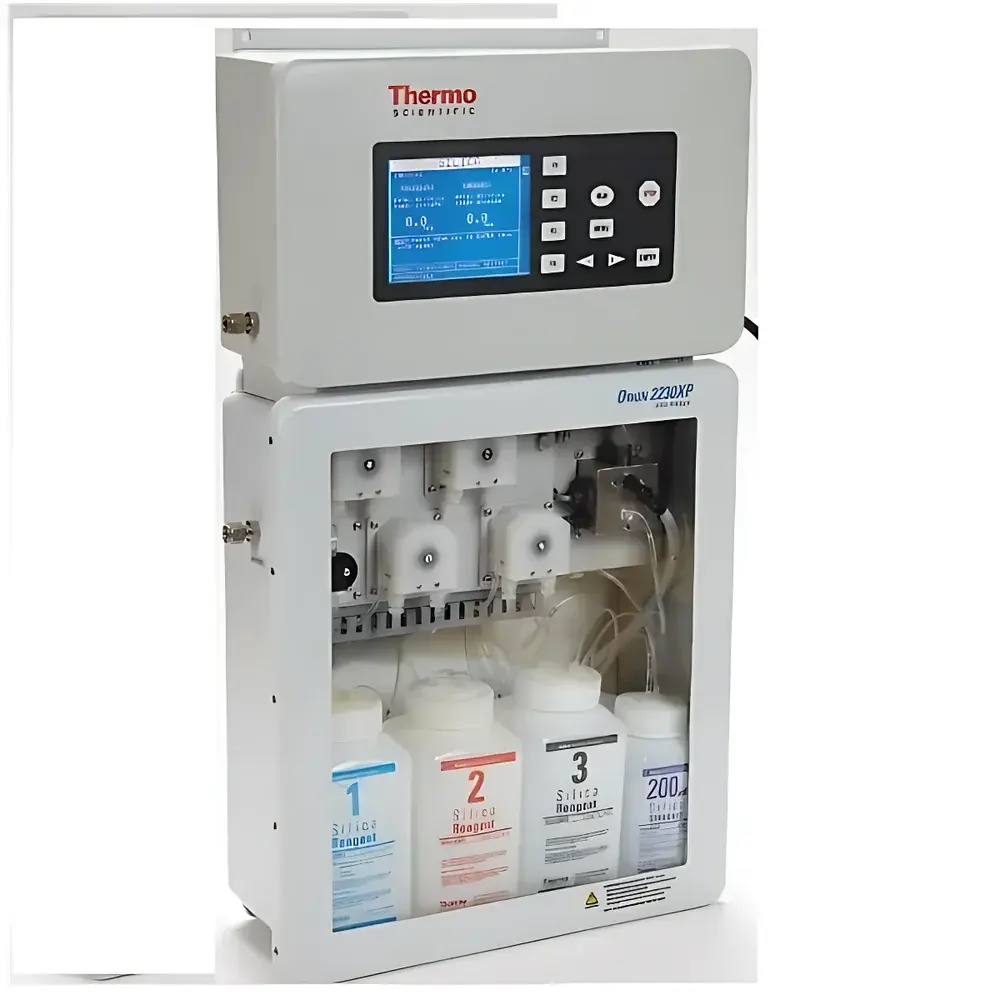
Thermo Fisher Scientific 2230XP Online Silicon Analyzer
| Brand | Thermo Fisher |
|---|---|
| Origin | USA |
| Model | 2230XP |
| Type | Online Analyzer |
| Detection Range | 0–5000 ppb (SiO₂) |
| Low-Range Accuracy | Optimized for 0–500 ppb |
| Reagent Consumption | 0.2 mL per reagent per analysis |
| Light Source | 810 nm LED (filter-free, fiber-optic-free) |
| Sample Temperature Control | Integrated heater maintains 25 °C |
| Zero Calibration | Performed before each analysis cycle |
| Pump Maintenance Interval | Every 6 months |
| Power Input | 100–240 VAC, 50–60 Hz |
| Enclosure Rating | NEMA 4 |
| Data Storage | 31 days of calibration and measurement logs |
| Display | Backlit LCD with multi-parameter status view |
| Installation | Panel-mount or wall-mount compatible |
| Compliance | Designed for continuous operation in power generation, semiconductor, and pharmaceutical water monitoring environments |
Overview
The Thermo Fisher Scientific 2230XP Online Silicon Analyzer is a fully automated, colorimetric photometric instrument engineered for continuous, real-time silicon (as SiO₂) monitoring in ultrapure water streams. It operates on the molybdenum blue reaction principle—where soluble silicate reacts with molybdate under acidic conditions to form a heteropoly acid, subsequently reduced to a stable blue complex measurable at 810 nm. This method complies with ASTM D859 and ISO 10573 for low-level silica determination in high-purity water. The analyzer is specifically designed for deployment in critical water loops including boiler feedwater, condensate, and steam-cycle makeup water in fossil and nuclear power plants; process ultrapure water (UPW) in semiconductor fabrication; purified water (PW) and water for injection (WFI) systems in pharmaceutical manufacturing; and effluent streams in pulp & paper and petrochemical facilities.
Key Features
- Ultra-low reagent consumption: Only 0.2 mL per reagent per analysis cycle—reducing operational cost and waste generation by up to 67% compared to conventional online silicon analyzers.
- Dual-range detection architecture: Full-scale range of 0–5000 ppb SiO₂, with enhanced linearity, repeatability, and signal-to-noise ratio in the 0–500 ppb sub-range—critical for early detection of silica breakthrough in mixed-bed ion exchange units.
- Integrated sample temperature regulation: Built-in Peltier-assisted heating ensures consistent 25 °C reaction temperature—even for sub-ambient feedwater—eliminating kinetic variability in the molybdenum blue reaction and improving inter-laboratory reproducibility.
- Zero-reference verification prior to every analysis: Automatic blank measurement using deionized water or system rinse solution removes optical drift and background interference from tubing residue or ambient light scatter.
- High-stability optical system: 810 nm LED light source with no moving parts, filters, or optical fibers—designed for >50,000 hours MTBF and zero recalibration requirement over instrument lifetime.
- Industrial-grade fluidics: Chemically resistant peristaltic pump with proprietary rotor geometry and reinforced silicone tubing—rated for continuous operation and requiring replacement only once every six months under typical duty cycles.
- Intelligent power management: Auto-restart function initiates analysis after 30 minutes of inactivity unless disabled via configuration menu—supporting unattended operation during scheduled maintenance windows.
- NEMA 4-rated enclosure: Dust-tight, corrosion-resistant housing protects internal components—including the reagent manifold and pump assembly—from harsh plant environments, extending service intervals and reducing mean time to repair (MTTR).
Sample Compatibility & Compliance
The 2230XP accepts sample inlet pressures from 10–100 psig and flow rates of 50–200 mL/min, accommodating both pressurized UPW loops and gravity-fed condensate lines. It is compatible with ASTM D1129-defined “Type I” and “Type II” water, and meets the analytical performance criteria outlined in EP 2.2.43 and USP for silica in purified water. Its design supports GLP/GMP data integrity requirements: all calibrations, measurements, alarms, and maintenance events are timestamped and stored locally with non-volatile memory retention. Audit trail functionality—including user login, parameter changes, and calibration history—is available when integrated with Thermo Fisher’s optional AquaTrack™ SCADA interface.
Software & Data Management
The embedded firmware provides a menu-driven interface accessible via the backlit LCD display or remote RS-485/Modbus RTU connection. All measurement data—including raw absorbance, calculated concentration, temperature, reagent usage, and diagnostic flags—are logged with UTC timestamps and retained for 31 days. Data export is supported via SD card (optional) or Modbus TCP to DCS/SCADA systems. Firmware updates are performed via USB or secure HTTPS endpoint. Optional AquaTrack™ software enables trend visualization, alarm threshold configuration, report generation (PDF/CSV), and integration with enterprise LIMS platforms compliant with FDA 21 CFR Part 11 for electronic records and signatures.
Applications
- Power Generation: Monitoring silica carryover in steam turbines to prevent blade deposition and efficiency loss in fossil and nuclear plants.
- Semiconductor Manufacturing: Ensuring UPW meets SEMI F63 specifications (<0.5 ppb SiO₂) for wafer cleaning and tool rinsing.
- Pharmaceutical Production: Verifying silica levels in PW/WFI distribution loops per USP and Annex 1 requirements for sterile process water.
- Petrochemical Refining: Detecting silica leaching from catalyst support materials in high-pressure boiler feed systems.
- Pulp & Paper Mills: Controlling silica scaling in recovery boilers and evaporators fed by recycled process water.
FAQ
What is the minimum detectable limit (MDL) for silica using the 2230XP?
The instrument achieves an MDL of ≤0.5 ppb SiO₂ under optimized conditions (0–500 ppb range, fresh reagents, calibrated optics).
Can the 2230XP be used for phosphate analysis?
No—the 2230XP is configured exclusively for silica via the molybdenum blue method. Thermo Fisher offers the 2220XP model for simultaneous phosphate/silica analysis.
Is the reagent kit certified for ISO 17025 traceability?
Yes—reagents are supplied with CoA (Certificate of Analysis) traceable to NIST SRM 1250a for silica concentration and certified for stability up to 12 months unopened.
Does the analyzer support remote diagnostics via Ethernet?
Standard RS-485/Modbus RTU is included; Ethernet connectivity and web-based diagnostics require the optional AquaTrack™ Gateway module.
How often must the optical path be cleaned?
The filter-free, LED-based optical design eliminates routine lens cleaning; periodic inspection of the flow cell window is recommended every 6 months during scheduled maintenance.
Related Products







