
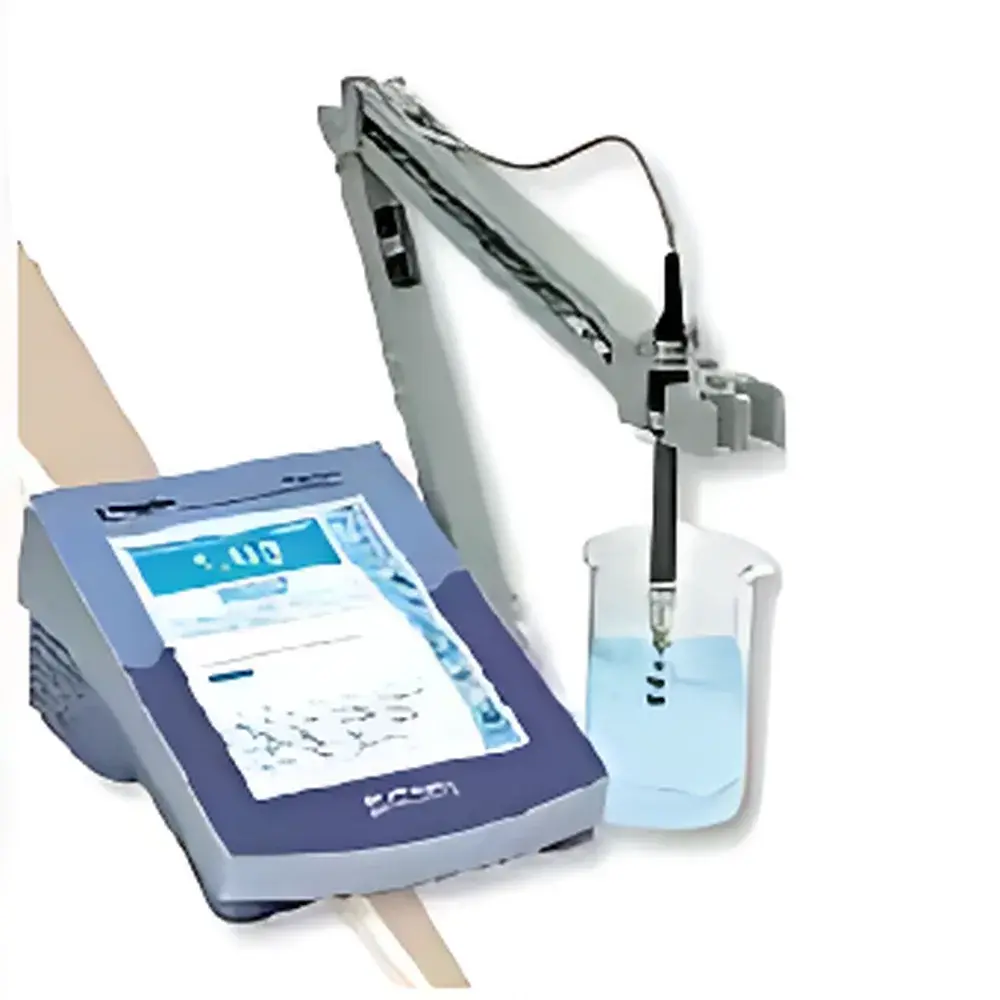
Thermo Fisher Scientific CyberScan CON 6000 Conductivity Meter
| Brand | Thermo Fisher Scientific |
|---|---|
| Origin | USA |
| Model | CON 6000 |
| Conductivity Range | 0.000–500.0 mS/cm |
| Resistivity Range | 3 Ω·cm – 100 MΩ·cm |
| TDS Range | 0.0–500.0 ppt |
| Accuracy | ±0.5% of full scale + 1 digit |
| Repeatability | ±0.01% of full scale |
| Temperature Range | −5.0 to 105.0 °C |
| Temp. Accuracy | ±0.2 °C |
| Temp. Repeatability | ±0.1 °C |
| Calibration | Auto or manual up to 4-point per range |
| Cell Constants | 0.1, 1.0, 10.0 cm⁻¹ |
| Display | 640 × 480 pixel color TFT touchscreen |
| Data Storage | Up to 10,000 readings with timestamp and user ID |
| Connectivity | USB, IrDA, RS-232C, Ethernet (RJ45) |
| Power | 9 VDC, 3.3 A, center-negative |
Overview
The Thermo Fisher Scientific CyberScan CON 6000 Conductivity Meter is a high-precision, GLP-compliant benchtop instrument engineered for rigorous electrochemical measurement of aqueous solution conductivity, resistivity, and total dissolved solids (TDS). Based on four-electrode or two-electrode AC conductometric principles—optimized to minimize polarization effects and electrode fouling—the CON 6000 delivers stable, traceable measurements across an extended dynamic range (0.000–500.0 mS/cm). Its architecture supports temperature-compensated conductivity (TCC) calculations using linear or non-linear (e.g., NaCl or custom) temperature coefficient models, enabling accurate normalization to reference temperatures (15.0–30.0 °C). Designed for regulatory environments, the meter incorporates hardware-level audit trail support, user-accessible calibration logs, and timestamped data capture—features aligned with FDA 21 CFR Part 11 expectations for electronic records in pharmaceutical and food safety laboratories.
Key Features
- Full-color 640 × 480 pixel TFT touchscreen interface powered by Windows CE, delivering intuitive icon-driven navigation and context-sensitive help screens.
- Multi-mode calibration: automated 4-point conductivity calibration per range using preloaded standards (15 buffer options), or manual calibration with user-defined solutions.
- Real-time graphical display of conductivity vs. time, supporting kinetic monitoring—for example, during titration-based salinity profiling or cleaning-in-place (CIP) validation.
- Comprehensive connectivity suite: USB host port (for keyboards, mice, printers), IrDA for wireless data transfer, RS-232C legacy interface, and Ethernet (RJ45) for LAN integration and remote data streaming via TCP/IP.
- Secure multi-user operation with up to 10 configurable accounts, each with password protection and individual data access permissions.
- Onboard storage for up to 10,000 measurement records—including conductivity, temperature, TDS, resistivity, cell constant, calibration history, operator ID, and ISO 8601-formatted timestamps.
Sample Compatibility & Compliance
The CON 6000 accommodates standard laboratory conductivity cells with cell constants of 0.1, 1.0, and 10.0 cm⁻¹, enabling precise measurement across ultrapure water (e.g., pharmaceutical WFI), process brines, wastewater effluents, and aggressive industrial electrolytes. Its temperature sensor (±0.2 °C accuracy) ensures reliable compensation across −5.0 to 105.0 °C—critical for hot-fill beverage QC or steam condensate analysis. The instrument meets ASTM D1125 (Standard Test Methods for Electrical Conductivity and Resistivity of Water) and EPA Method 120.1 (Conductivity Measurements for Water Quality Assessment). Its design supports Good Laboratory Practice (GLP) and Good Manufacturing Practice (GMP) workflows, including full calibration traceability, electronic signature-ready audit logs, and exportable CSV/Excel-compatible data files compliant with internal QA documentation requirements.
Software & Data Management
Data output is fully configurable via USB mass storage mode (direct file transfer to PC), IrDA beam transmission, or Ethernet-based network sharing. The built-in print engine supports customizable report templates—user-selectable fields (e.g., sample ID, operator, location, deviation flags), date/time formatting (12- or 24-hour clock; US/international calendar), and on-demand hardcopy generation without requiring external software. All stored records include embedded metadata: measurement mode, cell constant, temperature coefficient setting, calibration status, and user authentication token. Exported datasets retain ISO 8601 timestamps and are structured for seamless import into LIMS, ELN, or statistical process control (SPC) platforms. Firmware updates are delivered via USB or network download, ensuring long-term compliance with evolving cybersecurity and data integrity standards.
Applications
The CON 6000 serves as a primary metrology tool in regulated and research-intensive settings: routine QC testing of purified water in pharmaceutical manufacturing (USP , EP 2.2.38); HACCP-mandated conductivity verification in dairy and beverage processing lines; geological brine characterization in environmental field labs; TDS monitoring during paper pulp bleaching cycles; and R&D screening of ionic liquid formulations. Its robust construction, IP54-rated enclosure, and wide operating temperature range also support deployment in pilot-scale chemical reactors and municipal water treatment control rooms—where reproducibility (±0.01% FS) and inter-laboratory comparability are essential for method validation and proficiency testing.
FAQ
Does the CON 6000 support automatic temperature compensation (ATC) with non-linear models?
Yes—it allows selection of linear, NaCl, or user-defined temperature compensation curves, with adjustable temperature coefficients (0.000–10.000 %/°C).
Can calibration data be exported for audit purposes?
Yes—calibration logs (including date, standard used, slope, offset, and operator ID) are stored internally and exportable via USB or Ethernet in CSV format.
Is the instrument compatible with LIMS integration?
Yes—through its Ethernet port and ASCII-based communication protocol, it supports direct connection to laboratory information management systems using standard TCP/IP socket commands.
What power supply specifications are required?
A 9 VDC, 3.3 A center-negative external power adapter is supplied; no internal battery is included.
How does the CON 6000 handle electrode fouling in high-solids samples?
Its AC excitation frequency and selectable electrode configuration (two- or four-electrode mode) minimize polarization artifacts and enable stable readings in viscous or particulate-laden media when paired with appropriate flow-through or immersion cells.





