
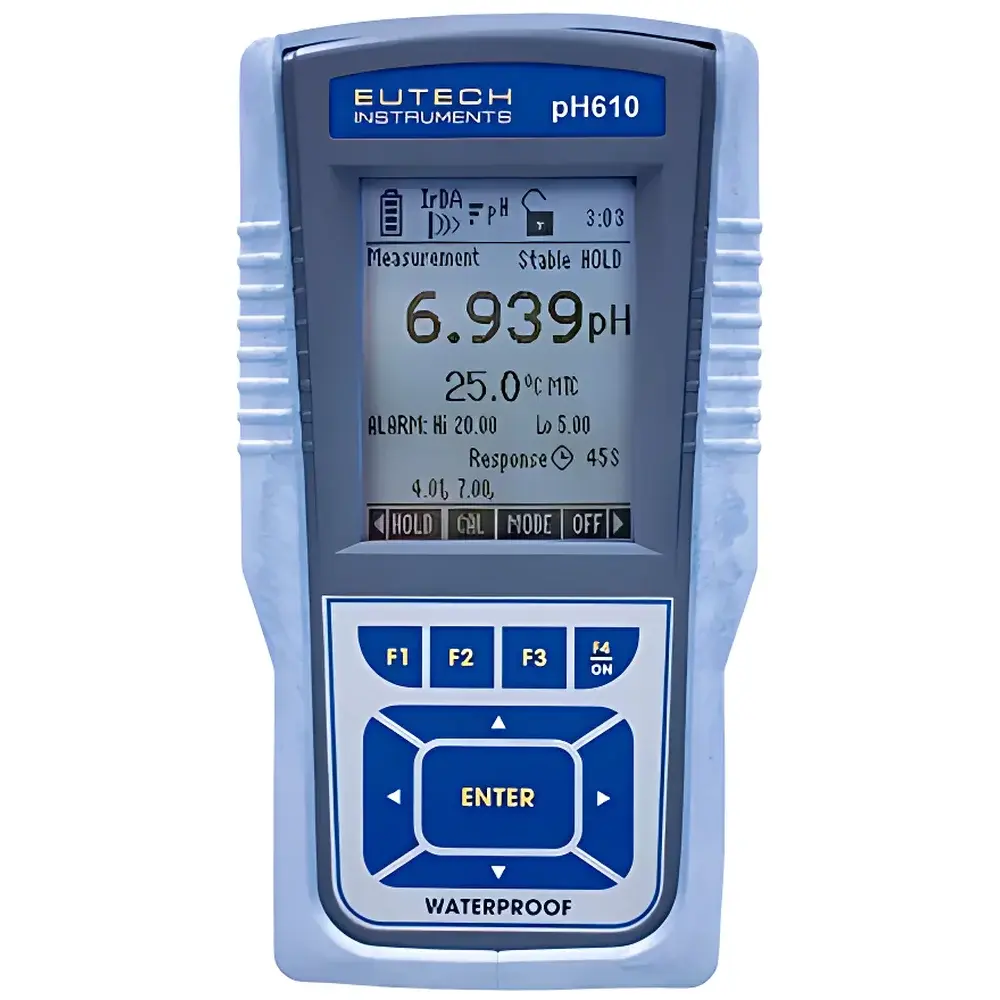
Thermo Fisher Scientific Eutech CyberScan pH 610 Portable pH/ORP/Temperature Meter
| Brand | Thermo Fisher Scientific |
|---|---|
| Origin | Singapore |
| Manufacturer | Thermo Fisher Scientific |
| Model | pH 610 |
| Type | Portable Electrochemical Analyzer |
| Measurement Parameters | pH, ORP (mV), Temperature (°C) |
| pH Range | −2.000 to 20.000 |
| pH Resolution | 0.001 / 0.01 / 0.1 |
| pH Accuracy | ±0.002 |
| ORP Range | ±2000.0 mV |
| ORP Resolution | 0.1 mV |
| ORP Accuracy | ±0.2 mV + 1 LSD |
| Temperature Range | −10.0 to 110.0 °C |
| Temperature Resolution | 0.1 °C |
| Temperature Accuracy | ±0.5 °C |
| Calibration Points | 1–6 |
| Auto-Buffer Recognition | USA, NIST, DIN, PWB, Custom |
| Temperature Compensation | Automatic or Manual (0.0–100.0 °C) |
| GLP Compliance | Yes |
| Data Storage | 500 readings with timestamp, electrode ID, and calibration history |
| IP Rating | IP67 |
| Display | Backlit LCD (5.4 × 7.1 cm) |
| Communication | IrDA infrared, RS232C, no cables required |
| Power | 4×AAA alkaline batteries (≥500 h life) or 9 V regulated DC adapter (500 mA) |
| Dimensions (H×W×D) | 18.3 × 9.5 × 5.7 cm |
| Weight | 460 g (instrument only) |
Overview
The Thermo Fisher Scientific Eutech CyberScan pH 610 is a high-precision, field-deployable electrochemical analyzer engineered for rigorous pH, oxidation-reduction potential (ORP), and temperature measurements in laboratory, industrial, environmental, and educational settings. Built upon potentiometric measurement principles, the instrument employs a high-impedance input circuit (>1012 Ω) to ensure stable signal acquisition from glass pH electrodes and redox sensors under variable ionic strength conditions. Its dual-mode temperature compensation—automatic via integrated Pt1000 sensor or manual entry—enables accurate thermodynamic correction per Nernst equation standards. Designed for operational continuity in demanding environments, the pH 610 meets IP67 ingress protection requirements, guaranteeing full dust resistance and temporary submersion tolerance (up to 1 m for 30 min), making it suitable for wastewater monitoring, aquaculture, food processing line checks, and field-based environmental sampling.
Key Features
- Triple-parameter capability: Simultaneous real-time display of pH, ORP (in mV), and temperature—with 3-digit pH resolution (0.001) and ±0.002 pH accuracy traceable to NIST-certified reference buffers.
- Intelligent calibration architecture: Supports up to six-point pH calibration with automatic recognition of five international buffer series (USA, NIST, DIN, PWB) plus user-defined entries; slope and offset values are displayed post-calibration for immediate electrode performance assessment.
- GLP-compliant data integrity: Each stored reading (up to 500 entries) includes timestamp, electrode identification, calibration status, temperature, and operator ID—fully auditable for ISO/IEC 17025, FDA 21 CFR Part 11, and GMP-aligned workflows.
- Cable-free data transfer: Integrated IrDA infrared interface enables one-touch wireless transmission to Windows-based PCs without drivers or physical connectors—eliminating cable wear, electromagnetic interference, and port compatibility constraints.
- Rugged human-centered design: Backlit monochrome LCD (5.4 × 7.1 cm active area) ensures legibility in low-light conditions; ergonomic housing with non-slip grip withstands repeated drop testing per MIL-STD-810G; auto-power-off configurable from 2 to 30 minutes.
Sample Compatibility & Compliance
The pH 610 accommodates standard BNC-connected pH electrodes, ORP combination probes, and separate temperature sensors (including Pt1000 and thermistor types). It supports aqueous, semi-aqueous, and low-conductivity samples—including purified water, fermentation broths, soil extracts, and pharmaceutical buffers—provided electrode junction design matches sample viscosity and fouling potential. Regulatory alignment includes compliance with ASTM D1293 (pH of water), ISO 7888 (water quality), USP (pH measurement in pharmaceutical preparations), and GLP documentation requirements for method validation records. The device’s firmware implements secure calibration lockout and audit trail logging to support regulatory inspections under FDA, EMA, and APVMA frameworks.
Software & Data Management
Data export is facilitated through Thermo Fisher’s proprietary Eutech LogPro software (Windows-compatible), which enables batch download, CSV/Excel report generation, trend visualization, and statistical analysis (mean, SD, %RSD). All transfers retain full metadata—including calibration logs, electrode history, and environmental timestamps—to satisfy ALCOA+ principles (Attributable, Legible, Contemporaneous, Original, Accurate, Complete, Consistent, Enduring, Available). The instrument does not require cloud connectivity or subscription services; local storage and offline analysis preserve data sovereignty and network security in regulated facilities.
Applications
- Environmental monitoring: Field measurement of surface water, groundwater, and effluent streams per EPA Method 150.1 and ISO 10523.
- Pharmaceutical QC: Buffer verification, cleaning validation rinse water testing, and stability study sample pH tracking under ICH Q5C guidelines.
- Food & beverage: pH control during fermentation (e.g., yogurt, beer), brine formulation, and HACCP-critical point verification.
- Academic research: Teaching potentiometry fundamentals, electrode kinetics studies, and comparative sensor evaluation in undergraduate and graduate labs.
- Industrial process support: Real-time pH supervision in electroplating baths, boiler feedwater treatment, and bioreactor inoculation protocols.
FAQ
Does the pH 610 support automatic temperature compensation for all probe types?
Yes—when used with integrated or external Pt1000 sensors, the instrument applies automatic temperature compensation across the full −10.0 to 110.0 °C range; manual compensation remains available for legacy or non-standard sensors.
Can calibration data be exported separately from measurement logs?
Yes—LogPro software allows selective export of calibration reports (including slope, offset, buffer IDs, and date/time stamps) as standalone PDF or CSV files for internal review or regulatory submission.
Is the IrDA interface compatible with modern laptops lacking infrared hardware?
No—IrDA requires an infrared transceiver; however, the included RS232C port (with optional USB-to-serial adapter) provides universal connectivity for contemporary systems.
What electrode maintenance alerts does the instrument provide?
The display indicates electrode response time degradation, abnormal slope deviation (>5% from theoretical), and high impedance warnings—prompting cleaning, rehydration, or replacement per manufacturer guidelines.
How is battery life validated under continuous use conditions?
Battery endurance (>500 hours) is measured at 25 °C with backlight disabled, 1-minute sampling interval, and default auto-off set to 30 minutes—per IEC 62304 Annex C test protocol for portable medical-grade instrumentation.
Related Products





