
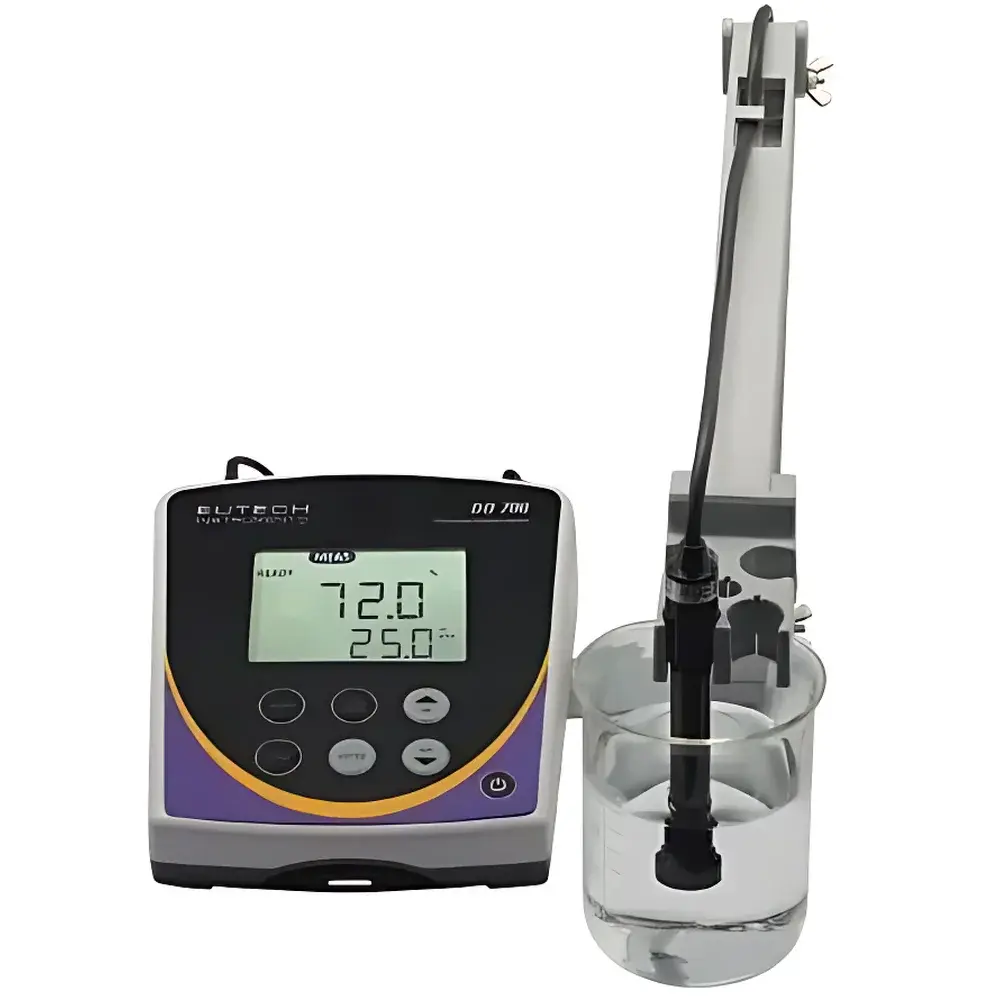
Thermo Fisher Scientific Eutech DO700 Dissolved Oxygen Meter
| Brand | Thermo Fisher Scientific |
|---|---|
| Origin | Singapore |
| Manufacturer Type | Original Equipment Manufacturer (OEM) |
| Product Origin | Imported |
| Model | Eutech DO700 |
| Price | Available Upon Request |
| DO Range | 0–30.0 mg/L |
| DO Resolution | 0.01 mg/L |
| DO Accuracy | ±0.5% of full scale |
| % Saturation Range | 0–199.9% / up to 300% |
| % Saturation Resolution | 0.1% |
| % Saturation Accuracy | ±0.5% of full scale |
| Salinity Compensation Range | 0–50 ppt |
| Salinity Resolution | 0.1 ppt |
| Barometric Pressure Adjustment Range | 450–825 mmHg |
| Barometric Resolution | 1 mmHg |
| Temperature Range | 0.0–50.0 °C (32.0–122.0 °F) |
| Temperature Resolution | 0.1 °C/°F |
| Temperature Accuracy | ±0.5 °C / ±0.9 °F |
| Data Storage Capacity | 100 measurement records |
| Auto-Stability Indicator | Yes |
| Display | Large backlit LCD |
| Includes | Electrode stand |
Overview
The Thermo Fisher Scientific Eutech DO700 Dissolved Oxygen Meter is a rugged, field- and lab-ready electrochemical instrument engineered for precision measurement of dissolved oxygen (DO) in aqueous samples using polarographic (Clark-type) sensor technology. It operates on the principle of oxygen diffusion through a gas-permeable membrane to a cathode, where molecular oxygen is reduced in an electrolytic cell, generating a current linearly proportional to the partial pressure of dissolved O₂. This fundamental electrochemical response—combined with integrated temperature, salinity, and barometric pressure compensation—ensures traceable, reproducible DO quantification across diverse environmental and process water matrices. Designed for routine monitoring in municipal wastewater treatment plants, aquaculture facilities, drinking water distribution systems, and academic teaching laboratories, the DO700 delivers ISO/IEC 17025-aligned measurement confidence without requiring advanced operator training.
Key Features
- Polarographic DO sensor interface supporting interchangeable Clark-type electrodes with replaceable membranes and electrolyte
- Automatic temperature, salinity (0–50 ppt), and barometric pressure (450–825 mmHg) compensation algorithms compliant with ASTM D888 and ISO 5814 standards
- Triple-unit display: simultaneous readout in mg/L, ppm (equivalent to mg/L for dilute aqueous solutions), and % saturation—enabling direct interpretation under varying environmental conditions
- Large backlit LCD with high-contrast alphanumeric characters optimized for low-light field use and glove-compatible operation
- Auto-stability detection with audible and visual indication upon signal convergence (±0.02 mg/L over 10 sec), reducing subjective endpoint judgment
- Non-volatile memory storing up to 100 timestamped measurement records—including DO value, % saturation, temperature, salinity, and atmospheric pressure settings—for GLP-compliant data traceability
- Integrated electrode stand for hands-free calibration and measurement; compatible with standard BNC and mini-DIN DO probe connectors
Sample Compatibility & Compliance
The DO700 is validated for use with natural waters (freshwater, estuarine, seawater), treated effluents, potable water, and biological reactor samples. Its compensation logic accommodates variable ionic strength and thermal gradients typical of open-channel monitoring or bioreactor sampling. The instrument meets functional requirements outlined in EPA Method 360.1, APHA Standard Methods 4500-O G, and ISO 5814:2012 for electrochemical DO determination. While not inherently 21 CFR Part 11 compliant, its audit-ready data log supports manual verification workflows required under GLP and GMP environments when paired with documented SOPs and calibration logs.
Software & Data Management
Data export is performed via manual transcription from the onboard display or printed reports generated using optional thermal printers (e.g., Thermo Fisher Scientific P100 series). No proprietary PC software or USB connectivity is embedded; however, the 100-entry memory includes date/time stamps, sensor identification fields (user-entered), and environmental correction parameters—facilitating manual import into LIMS or Excel-based QA/QC tracking systems. Calibration history (zero and span points) must be recorded externally per ISO/IEC 17025 Clause 7.7, and the device supports two-point DO calibration using air-saturated water and sodium sulfite zero solution.
Applications
- Wastewater treatment plant process control: aeration basin DO profiling, nitrification/denitrification monitoring
- Aquaculture health management: real-time DO surveillance in recirculating aquaculture systems (RAS) and hatchery tanks
- Environmental field surveys: stream, lake, and coastal zone DO mapping under variable barometric and salinity conditions
- Academic laboratory instruction: student experiments in aquatic ecology, biogeochemistry, and environmental engineering labs
- Drinking water quality assurance: post-chlorination and reservoir DO stability assessment per WHO Guidelines for Drinking-water Quality
FAQ
Does the DO700 support automatic barometric pressure sensing?
No—it requires manual entry of local atmospheric pressure (in mmHg), obtainable from weather services or calibrated barometers.
Can the instrument store calibration data?
No—the DO700 does not retain calibration coefficients; users must document zero and span values externally per GLP requirements.
Is the sensor cable replaceable or repairable in the field?
Yes—standardized BNC or mini-DIN connectors allow field replacement of damaged cables without instrument servicing.
What maintenance is required for long-term accuracy?
Regular membrane replacement (every 2–4 weeks depending on sample fouling), electrolyte replenishment, and daily zero/scale verification using certified reference solutions are essential.
Does the DO700 comply with FDA 21 CFR Part 11?
No—it lacks electronic signature capability, audit trail generation, or user access controls required for regulated pharmaceutical or clinical applications.







