
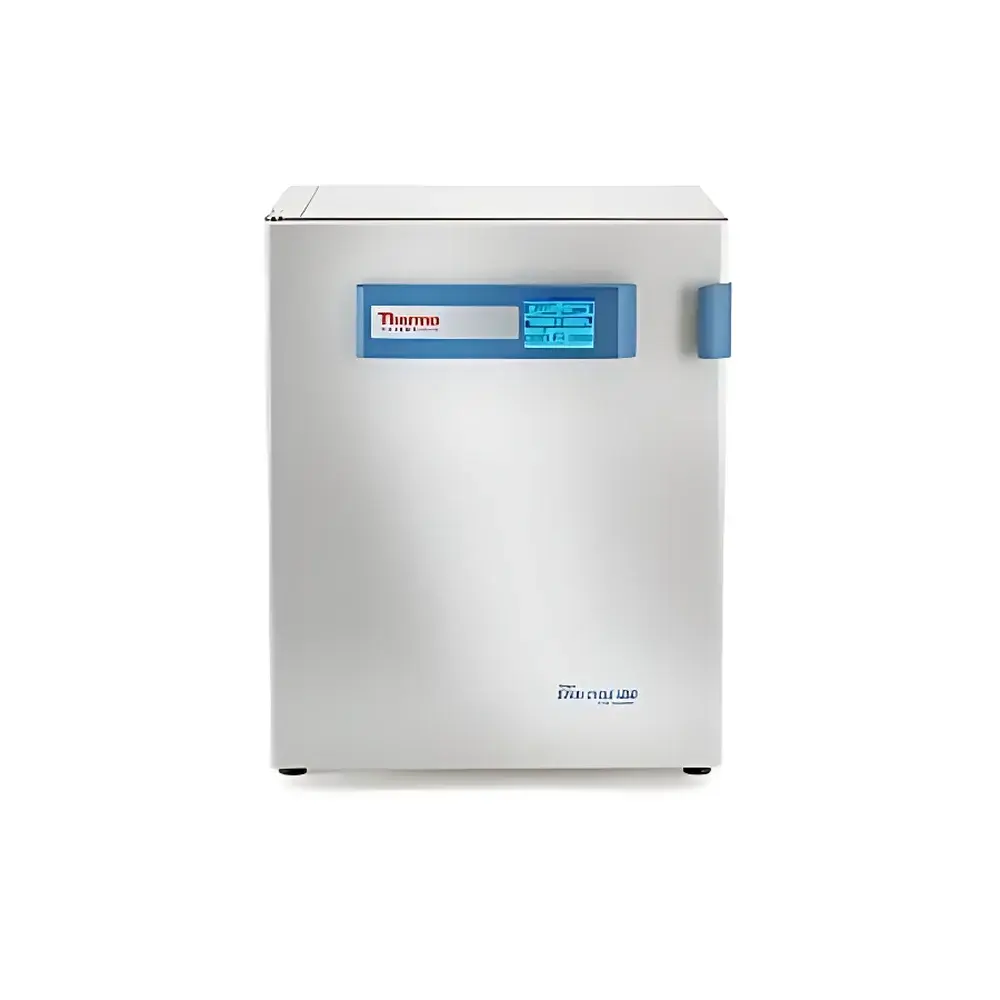
Thermo Fisher Scientific Forma Steri-Cycle i250 CO₂ Incubator
| Brand | Thermo Fisher Scientific |
|---|---|
| Origin | Germany |
| Manufacturer Type | Original Equipment Manufacturer (OEM) |
| Import Status | Imported |
| Model | i250 |
| Temperature Range & Accuracy | 3 °C to 55 °C (±0.1 °C setpoint stability) |
| Temperature Uniformity | ±0.1 °C across chamber volume |
| Humidity Control | >93% RH at 37 °C |
| Chamber Capacity | 255 L |
| Sterilization Cycle | 140 °C dry-heat, 14-hour duration |
| Air Filtration | Internal HEPA filter (ISO Class 5 / Grade A equivalent), optional VOC adsorption module |
| Sensor Type | High-temperature-resistant TC sensor (in situ during sterilization), IR-based CO₂ sensing |
Overview
The Thermo Fisher Scientific Forma Steri-Cycle i250 CO₂ Incubator is an ISO Class 5–compliant, microprocessor-controlled environmental chamber engineered for high-fidelity mammalian cell culture, stem cell expansion, and sensitive primary tissue maintenance. It employs a precisely regulated dual-gas (air + CO₂) mixing system with infrared (IR) CO₂ sensing and feedback-controlled solenoid valves to maintain setpoint accuracy within ±0.1 vol% CO₂ across the full operating range (0–20%). Temperature regulation utilizes a forced-air convection system with asymmetric airflow distribution—designed to minimize thermal gradients and mechanical disturbance to cultures—while preserving laminar flow integrity over Petri dishes, flasks, and multiwell plates. The incubator’s thermal architecture integrates three independent heating zones (chamber walls, door, and base), each monitored by calibrated thermocouples, enabling dynamic compensation for ambient fluctuations and door-opening events. Its 140 °C dry-heat sterilization cycle meets ISO 13485 and EU GMP Annex 1 requirements for decontamination of critical surfaces without chemical residues.
Key Features
- 255 L stainless steel chamber with electropolished, radius-cornered interior for seamless cleaning and reduced microbial retention
- Integrated ISO Class 5 HEPA filtration (0.3 µm @ 99.99% efficiency) providing continuous recirculated air purification; HEPA module is tool-free removable for routine replacement or validation
- Optional activated carbon–based VOC adsorption cartridge for removal of trace organic contaminants from ambient intake air
- In-situ high-temperature thermocouple (TC) sensor rated for continuous operation up to 140 °C—no sensor repositioning required before or after sterilization cycles
- Microprocessor-based control system with alphanumeric LCD display showing real-time temperature, CO₂ concentration, relative humidity (optional probe), and active alarm status
- Configurable audible/visual alarm suite including over-temperature (>60 °C), CO₂ high/low deviation (>±0.3 vol%), door-open detection, low-humidity warning, and HEPA service reminder
- Access code protection prevents unauthorized initiation of sterilization or parameter modification—supports audit trail compliance under FDA 21 CFR Part 11 when paired with validated software
- Tool-less removable stainless steel shelves and adjustable silicone-coated door gasket ensure reproducible sealing performance and long-term dimensional stability
Sample Compatibility & Compliance
The i250 accommodates standard cell culture formats including T-flasks (up to T-225), 100 mm Petri dishes, 96-well plates, roller bottles, and bioreactor vessels up to 5 L working volume. Its uniform temperature distribution (±0.1 °C) and stable CO₂ homogeneity (<±0.1 vol% spatial variation) are verified per ASTM E1651 and ISO 15189 Annex B protocols. The chamber design conforms to ISO 14644-1 Class 5 (formerly Class 100) cleanroom air quality standards when operated with HEPA filtration enabled. All materials in contact with the internal environment—including gaskets, shelf coatings, and sensor housings—comply with USP and biological reactivity testing. Routine sterilization cycles satisfy EN 1422 and ISO 17665-1 for moist-heat equivalence validation.
Software & Data Management
The embedded controller supports RS-232 and optional Ethernet connectivity for integration into laboratory information management systems (LIMS) or centralized monitoring platforms. Logged parameters include timestamped temperature, CO₂, humidity (if equipped), door status, alarm events, and sterilization cycle metadata. Data export is available in CSV format; raw logs retain ≥30 days of continuous history onboard. When used with Thermo Fisher’s optional Traceable™ Software Suite (validated per GAMP 5), the system provides electronic signatures, user-level access controls, and full 21 CFR Part 11–compliant audit trails—including operator ID, action timestamp, parameter change values, and reason-for-change annotation.
Applications
- Long-term maintenance of human embryonic stem cells (hESCs) and induced pluripotent stem cells (iPSCs) requiring strict CO₂ and humidity fidelity
- GMP-compliant production of viral vectors and monoclonal antibodies in adherent and suspension culture modes
- Primary neuronal and organoid culture where thermal drift or airborne contaminants compromise viability
- Regulatory submissions supporting ICH M10 bioanalytical method validation where environmental stability documentation is mandatory
- Academic core facilities serving high-throughput screening workflows with concurrent use of multiple plate formats
FAQ
Does the i250 support remote monitoring via network interface?
Yes—standard RS-232 and optional Ethernet ports enable connection to facility-wide environmental monitoring systems (EMS) or SCADA platforms.
Can the HEPA filter be replaced without tools?
Yes—the HEPA module mounts via spring-loaded latches and requires no screws or alignment fixtures for installation or removal.
Is the 140 °C sterilization cycle validated for sporicidal efficacy?
The cycle achieves ≥6-log reduction of Geobacillus stearothermophilus spores when performed per Thermo Fisher’s published SOPs and verified using biological indicators per ISO 11138-3.
What humidity measurement technology is used?
An optional capacitive relative humidity (RH) sensor is available; it is calibrated traceably to NIST standards and features automatic drift compensation.
How is temperature uniformity verified during IQ/OQ?
Validation includes 9-point mapping per ISO 15189 Annex B using calibrated PT100 probes, with acceptance criteria of ±0.1 °C maximum deviation from setpoint across all locations.





