
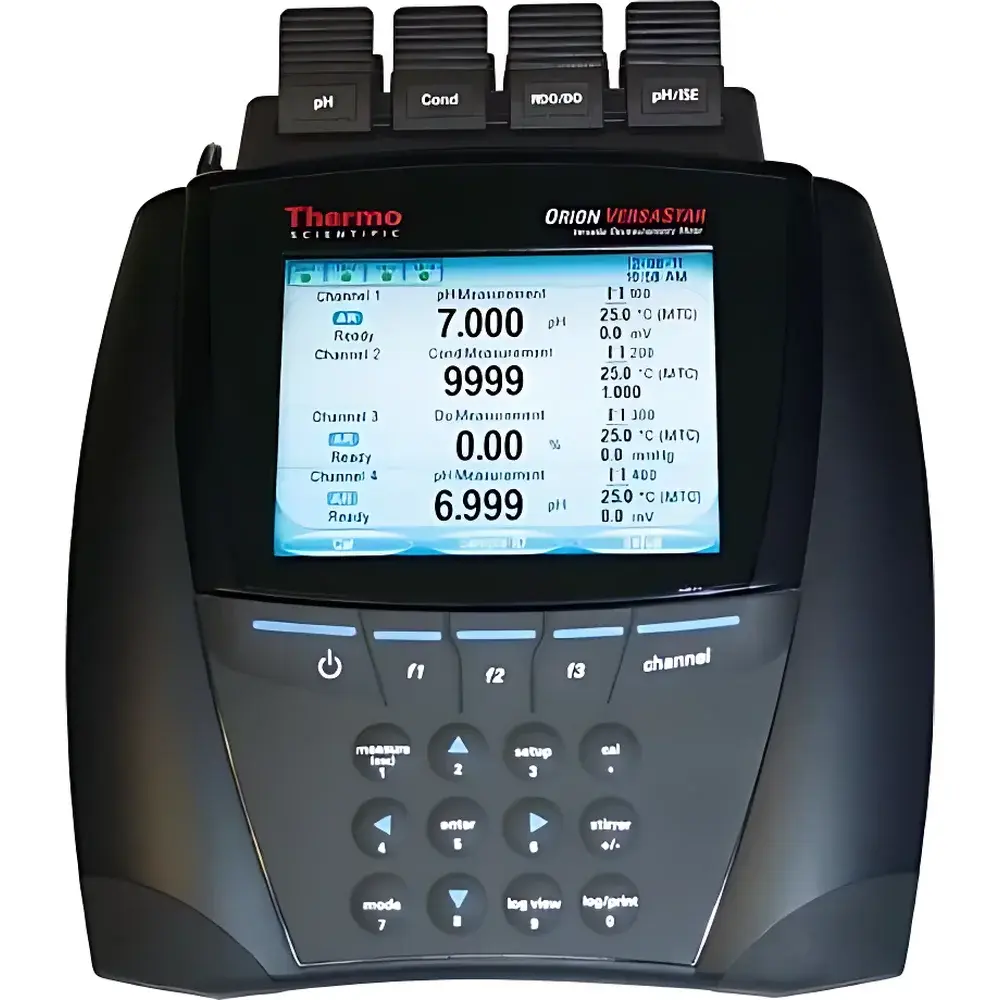
Thermo Fisher Scientific Orion VERSA STAR Multi-Parameter Benchtop Meter
| Brand | Thermo Fisher Scientific |
|---|---|
| Origin | Singapore |
| Manufacturer | Thermo Fisher Scientific |
| Country of Origin | Imported |
| Model | VERSA STAR |
| Instrument Type | Laboratory Water Quality Analyzer |
| Measurable Parameters | pH, ISE (Ion Selective Electrode), Conductivity, Dissolved Oxygen (DO), Temperature |
| Compliance | GLP-Compliant Data Storage (2000 Records) |
| Connectivity | Dual USB + RS232 |
| Protection Rating | IP54 |
| Operating Modules | Up to 4 Simultaneous Modules |
| Stirrer Support | 2 Orion Star Stirrers (Hot-Swappable) |
Overview
The Thermo Fisher Scientific Orion VERSA STAR Multi-Parameter Benchtop Meter is an engineered platform for high-integrity water quality analysis in regulated laboratory environments. Designed around modular electrochemical measurement principles—including potentiometric pH/ISE, conductimetric conductivity/resistivity/TDS/salinity, amperometric polarographic and optical fluorescent dissolved oxygen (RDO), and thermometric temperature compensation—the VERSA STAR delivers traceable, repeatable, and audit-ready results. Its architecture supports simultaneous operation of up to four independent measurement modules, each auto-recognized via proprietary 8-pin or 9-pin mini-DIN interfaces. The system implements NIST-traceable calibration protocols, automatic temperature compensation (ATC) with configurable slope correction, and real-time electrode diagnostics—critical for method validation under ISO/IEC 17025, USP , ASTM D1125, and EPA 150.1–150.3 frameworks.
Key Features
- Four-channel expandable architecture with hot-swappable module recognition—no power cycling required during configuration changes
- 7-inch full-color LCD display supporting simultaneous readout of primary parameter, secondary parameter (e.g., temperature), time/date stamp, sample ID, user ID, and active calibration status
- GLP-compliant data management: 2000-storable records with timestamp, operator ID, electrode serial number, calibration history, and environmental metadata
- Multi-language UI (English, Chinese, Spanish, French, German, Portuguese) with intuitive icon-driven navigation and context-sensitive help
- Dual stirrer control ports enabling synchronized BOD incubation or kinetic titration workflows without external controllers
- Integrated electrode diagnostics including LogR resistance monitoring (for glass electrode integrity), mV offset tracking, and junction potential assessment
- Configurable endpoint detection: fixed-time, slope-based, or user-defined stability thresholds for ISE and DO measurements
- Onboard calculation engine supporting BOD5, DO utilization rate (DOUR), and specific oxygen uptake rate (SOUR) when paired with PC software
Sample Compatibility & Compliance
The VERSA STAR accommodates a broad spectrum of aqueous matrices—from ultrapure water (UPW) and pharmaceutical process streams to wastewater effluents and seawater. Its conductivity module incorporates non-linear temperature compensation algorithms aligned with USP for purified water and ASTM D1125 for natural waters. The RDO probe option meets ISO 5814:2012 requirements for optical DO measurement, while the polarographic DO module complies with ISO 5815-1:2016. All modules support buffer recognition per USA (NIST), DIN, and JIS standards. Data integrity safeguards include electronic signatures, audit trail logging (per FDA 21 CFR Part 11 readiness), and immutable record archiving—ensuring alignment with GLP, GMP, and ISO 17025 documentation requirements.
Software & Data Management
Data export is supported via USB mass storage mode (CSV/Excel-compatible) or RS232 serial transmission to LIMS or ELN systems. The included Orion Star Com software enables remote firmware updates, batch calibration report generation, trend analysis, and statistical evaluation (mean, SD, RSD, confidence intervals). All stored measurements retain full metrological context: electrode model and serial number, calibration date and standard values, ambient pressure (for DO), salinity correction factor, and user-defined QC flags. Exported files are structured to meet ALCOA+ principles (Attributable, Legible, Contemporaneous, Original, Accurate, Complete, Consistent, Enduring, Available).
Applications
- Pharmaceutical water system qualification (PW, WFI, UPW) per USP and EU Annex 1
- Environmental compliance testing for NPDES permits, drinking water (EPA Method 150.1), and wastewater discharge (EPA Method 120.1)
- Academic and industrial research requiring multi-parameter correlation (e.g., pH–conductivity–DO interdependence in bioreactor studies)
- Food & beverage quality control: titratable acidity, salt content (via conductivity), and dissolved oxygen in packaging headspace
- Electrode performance validation and lifetime monitoring in central lab QA/QC workflows
- BOD5 and respirometry assays compliant with ISO 5815-2:2016 and ASTM D5210
FAQ
Does the VERSA STAR support FDA 21 CFR Part 11 compliance?
Yes—when used with Orion Star Com software and configured with electronic signatures, audit trails, and role-based access control, the system meets foundational Part 11 requirements for electronic records and signatures.
Can I perform simultaneous pH and conductivity measurements on the same sample?
Yes—using two dedicated modules (e.g., VSTAR-PH and VSTAR-CND), the instrument acquires and displays both parameters in real time with synchronized timestamps and shared temperature compensation.
What electrode diagnostics does the LogR module provide?
The LogR module measures glass electrode resistance (0–6000 MΩ·cm) and detects degradation trends, junction clogging, or reference electrode failure—enabling predictive maintenance and reducing calibration drift risk.
Is seawater salinity measurement traceable to international standards?
Yes—the built-in seawater salinity curve follows UNESCO 1983 Practical Salinity Scale (PSS-78), and conductivity cell constants are certified per ISO 7888.
How is atmospheric pressure compensated during dissolved oxygen measurement?
The DO module accepts manual barometric input (450.0–850.0 mmHg) or integrates with optional external pressure sensors for fully automated compensation—critical for high-altitude or variable-pressure lab environments.







