
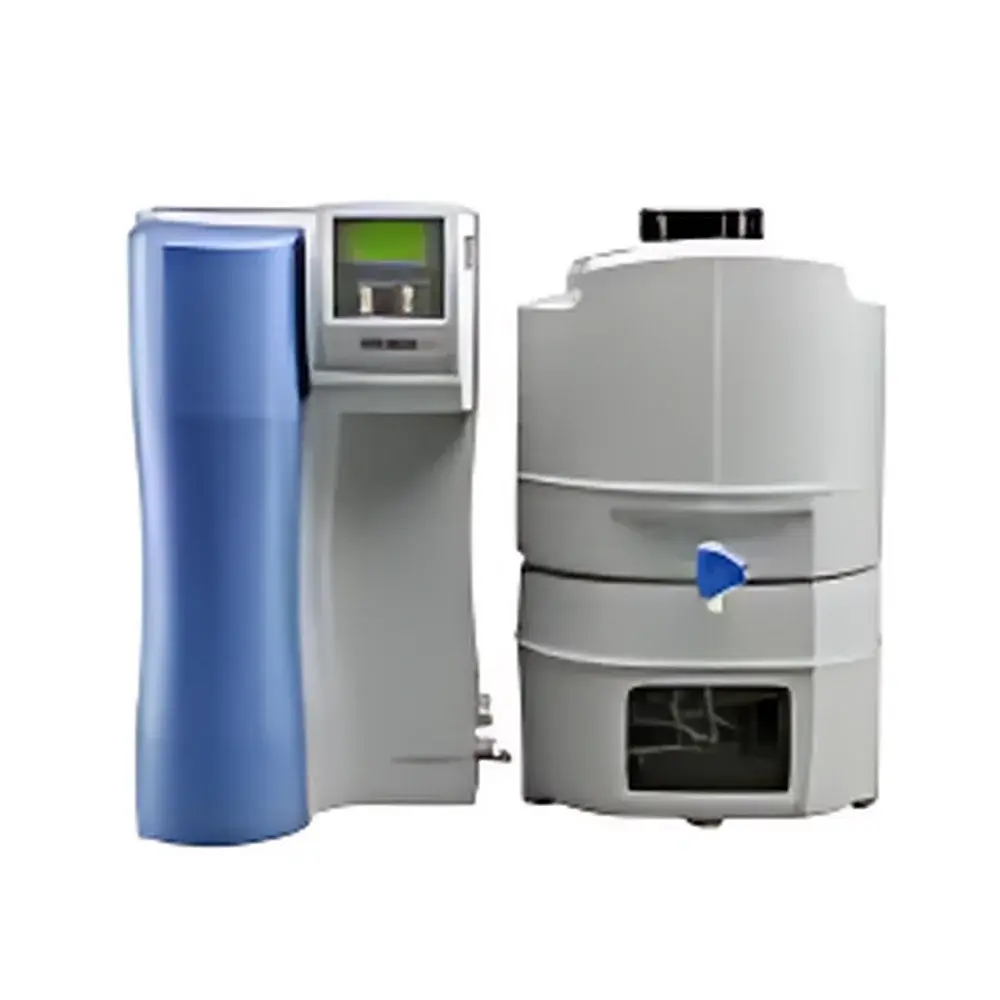
Thermo Fisher Scientific Pacific TII Type II Pure Water System
| Brand | Thermo Fisher Scientific |
|---|---|
| Origin | Germany |
| Manufacturer | Yes |
| Import Status | Imported |
| Model | Pacific TII |
| Output Flow Rates | 3 / 7 / 12 / 20 / 40 L/hr |
| Resistivity | 10–15 MΩ·cm at 25 °C |
| TOC | <30 ppb |
| Particulates (>0.1 µm) | <1 particle/mL |
| Display | Backlit adjustable-angle LCD with resistivity/conductivity, status mode, tank level (%), and temperature (±0.1 °C per USP <645>) |
| Conductivity Cell Constant | 0.01 cm⁻¹ |
| Compliance | GLP-supporting data logging via RS-232 printer interface |
| Installation | Benchtop or wall-mounted |
| Scalability | Field-upgradable to higher flow capacity |
Overview
The Thermo Fisher Scientific Pacific TII Type II Pure Water System is an engineered solution for laboratories requiring consistent, high-reliability grade II purified water in compliance with ISO 3696:1987 (Grade 2), CLSI EP21-A, and ASTM D1193-20 (Type II). It employs a multi-stage purification architecture—comprising prefiltration, reverse osmosis (RO), dual-bed ion exchange, and optional 254 nm ultraviolet irradiation—to remove ionic contaminants, organic compounds, colloids, and microorganisms. The system delivers water with resistivity of 10–15 MΩ·cm at 25 °C and total organic carbon (TOC) consistently below 30 ppb, meeting critical requirements for buffer preparation, media formulation, HPLC mobile phase dilution, and general analytical laboratory use. Its closed-loop recirculation design—activated automatically during non-use periods—maintains microbiological integrity without compromising chemical purity.
Key Features
- Five scalable flow rate options: 3, 7, 12, 20, and 40 L/hr—enabling precise matching to lab demand and future expansion via field-upgradable pump and storage modules;
- Microprocessor-controlled operation with real-time monitoring of resistivity, temperature (±0.1 °C accuracy, validated per USP ), and tank level (%); all displayed on a backlit, tilt-adjustable LCD;
- Automatic standby-to-recirculation transition ensures continuous loop circulation during idle periods, minimizing biofilm formation and preserving conductivity stability;
- Integrated 0.01 cm⁻¹ conductivity cell enables high-resolution resistivity measurement across the full 0.055–18.18 µS/cm range, supporting trace-level ionic impurity detection;
- Modular footprint supports benchtop installation or space-saving wall-mount configuration; compact design minimizes floor space without sacrificing service accessibility;
- Secure parameter management via password-protected settings to prevent unauthorized configuration changes—essential for GLP/GMP-aligned environments.
Sample Compatibility & Compliance
The Pacific TII is designed for continuous production of Type II water suitable for applications where low ionic and organic contamination is required—but where ultrapure (Type I) specifications are not mandated. It complies with ISO 3696:1987 Grade 2, ASTM D1193-20 Type II, and CLSI EP21-A for water quality verification. Its resistivity measurement system is calibrated and verified in accordance with USP , including temperature compensation algorithms and electrode constant validation (0.01 cm⁻¹). Data traceability is supported through optional RS-232 serial output to external printers or LIMS interfaces, enabling audit-ready records for GLP-regulated workflows. While not certified for endotoxin-free or sterile water production, its 0.1 µm) performance and optional UV lamp provide robust mitigation against particulate and microbial carryover.
Software & Data Management
The Pacific TII operates without proprietary software dependencies—its embedded firmware handles all operational logic, diagnostics, and parameter logging locally. Critical metrics—including date/time-stamped resistivity, temperature, tank level, and operational mode—are retained in non-volatile memory and exportable via RS-232 to standard ASCII-formatted printers or legacy lab data systems. No cloud connectivity or vendor-specific drivers are required. This architecture aligns with FDA 21 CFR Part 11 principles for electronic records when paired with appropriate procedural controls (e.g., defined user roles, audit trail documentation, and secure archive protocols). Firmware updates are performed via physical USB interface under controlled change management procedures.
Applications
- Preparation of reagent-grade solutions, calibration standards, and sample diluents for spectrophotometry, titration, and elemental analysis;
- Formulation of cell culture media, PBS, and Tris-based buffers where residual ions must be minimized but endotoxin levels are not critical;
- Mobile phase preparation and instrument rinsing for HPLC, IC, and GC systems requiring low TOC and stable resistivity;
- General laboratory cleaning, glassware rinsing, and feed water for downstream ultrapure systems (e.g., as pretreatment for Type I polishing units);
- Quality control laboratories operating under ISO/IEC 17025 or pharmaceutical QC environments adhering to internal SOPs referencing ASTM D1193 or ISO 3696.
FAQ
What is the maximum allowable TOC level for Type II water per ASTM D1193-20?
Per ASTM D1193-20, Type II water requires TOC ≤ 50 ppb; the Pacific TII achieves <30 ppb under standard operating conditions.
Can the Pacific TII be integrated into a central water distribution system?
No—it is a point-of-use system designed for direct dispensing from its integrated reservoir. For centralized distribution, Thermo Fisher offers the Elix or Purelab ranges.
Is the 0.2 µm terminal filter included by default?
No—the 0.2 µm final filter (Cat. No. 50138221) is an optional accessory installed at the point of dispensing.
Does the system meet USP requirements for conductivity testing?
Yes—the temperature-compensated conductivity measurement subsystem, including its 0.01 cm⁻¹ cell and ±0.1 °C thermistor, satisfies instrumental and procedural criteria outlined in USP .
How often does the system require preventive maintenance?
Routine maintenance intervals are defined by usage volume and feed water quality; typical service includes RO membrane replacement every 12–24 months and ion exchange cartridge replacement every 6–12 months, per Thermo Fisher’s PM schedule.
Related Products



