
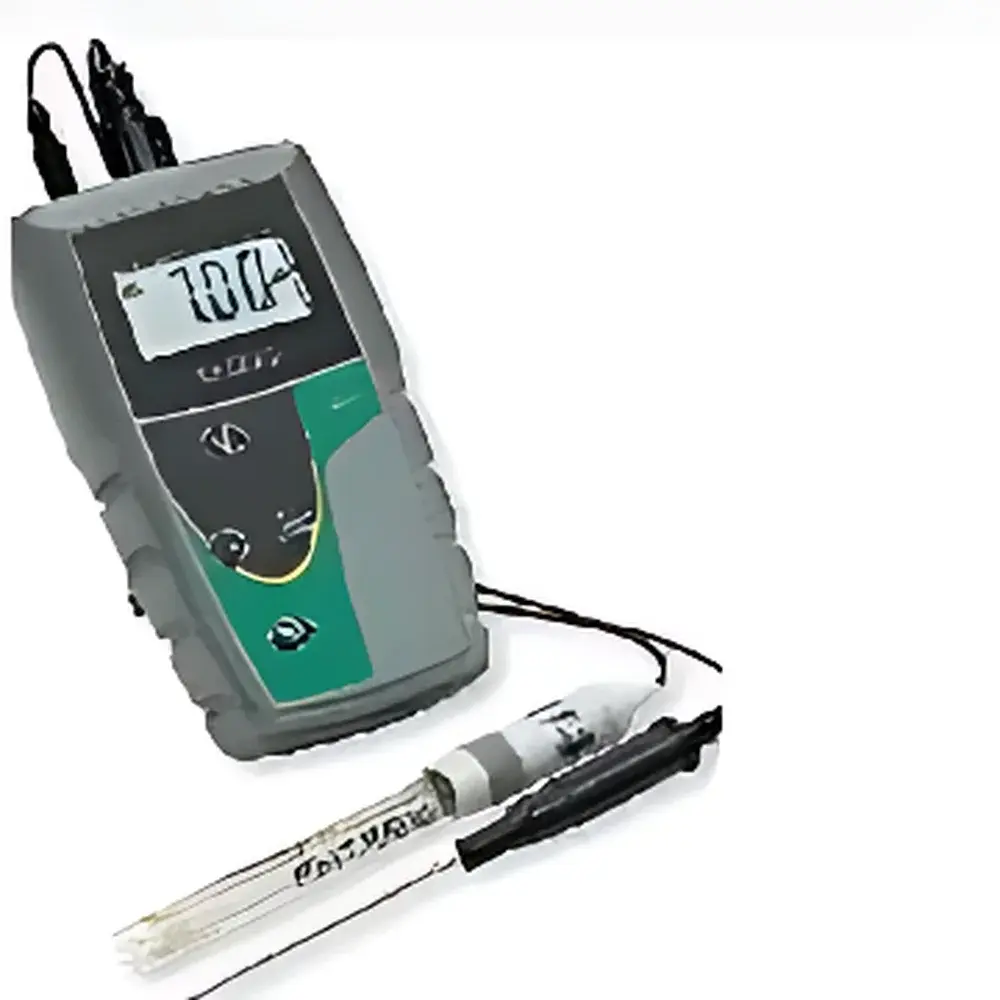
Thermo Fisher Scientific pH6+ Portable pH/ORP/Temperature Meter
| Brand | Thermo Fisher Scientific |
|---|---|
| Origin | Singapore |
| Model | pH6+ |
| Instrument Type | Portable |
| Measurement Parameters | pH, ORP, Temperature (°C) |
| pH Range | 0.00–14.00 |
| pH Resolution | 0.01 pH |
| pH Accuracy | ±0.01 pH |
| Temperature Range | 0.0–100.0 °C |
| Temperature Resolution | 0.1 °C |
| Temperature Accuracy | ±0.5 °C |
| ORP Range | ±1000 mV |
| ORP Resolution | 0.1 mV (up to 199.9 mV), 1 mV (above) |
| ORP Accuracy | ±2 mV ±1 LSD |
| Calibration Points | 3-point (pH) |
| Buffer Standards | USA, NIST, PWB |
| ATC/MTC Compensation | 0–100 °C |
| Auto-Off | After 20 min inactivity |
| Power Supply | 4 × 1.5 V AAA alkaline batteries |
| Battery Life | >200 hours |
| Display | LCD (4.5 × 2.3 cm) |
| Dimensions (unit) | 14 × 17 × 3.5 cm |
| Weight (unit) | 200 g |
| Packaging Dimensions | 36 × 28 × 8 cm |
| Packaging Weight | 1500 g |
Overview
The Thermo Fisher Scientific pH6+ Portable pH/ORP/Temperature Meter is an engineered field-deployable electrochemical instrument designed for reliable, on-site measurement of pH, oxidation-reduction potential (ORP), and temperature in diverse environmental, industrial, and educational settings. Built upon a robust potentiometric measurement architecture, the pH6+ employs high-impedance input circuitry (≥1012 Ω) to minimize loading effects on reference and sensing electrodes, ensuring stable voltage acquisition from glass pH electrodes and platinum or gold ORP sensors. Its microprocessor-controlled analog-to-digital conversion supports dual-slope integration for noise rejection in electrically noisy environments—critical for wastewater sampling, aquaculture monitoring, or field-based quality control in food processing facilities. The device operates under standardized electrochemical principles defined in ASTM D1293 (Standard Test Method for pH of Water) and ISO 10523 (Water Quality — Determination of pH), with calibration traceability aligned to NIST-traceable buffer standards.
Key Features
- Triple-parameter capability: Simultaneous real-time display of pH, ORP (mV), and temperature (°C) on a high-contrast LCD (4.5 × 2.3 cm)
- High-precision pH measurement: 0.01 pH resolution and ±0.01 pH accuracy across full 0.00–14.00 range, validated per IUPAC recommended procedures
- Flexible calibration protocol: Supports 3-point pH calibration using user-selectable buffer sets (USA, NIST, or PWB), enabling adaptation to regional regulatory requirements
- Intelligent temperature compensation: Automatic (ATC) or manual (MTC) compensation over 0.0–100.0 °C, with ±0.5 °C accuracy and 0.1 °C resolution
- Dual-mode ORP measurement: High-resolution 0.1 mV readout up to ±199.9 mV, switching to 1 mV resolution beyond that range; accuracy meets ASTM D3223 for redox monitoring
- Low-power architecture: Optimized circuit design delivers >200 hours of continuous operation on four standard AAA alkaline cells
- Environmental resilience: IP65-rated housing provides dust-tight protection and resistance to low-pressure water jets—suitable for outdoor deployment and humid laboratory peripheries
- Compliance-ready operation: Auto-off after 20 minutes of inactivity conserves battery life and supports GLP-aligned usage logs when paired with external data recording
Sample Compatibility & Compliance
The pH6+ is compatible with standard BNC-input combination pH electrodes (e.g., Thermo Scientific Orion 9107BNMD, 9102BN) and dedicated ORP electrodes with non-polarizable reference systems. It accepts both refillable and gel-filled electrolyte configurations, supporting routine use in aqueous matrices including drinking water, surface runoff, process streams, and buffered calibration solutions. The instrument conforms to IEC 61010-1:2010 for electrical safety in laboratory equipment and meets EMC requirements per IEC 61326-1:2020. While not certified for intrinsic safety in hazardous locations, its design aligns with general-purpose use under ISO/IEC 17025-accredited testing workflows where documented calibration, traceable buffers, and operator training are maintained.
Software & Data Management
As a standalone portable meter, the pH6+ does not feature onboard data logging or Bluetooth/Wi-Fi connectivity. However, its stable analog output and consistent serial response enable seamless integration with external GLP-compliant data acquisition systems via RS-232 or TTL-level UART interfaces (with optional adapter). When used in regulated environments—including those governed by FDA 21 CFR Part 11—the device supports audit-trail-capable workflows when paired with validated third-party software platforms that record operator ID, timestamp, calibration history, and raw mV/pH values. All calibration events—including date, buffer IDs, slope (%), offset (mV), and temperature—are displayed and can be manually transcribed into electronic lab notebooks (ELNs) or LIMS.
Applications
- Environmental field monitoring: pH and ORP profiling of rivers, lakes, wetlands, and stormwater outfalls per EPA Method 150.1 and ISO 5667-3
- Food & beverage QC: Spot-checking rinse water pH in dairy processing lines, brine solution verification in meat curing, and fermentation tank redox stability
- Educational laboratories: Undergraduate electrochemistry experiments involving Nernst equation validation, buffer capacity analysis, and electrode response time studies
- Aquaculture and hydroponics: Daily tracking of nutrient solution pH drift and redox status to prevent microbial imbalance or metal precipitation
- Wastewater treatment: Monitoring influent/effluent pH shifts and disinfection-stage ORP thresholds (>650 mV for chlorine efficacy)
- Pharmaceutical water systems: Routine checks of purified water (PW) and water-for-injection (WFI) distribution loop pH during system sanitization cycles
FAQ
What buffer standards does the pH6+ support?
The meter offers selectable calibration modes for USA (pH 4.01, 7.00, 10.01), NIST (pH 4.01, 6.86, 9.18), and PWB (phosphate-buffered water) standards—allowing alignment with local metrological practice.
Does the pH6+ meet GLP requirements?
While the device itself lacks built-in audit trail functionality, it supports GLP compliance when used with documented calibration records, traceable buffers, trained personnel, and externally validated data capture protocols.
Can the pH6+ measure samples above 100 °C?
No—the integrated temperature sensor and ATC algorithm are rated for 0.0–100.0 °C; measurements beyond this range require external temperature probes and manual compensation.
Is electrode diagnostics available on this model?
The pH6+ displays slope and offset values post-calibration but does not provide real-time impedance monitoring or electrode health diagnostics—features found in higher-tier benchtop meters.
How is temperature compensation applied during ORP measurement?
ORP values are not temperature-compensated by default; however, simultaneous temperature reading enables manual correction using the Nernst equation (−59.16 mV/pH unit at 25 °C), as specified in ASTM D3223.





