
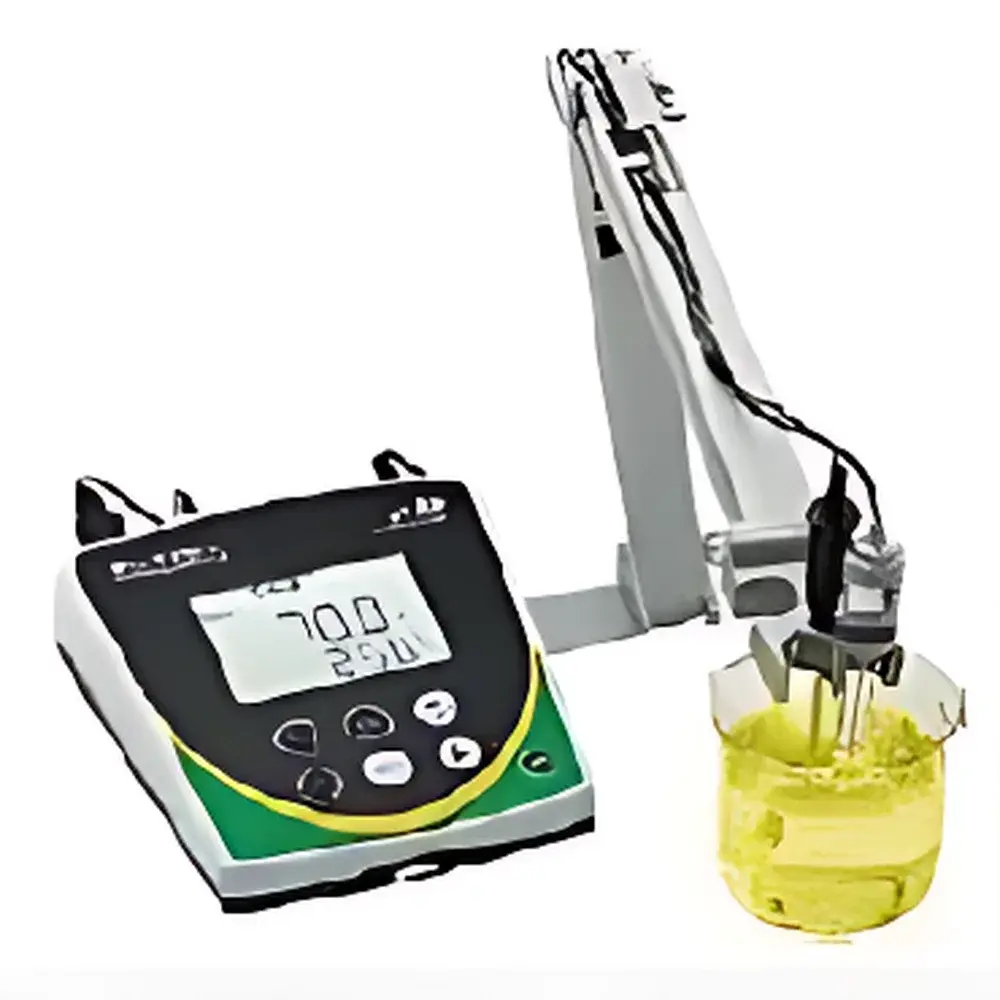
Thermo Fisher Scientific PH700 Benchtop pH Meter
| Brand | Thermo Fisher Scientific |
|---|---|
| Model | PH700 |
| Origin | USA |
| Type | Benchtop Electrochemical pH Meter |
| pH Range | −2.00 to 16.00 |
| pH Resolution & Accuracy | 0.01, ±0.01 pH |
| mV Range | ±2000 mV |
| mV Resolution & Accuracy | 0.1 mV (±199.9 mV), 1 mV (±200 mV+) |
| Temperature Range | 0.0 to 100.0 °C |
| Temp Resolution & Accuracy | 0.1 °C, ±0.5 °C |
| Calibration Points | Up to 5-point |
| Buffer Standards | USA (pH 4.01, 7.00, 10.01) and NIST (pH 4.01, 6.86, 9.18) |
| Temperature Compensation | Automatic or Manual (0–100 °C) |
| Data Storage | 100 measurements |
| Output Interface | RS-232 or USB (with optional cable) |
| Power Supply | 9 V DC adapter |
Overview
The Thermo Fisher Scientific PH700 Benchtop pH Meter is a precision electrochemical instrument engineered for reliable, high-reproducibility pH and millivolt measurements in regulated laboratory environments. It operates on the fundamental principle of potentiometric measurement—detecting the potential difference between a glass pH electrode and a reference electrode immersed in an aqueous sample, converted via the Nernst equation into pH units. Designed for routine quality control, research validation, and educational applications, the PH700 delivers traceable accuracy across an extended pH range (−2.00 to 16.00), accommodating strongly acidic, neutral, and highly alkaline solutions encountered in pharmaceutical formulation, environmental water analysis, food processing, and chemical synthesis workflows. Its robust architecture supports GLP-compliant operation through audit-ready calibration logging, real-time stability monitoring, and full traceability of electrode performance metrics—including slope (%), offset (mV), and calibration history.
Key Features
- Precision measurement engine with 0.01 pH resolution and ±0.01 pH accuracy at 25 °C, validated per ASTM E70 and ISO 3696 Grade 2 water specifications
- Extended mV measurement capability (±2000 mV) with dual-range resolution: 0.1 mV (±199.9 mV) and 1 mV (beyond), enabling redox potential (Eh) and ion-selective electrode (ISE) compatibility when paired with appropriate sensors
- Intelligent auto-recognition of both USA and NIST pH buffer standards during calibration—eliminating manual buffer selection errors and supporting multi-point (up to 5-point) linear or non-linear calibration curves
- Real-time electrode diagnostics: continuous display of slope (%), asymmetry potential (offset), and response time; automatic alerting for degraded electrodes or out-of-spec calibration
- Stability-driven measurement protocol: “Ready” indicator activates only upon signal stabilization within user-defined tolerance (e.g., ΔpH ≤ 0.002 over 10 s), ensuring data integrity prior to recording
- Dual temperature compensation modes—automatic (via integrated Pt1000 probe or external sensor) and manual entry—enabling accurate correction across 0.0–100.0 °C with ±0.5 °C system-level uncertainty
Sample Compatibility & Compliance
The PH700 is optimized for aqueous and low-ionic-strength samples typical in QC laboratories, including buffer solutions, cell culture media, wastewater effluents, titration endpoints, and purified water systems (USP , EP 2.2.38). It complies with IEC 61010-1 safety requirements for electrical laboratory equipment and meets electromagnetic compatibility (EMC) standards per EN 61326-1. While not intrinsically safe, its design conforms to general Good Laboratory Practice (GLP) documentation requirements, including timestamped calibration records, operator ID fields (via optional software), and non-volatile storage of up to 100 measurement sets with pH, mV, temperature, date/time, and electrode ID metadata. The instrument supports 21 CFR Part 11 readiness when used with Thermo Fisher’s optional LabTrack™ software suite for electronic signature, audit trail, and role-based access control.
Software & Data Management
Data export is supported via RS-232 or USB interface using Thermo Fisher’s free PH Manager PC software (Windows-compatible), enabling direct transfer of stored measurements, calibration reports, and electrode diagnostics into CSV or Excel formats. Each record includes embedded metadata: measurement mode (pH/mV), temperature, calibration status, slope/offset values, and timestamp. The software permits trend analysis, statistical summary (mean, SD, RSD), and generation of PDF-formatted compliance reports aligned with ISO/IEC 17025 documentation frameworks. No cloud dependency or subscription model is required—local data sovereignty is maintained by default.
Applications
- Pharmaceutical manufacturing: pH verification of injectables, excipients, and cleaning validation rinse waters per USP and EU GMP Annex 8
- Environmental testing labs: Routine monitoring of surface water, wastewater, and soil leachates per EPA Method 9040C and ISO 10523
- Food & beverage QA: Batch consistency checks for dairy products, soft drinks, and fermented foods where pH directly correlates with microbial stability and shelf life
- Academic teaching labs: Hands-on instruction in electrochemical fundamentals, calibration theory, and measurement uncertainty propagation
- Chemical R&D: Monitoring reaction progress in hydrolysis, neutralization, or catalyst activation studies requiring sub-0.01 pH resolution
FAQ
Does the PH700 support automatic temperature compensation with all electrode types?
Yes—when used with a built-in or external temperature probe (e.g., ATC cable or integrated Pt1000 sensor), the instrument applies real-time Nernstian correction. Manual temperature entry is also available for fixed-temperature applications.
Can calibration data be exported for internal audit review?
Yes—calibration logs (including date/time, buffers used, slope, offset, and pass/fail status) are stored onboard and fully exportable via PH Manager software in human-readable and machine-parsable formats.
Is the PH700 compliant with FDA 21 CFR Part 11 for electronic records?
The hardware supports Part 11 principles (audit trail, secure login, electronic signatures) when deployed with validated LabTrack™ software and documented SOPs; standalone meter operation does not constitute full Part 11 compliance without procedural controls.
What electrode connectors are supported?
The PH700 features a standard BNC input for pH electrodes and a separate mini-DIN port for temperature probes; it is compatible with Thermo Fisher Orion, Ross, and most industry-standard combination electrodes.
How often should the instrument be verified between calibrations?
Per ISO/IEC 17025:2017 Clause 7.7, daily verification using a check standard (e.g., pH 7.00 buffer) is recommended; deviation exceeding ±0.02 pH triggers recalibration and root-cause assessment.





