
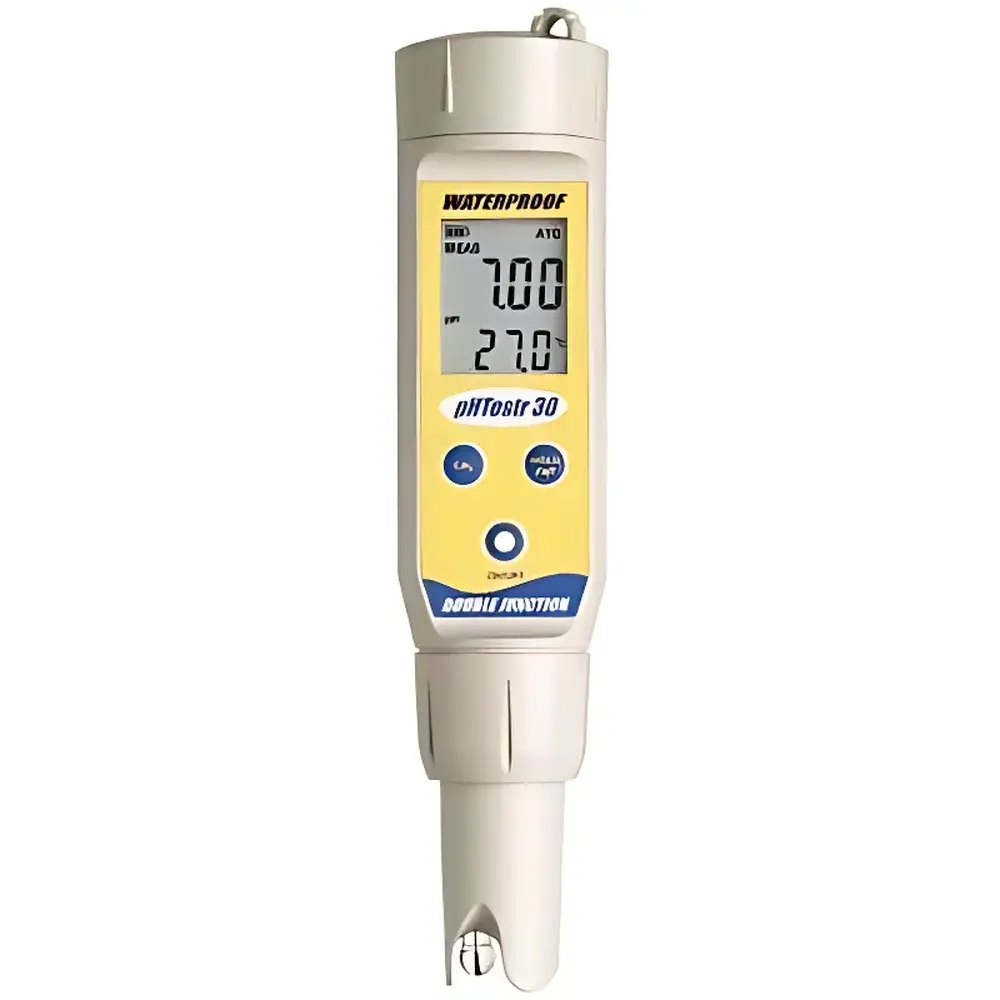
Thermo Fisher Scientific pHTestr30 Pen-Style pH Meter
| Brand | Thermo Fisher Scientific |
|---|---|
| Origin | Singapore |
| Manufacturer Type | Original Equipment Manufacturer (OEM) |
| Country of Origin | Imported |
| Model | pHTestr30 |
| Price | Upon Request |
| pH Range | –1.00 to 15.00 |
| Resolution | 0.01 pH |
| Accuracy | ±0.01 pH |
| Calibration | Up to 3-point, auto-buffer recognition (pH 4.01, 7.00, 10.01) |
| Temperature Range | 0.0 to 50.0 °C |
| Temp. Resolution | 0.1 °C |
| Temp. Accuracy | ±0.1 °C |
| ATC | Built-in automatic temperature compensation |
| Enclosure Rating | IP67 |
| Electrode Design | Dual-junction (double salt bridge), gel-filled KCl electrolyte with enhanced gel volume |
| Electrode Module | Replaceable sensor cartridge |
| Display | Dual-line LCD, configurable °C/°F output |
Overview
The Thermo Fisher Scientific pHTestr30 is a precision-engineered pen-style pH meter designed for rapid, reliable field and benchtop pH measurements in demanding chemical, environmental, educational, and quality control applications. Based on potentiometric measurement principles, the instrument determines hydrogen ion activity via a glass pH sensing electrode and a robust dual-junction reference system. Its architecture conforms to fundamental electrochemical measurement standards—specifically, Nernstian response behavior across wide pH ranges (–1.00 to 15.00)—and integrates built-in automatic temperature compensation (ATC) to correct for thermal effects on electrode potential, ensuring traceable accuracy per ISO 8655-4 and ASTM D1293 guidelines. Unlike conventional single-junction electrodes, the pHTestr30 employs a Kynar®-based porous double salt bridge that minimizes liquid junction potential drift and resists clogging from heavy metals, sulfides, proteins, or suspended solids—critical for wastewater, industrial effluent, and food processing matrices.
Key Features
- High-resolution measurement capability: 0.01 pH resolution with ±0.01 pH accuracy at 25 °C, verified against certified NIST-traceable buffer standards.
- Dual-junction reference design with extended-volume polymer gel electrolyte, significantly extending operational life versus conventional aqueous-fill electrodes.
- Modular electrode architecture: only the sensor cartridge requires replacement—housing, electronics, and display remain serviceable for multi-year deployment.
- IP67-rated housing constructed from chemically inert, impact-resistant polymer; fully submersible and buoyant—enabling direct immersion in tanks, streams, or open containers without risk of ingress.
- Intuitive dual-line LCD interface supporting simultaneous pH and temperature readout, user-selectable °C/°F units, and real-time calibration status indicators.
- Auto-buffer recognition for pH 4.01, 7.00, and 10.01 buffers; supports up to three-point calibration with slope and offset diagnostics logged internally.
- Non-volatile memory retains calibration data, date/time stamp, and last-measured values after power loss—compliant with basic GLP data integrity expectations.
Sample Compatibility & Compliance
The pHTestr30 is validated for use with aqueous solutions, buffer standards, process streams, drinking water, swimming pool water, hydroponic nutrient solutions, and mildly aggressive chemical media (e.g., dilute acids/bases up to pH 15.00). Its dual-junction construction meets functional requirements outlined in USP for pH measurement in pharmaceutical water systems and ASTM D1129 for standard terminology in water testing. While not inherently 21 CFR Part 11 compliant due to lack of electronic signature functionality, its audit-ready calibration logs and stable metrology support integration into GMP-aligned workflows when paired with documented SOPs and manual record-keeping. The device carries CE marking for EMC and RoHS compliance and adheres to IEC 61010-1 safety standards for portable electrical measurement equipment.
Software & Data Management
The pHTestr30 operates as a standalone instrument with no proprietary software dependency. All calibration, measurement, and configuration functions are executed via front-panel controls. Calibration coefficients and timestamps are stored in non-volatile memory with battery-backed retention (>10 years typical). Data export is manual: users record readings directly into lab notebooks or LIMS-compatible spreadsheets. For traceability, each unit ships with a factory calibration certificate referencing NIST-traceable buffers. Optional accessories—including rugged carrying cases, calibration kit bundles (buffers + storage solution), and USB-C charging docks—support routine maintenance and documentation consistency in regulated environments.
Applications
- Environmental monitoring: On-site pH verification in surface water, groundwater, and wastewater treatment lagoons.
- Food & beverage QA/QC: Spot-checking rinse water, brine solutions, dairy products, and fermentation broths.
- Educational laboratories: Teaching core concepts of acid-base chemistry, electrode kinetics, and calibration theory.
- Aquaculture & hydroponics: Daily monitoring of nutrient solution pH stability across growth cycles.
- Facility maintenance: Quick verification of boiler feedwater, cooling tower chemistry, and cleaning agent concentration.
- Pharmaceutical water systems: Complementary pH screening during purified water (PW) and water-for-injection (WFI) distribution loop checks.
FAQ
What is the recommended calibration frequency for routine use?
For daily operational use, calibration before first use and after every 10–15 measurements is advised; for regulatory applications, follow site-specific SOPs aligned with ISO/IEC 17025 or pharmacopeial requirements.
Can the pHTestr30 measure non-aqueous or high-ionic-strength samples?
It is optimized for aqueous solutions. Non-aqueous solvents (e.g., ethanol, acetone) or samples with >1 M ionic strength may cause reference junction instability and require specialized electrodes not supported by this platform.
Is the electrode module compatible with other Thermo Fisher pen meters?
No—the pHTestr30 uses a proprietary cartridge interface; modules are not interchangeable with pHTestr10 or pHTestr20 models.
Does the device support data logging or Bluetooth connectivity?
No—it lacks internal memory logging or wireless transmission capabilities; all data capture is manual.
How should the electrode be stored between uses?
Always store the sensor tip immersed in Thermo Fisher-recommended electrode storage solution (e.g., pH 4 buffer or 3 M KCl); never allow the junction to dry out.
Related Products





