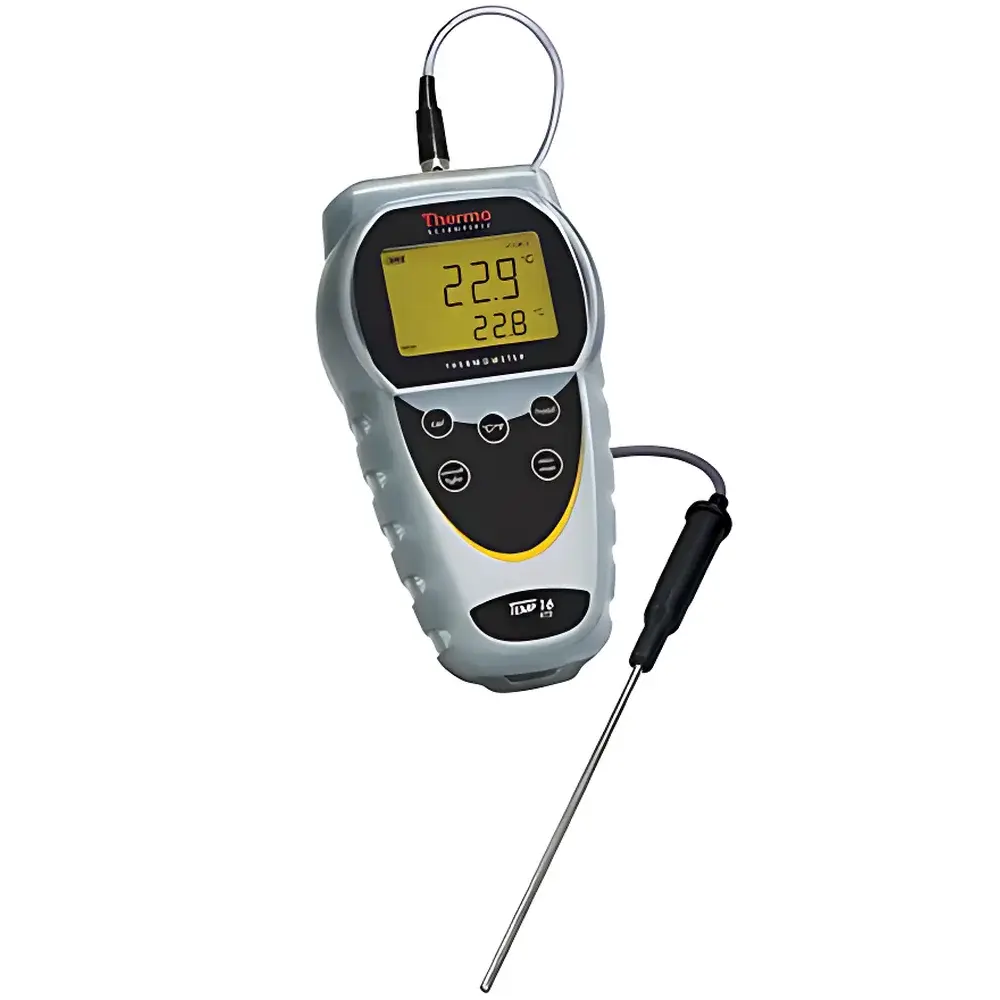
Thermo Fisher Temp 360-2 Precision RTD Temperature Meter
| Brand | Thermo Fisher |
|---|---|
| Origin | Singapore |
| Manufacturer Type | Original Equipment Manufacturer (OEM) |
| Origin Category | Imported Instrument |
| Model | Temp 360-2 |
| Pricing | Upon Request |
| Measurement Range | −201 °C to 1210 °C (−330 °F to 2210 °F) |
| Resolution | 0.1 °C/°F (−330 to −100), 0.01 °C/°F (−99.99 to 99.9), 0.1 °C/°F (100 to 999.9), 1 °C/°F (>1000) |
| Accuracy | ±0.1 °C/±0.2 °F (−330 to −100), ±0.03 °C/±0.06 °F (−99.99 to 99.9), ±0.1 °C/±0.2 °F (100 to 999.9), ±1 °C/±2 °F (>1000) |
| Display | 58 × 40 mm backlit LCD, dual-line |
| Data Storage | 2000 readings |
| Logging Interval | 1 s – 60 min (programmable) |
| Max/Min/Diff Functions | Yes |
| Auto-Power-Off | 17.5 min (configurable) |
| Data Hold & Stability Indicator | Yes |
| Input Interface | 3-pin DIN connector |
| Environmental Storage | −40 °C to 65 °C (−40 °F to 149 °F) |
| Power Supply | Three AA 1.5 V alkaline batteries (>750 h without backlight) |
| Dimensions (L×W×H) | 175 × 97 × 42 mm (instrument only) |
| Weight | 267 g (instrument only) |
| Enclosure Rating | IP54 (with probe connected) |
| Compliance | CE-marked per EN 61326-1/A1:1998 (EU EMC Directive) |
Overview
The Thermo Fisher Temp 360-2 Precision RTD Temperature Meter is a high-stability, laboratory- and field-grade resistance temperature detector (RTD) measurement system engineered for traceable, repeatable thermal characterization across extreme industrial and scientific environments. Utilizing platinum-based Class A or Class B RTD sensors (Pt100/Pt1000) connected via standardized 3-wire 3-pin DIN interfaces, the instrument applies precision four-terminal sensing principles to minimize lead-wire resistance errors and ensure metrological integrity. Its extended operating range—from cryogenic −201 °C to ultra-high-temperature 1210 °C—enables validation of thermal processes in furnace calibration, reactor monitoring, heat treatment verification, and cryogenic storage qualification. Designed for compliance-critical workflows, the Temp 360-2 delivers NIST-traceable accuracy with documented uncertainty budgets aligned with ISO/IEC 17025 requirements for accredited calibration laboratories.
Key Features
- Wide dynamic range: −201 °C to 1210 °C (−330 °F to 2210 °F) with auto-ranging resolution switching (0.01 °C down to −99.99 °C; 1 °C above 1000 °C)
- High-accuracy RTD measurement architecture with compensated cold-junction reference and linearization algorithms per IEC 60751
- 2000-point internal memory with programmable logging intervals from 1 second to 60 minutes—supports continuous trending or event-triggered capture
- Dual-line backlit LCD (58 × 40 mm) optimized for low-light and high-glare conditions; configurable contrast and brightness
- Three hands-free mounting options: magnetic base, strap suspension, and integrated fold-out stand for benchtop stability
- Ruggedized enclosure with IP54-rated dust- and splash-resistant keyboard and shock-absorbing rubber overmold housing
- USB 2.0 interface compliant with CDC ACM class for plug-and-play connectivity to Windows/macOS/Linux systems without proprietary drivers
- Configurable auto-power-off (17.5 min default), data hold, stability indicator, and real-time ΔT (differential temperature) calculation
Sample Compatibility & Compliance
The Temp 360-2 interfaces exclusively with standard 3-wire Pt100 or Pt1000 RTD probes conforming to DIN EN 60751:2022 (Class A/B). It does not support thermocouples, thermistors, or infrared sensors. Probe compatibility includes immersion, surface-mount, and air-gap configurations—provided the sensor’s physical construction and sheath material (e.g., stainless steel 316, Inconel 600) are rated for the target temperature and chemical environment. The instrument meets electromagnetic compatibility (EMC) requirements under EN 61326-1/A1:1998 and carries CE marking for use within the European Economic Area. While not inherently 21 CFR Part 11-compliant out-of-the-box, its audit-ready data export (CSV/TXT) and timestamped logging support integration into validated GxP systems when paired with controlled software protocols and procedural SOPs.
Software & Data Management
Data retrieval occurs via native USB virtual COM port communication, enabling direct import into spreadsheet applications or custom Python/MATLAB scripts using standard serial libraries (e.g., PySerial). Exported files include full metadata: timestamp (YYYY-MM-DD HH:MM:SS), measured value, unit, probe ID (if encoded), and status flags (e.g., “stable”, “out-of-range”). No proprietary software installation is required. For regulated environments, users may implement external validation packages that enforce electronic signature, change control, and audit trail generation—consistent with GLP and GMP documentation standards. Firmware updates are delivered as signed binary files through Thermo Fisher’s authorized service channels.
Applications
- Industrial process validation: oven, autoclave, and furnace temperature uniformity mapping (per ASTM E220, IEC 60584)
- Quality control in food & beverage production: retort sterilization cycle verification, cold chain monitoring, and HACCP critical limit logging
- Automotive component testing: exhaust gas temperature profiling, battery thermal management system (BTMS) validation, and brake disc thermal cycling
- Chemical manufacturing: reaction calorimetry support, distillation column tray temperature verification, and catalyst bed monitoring
- Research & development labs: cryostat temperature stabilization, high-temperature material sintering studies, and thermal aging experiments
- Metrology labs: secondary standard transfer calibration against reference PRTs in fixed-point cells (e.g., ITS-90 zinc point at 419.527 °C)
FAQ
What RTD probe types are supported?
The Temp 360-2 accepts only 3-wire Pt100 or Pt1000 RTDs with standard 3-pin DIN connectors (DIN 43760). Thermocouples, thermistors, and 2-wire RTDs are incompatible.
Is calibration certificate included with purchase?
A factory calibration report (traceable to NIST or equivalent national metrology institute) is supplied with each unit. Full ISO/IEC 17025-accredited calibration certificates require separate ordering through Thermo Fisher’s certified calibration services.
Can the logging interval be triggered by temperature thresholds?
No—the Temp 360-2 supports only time-based logging. Event-driven or alarm-triggered logging requires external programmable logic controllers (PLCs) or SCADA integration via analog output modules (not built-in).
Does the instrument support multi-point calibration?
Yes—users may perform single-point (offset) or two-point (span + offset) calibration using certified reference sources. Calibration coefficients are stored non-volatilely and persist across battery changes.
What is the typical battery life during continuous logging?
With backlight disabled and logging every 10 seconds, average battery life exceeds 500 hours. Frequent backlight use or sub-zero ambient operation reduces longevity proportionally.